by – L. Richardson
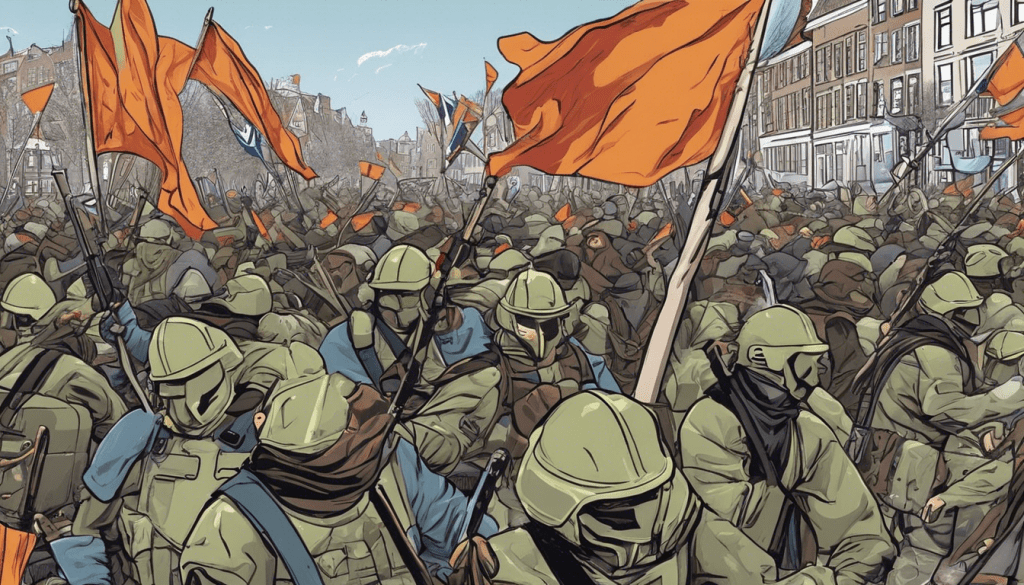
The once-celebrated Dutch tolerance towards immigrants is rapidly eroding as mass immigration 1 2 and unchecked migrant violence 3 4 fuel a conservative backlash defending national sovereignty. Dutch patriot Raisa Blommestijn has emerged as a defiant voice against Amsterdam’s migrant crisis 3 4, facing legal persecution for exercising her free speech rights 1. Her stand epitomizes Europe’s clash over national identity amidst the cultural impact of liberal migration policies and rising crime rates 1 2 3 4.
This polarizing issue has propelled Dutch conservatives 1 3 4 like Blommestijn into confronting the alleged silencing of political dissidents 1 2 3 4. As they decry the dilution of Dutch values through unchecked Immigration 1 2 3 4, a fierce debate rages over striking a balance between patriotic cultural preservation and xenophobic rhetoric.
Details of the Case
Origins of the Conflict
Several incidents fueled fears among segments of the Dutch population concerning Immigration, including the post-9/11 fallout and events like the 2002 assassination of anti-immigration politician Pim Fortuyn and the 2004 murder of filmmaker Theo van Gogh by a Dutch-born Muslim of Moroccan origin. 1 Across Europe, irregular migrants faced considerable difficulty accessing justice, protection, and services, limiting their ability to exercise fundamental rights like safely reporting crimes to the police. 2 This structural exclusion made irregular migrants more vulnerable to exploitation by perpetrators aware of their reluctance to report crimes. 2
Legal Assault on Freedom
While the EU Victims’ Directive aimed to include irregular migrants under victims’ rights protections, significant barriers remained in effectively realizing access to justice and rights for irregular migrant victims within Europe. 2 Human rights observers noted irregular migrants’ hesitance to interact with law enforcement out of fear of arrest or deportation. 2 Amnesty International raised concerns that the draft Dutch law on intelligence services could legitimize sweeping surveillance powers, making nationals and non-nationals vulnerable to violations of privacy, freedom of expression, and non-discrimination rights. 3
Presented Evidence and Counterarguments
The provided excerpts do not present specific evidence or counterarguments related to the case details. The information focuses on providing an overview of the legal and policy landscape surrounding safe reporting practices for irregular migrants in the Netherlands. 2
Free Speech Implications
Threat to Democratic Foundations
The rise of far-right populist figures like Geert Wilders and their anti-immigrant rhetoric poses a significant threat to the democratic foundations of the Netherlands. 11 While their parties have not yet been able to join governing coalitions, their inflammatory language and exploitation of public anxieties surrounding migration have the potential to erode the country’s long-standing values of tolerance and inclusivity. 11 By preying on fears and promoting discrimination against migrants, these populists undermine the principles of free Speech and open discourse that are essential to a healthy democracy [27]. 12
Public Backlash and Solidarity Movements
As tensions surrounding Immigration take on racist, discriminatory, or xenophobic dimensions, the risk of violence against migrants increases. 12 This not only violates the fundamental human rights of migrant communities but also breeds an atmosphere of fear and intolerance that can further polarize public opinion. In response, solidarity movements and human rights advocates have emerged to defend the rights of migrants and counter the narratives of hate and exclusion propagated by far-right groups. 12
Risks to Political Discourse
The inflammatory rhetoric employed by populist leaders can have a corrosive effect on the quality of political discourse, diverting attention from substantive policy debates and governance issues. 12 By scapegoating migrants and fanning tensions, these leaders may seek to deflect criticism from their own failures and consolidate support through divisive tactics. 12 This not only undermines the principles of free Speech and open debate but also poses risks to the integrity of the democratic process itself, as reasoned deliberation gives way to fear-mongering and demagoguery. 11 12
While the actual policy impact of these debates remains uncertain, the vocal role of figures like Wilders in shaping the Dutch and European political discourse around migration must be addressed. 15 Their influence has the potential to normalize intolerance, erode democratic norms, and create an environment hostile to the free exchange of ideas – a cornerstone of any healthy democracy. 11 12
Political Context
Stance of Dutch Conservatives
Far-right populists in the Netherlands, like Geert Wilders and Thierry Baudet, have preyed on and promoted public anxieties surrounding Immigration. However, they have gained less power than perceived from outside the country. 19 Wilders, leader of the far-right Freedom Party (PVV) that secured the second-largest seats in the 2017 elections, is a vocal opponent of Immigration, Islam, and any form of immigrant integration that alters his “pure” vision of Dutch culture. 19 20
Baudet, a newer alt-right figure, has railed against Dutch academia, media, and experts, accusing them of undermining “Boreal” (Aryan) Europe. 19 However, the Netherlands’ multiparty system means gaining 14% of the vote, as Baudet’s party did, and it is unlikely to attract enough mainstream support to join or lead a governing coalition. 19
Critical View on Immigration Policies
After the 9/11 attacks, a new xenophobic political climate emerged in the Netherlands. 20 Pim Fortuyn, a right-wing politician, agitated against immigrants and called for closing borders until full integration, striking a chord by boldly expressing views the establishment avoided. 20 His party’s success was short-lived, but the fierce anti-immigrant discourse persisted, with new integration minister Rita Verdonk proposing restrictive measures. 20
Theo van Gogh’s 2004 murder by a Dutch-Moroccan further fueled public fears about Muslim immigrants not integrating. 20 Geert Wilders then warned of a “tsunami of Islamization” and suggested banning the Quran, capitalizing on rising anti-Islamic sentiment to secure parliamentary seats for his Freedom Party in 2007. 20
Role of Social Media as a Battleground
Social media has become a key battleground in the immigration debate, with online conversations providing insights into public opinion formation. 22 Symbolic and realistic threats manifest on social media, influencing attitudes toward immigrants. 22 Unmoderated platforms allow racist stereotypes and hate speech to proliferate, increasing polarization and negatively affecting perceived social cohesion. 22
Moreover, hate Speech on social media can be transmitted nationwide, exacerbating societal divisions over immigration policies. 22 As the discourse rages online, anti-immigrant voices leverage social media’s reach to spread their narratives and shape the broader political conversation around this contentious issue. 22
Conclusion
In the Dutch battle against mass immigration and migrant violence, the threat to free Speech and national identity cannot be overstated. As patriotic voices like Raisa Blommestijn bravely confront the silencing of dissent, the erosion of Dutch values, and the surge in immigrant-related crime, it is imperative that we rally behind their cause. The very foundations of our democracy are at stake, and we must defend our right to openly discuss and address these pressing issues without fear of persecution or censorship.
The Dutch conservative movement stands as a bulwark against the onslaught of unchecked immigration policies and the dilution of our national identity. In the spirit of free speech champions like Alex Jones, we must raise our voices and refuse to be silenced by those who seek to undermine our cultural heritage and public safety. The time has come to take a firm stand against mass immigration, migrant gangs, and the defenseless Dutch citizens who fall victim to their violence. Only through unwavering resolve and open discourse can we preserve the essence of our nation and protect the freedoms that define our way of life.
FAQs
What was the Patriot Movement in the Netherlands?
The Patriot Movement, also known as the “Time of the Patriots,” occurred during political unrest in the Dutch Republic from around 1780 to 1787. This era is characterized by the rise of the Patriots, a group that challenged the authority of the stadtholder William V, Prince of Orange, and his Orangist supporters.
How did the Dutch contribute to the American Revolution?
The Netherlands did not officially take sides during the American Revolution. However, Dutch merchants played a significant role by continuing to trade war materials with the American Revolutionaries and the French in the 1770s. This heightened tensions with Britain, which increased its efforts to intercept and seize Dutch ships and cargo.
What was the significance of the Dutch Crisis of 1787?
The Dutch Crisis of 1787 was a pivotal moment that influenced the American debate on the ratification of the Constitution. The crisis underscored the potential threat of European conflict, prompting Americans to contemplate how the United States should respond as a neutral entity.
Did the Dutch participate in the American Revolutionary War?
While the Dutch Republic was not initially a direct combatant in the American Revolutionary War, it played a vital role by supplying essential goods to the American colonies. The Dutch involvement became more pronounced in the later stages of the war.
References
[2] – https://www.emnnetherlands.nl/sites/default/files/2020-07/EMN_jaaroverzicht2019_ENG.pdf
[3] – https://www.bpb.de/system/files/pdf/VIMF6T.pdf
[5] – https://www.amrevmuseum.org/the-netherlands-and-the-american-revolution
[6] – https://en.wikipedia.org/wiki/Patriottentijd
[8] – https://www.amnesty.nl/content/uploads/2017/05/EUR3554622016ENGLISH.pdf?x54649
[9] – https://www.jstor.org/stable/10.1086/650189
[10] – https://www.compas.ox.ac.uk/wp-content/uploads/SR19-Netherlands-country-report.pdf
[14] – https://www.degruyter.com/document/doi/10.3138/9781487530655-008/pdf?licenseType=restricted
[16] – https://apnews.com/article/netherlands-election-migration-asylum-e3d33eab084ffdbc87b7501f11076ec8
[17] – https://www.vox.com/world-politics/2023/7/8/23788036/dutch-parliament-migration-european-far-right
[20] – https://www.bpb.de/system/files/pdf/VIMF6T.pdf
[21] – https://pure.uva.nl/ws/files/41994125/1465116519841706.pdf
[22] – https://www.ncbi.nlm.nih.gov/pmc/articles/PMC10967952/
[24] – https://www.journals.uchicago.edu/doi/10.1086/650189
[25] – https://apnews.com/article/netherlands-election-migration-asylum-e3d33eab084ffdbc87b7501f11076ec8
[26] – http://ruppersberger.house.gov/issues/immigration
[27] – 3 journalists attacked in Machakos while covering crackdown on illegal brew: K24 TV. https://www.k24tv.co.ke/news/journalists-attacked-in-machakos-115868/
[30] – https://x.com/rblommestijn/status/1792908863802421657
 Critical Thinking Dispatch
Leave a comment