by – L. Richardson
We’ve just witnessed what might be the fastest trade war surrender in history, folks! In a stunning turn of events, less than 10 hours after President Trump announced crushing sanctions on Colombia, including a 25% emergency tariff on all Colombian imports, the South American nation completely folded to America’s demands. This unprecedented show of economic force, which included an immediate travel ban and visa revocations for Colombian government officials, left no room for doubt about the overwhelming power of Trump’s strategy. As a result, Colombia’s President Gustavo Petro quickly agreed to accept all illegal aliens returned from the United States, even offering their presidential aircraft for deportation flights.
The impact of Trump’s decisive action sent immediate shockwaves through Colombia’s economy, with the peso weakening against the dollar and assets heading for a significant downturn. This lightning-fast capitulation proves what we’ve known all along. Other nations fall in line when America flexes its economic muscle under strong leadership. Indeed, this demonstration of raw economic power sends a clear message to any country thinking about challenging American policies: we mean business and have the strength to back it up.
The Spark of Conflict
The diplomatic crisis unfolded on January 26, 2025, when Colombian President Gustavo Petro made a bold decision to bar U.S. military aircraft carrying deported Colombian nationals from entering his country’s airspace13. Petro took to social media platform X to explain his stance, stating that the United States “cannot treat Colombian migrants as criminals “14 [37]. His primary objection centered around the treatment of deportees, specifically referencing footage showing migrants in Brazil being transported with their hands and feet restrained15.
Subsequently, Petro demanded that Colombian nationals’ return be conducted with “dignity and respect” for both the individuals and his country14. He emphasized this point by offering Colombia’s presidential aircraft as an alternative means of transportation for the deportees15. This move marked a significant departure from the longstanding cooperation between the two nations in managing migration flows.
The implications for U.S. national security emerged as a central concern in this diplomatic standoff. President Trump, through his Truth Social platform, declared that Colombia’s refusal to accept these deportation flights posed a direct threat to American public safety13. This assessment aligned with his broader immigration policy, which declared illegal immigration a national emergency16.
The situation particularly alarmed U.S. security officials due to the potential disruption of established deportation protocols. Under Trump’s administration, immigration enforcement had intensified, with nearly 1,000 arrests conducted on that Sunday alone17. Moreover, this diplomatic tension threatened to undermine decades of bilateral cooperation, particularly in areas of mutual concern such as drug trafficking, where the United States had invested billions in Colombia’s security infrastructure15.
Colombia’s former President, Ivan Duque, characterized Petro’s actions as “tremendous irresponsibility,” highlighting the potential risks to bilateral relations14. The standoff particularly threatened to disrupt the established protocols for managing undocumented migrants, affecting a significant portion of the estimated 11-14 million undocumented individuals currently in the United States14.
Trump’s Retaliatory Measures
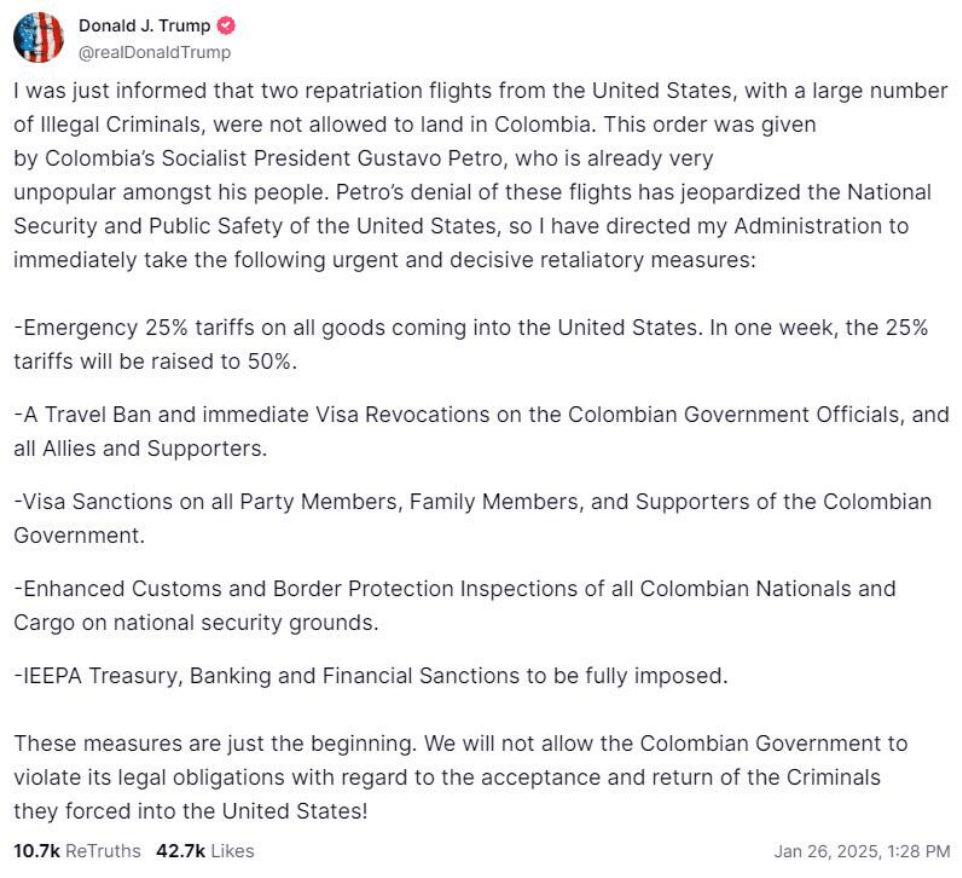
“Trump’s decisive action: Announcing sanctions against Colombia via Truth Social.”
President Trump unleashed a series of punitive measures against Colombia through a decisive post on Truth Social. The cornerstone of these sanctions was an immediate 25% emergency tariff on all Colombian exports to the United States, warning that this rate would double to 50% within one week if demands weren’t met16.
The financial implications of these tariffs were particularly significant for Colombia’s key exports. The United States imports approximately 27% of its coffee from Colombia, valued at nearly $2 billion18. Initially, these measures would have affected various sectors, including oil and gas, gold, coffee, and flowers, potentially resulting in thousands of job losses19.
Beyond the tariffs, Trump implemented a comprehensive set of restrictions. The State Department suspended visa issuance at the U.S. Embassy in Bogota’s consular section. Additionally, U.S. Customs and Border Protection began implementing enhanced inspections on Colombian cargo and nationals20. The administration also imposed travel bans on Colombian government officials and diplomats holding A and G visas20.
The economic warfare strategy extended into the financial sector. These measures threatened to trigger a devaluation of the Colombian peso and increase inflationary pressures through rising costs of imported goods and raw materials19. Meanwhile, U.S. officials maintained that these actions served as “a clear message” about nations’ obligations to accept repatriation flights20.
Key Colombian exports facing immediate impact:
- Coffee ($2 billion annual trade)
- Crude oil
- Bananas
- Avocados
- Fresh-cut flowers18
“These measures are just the beginning,” Trump declared on Truth Social20. Nevertheless, the White House later indicated that the tariffs would be suspended. However, visa restrictions and enhanced customs inspections would remain in effect until Colombia accepted the first planeload of deportees21.
The broader economic implications extended beyond immediate trade concerns. Economic experts predicted substantial social impacts. Victor Munoz from the European Council on Foreign Relations noted that such actions could create “significant political and economic implications” 19. Furthermore, these sanctions were a test case, potentially setting a precedent for future actions against other nations that might resist U.S. demands18.
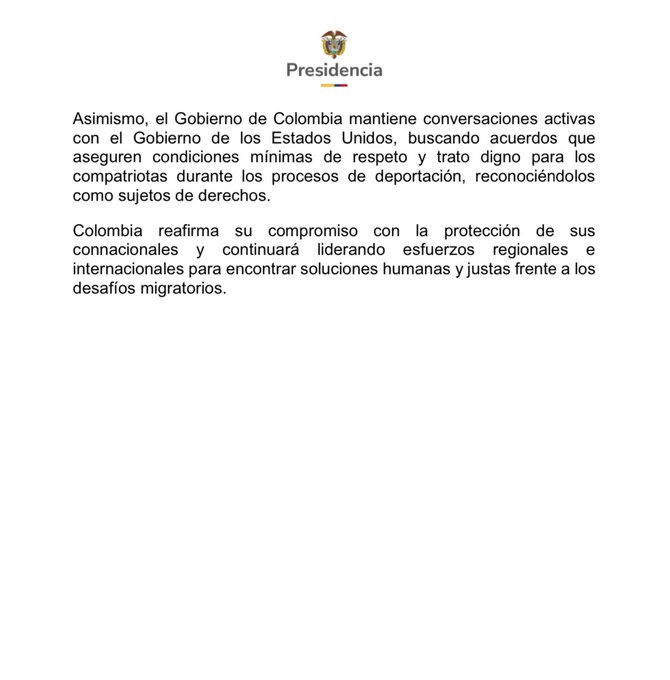
“Colombia’s diplomatic response: Maintaining a dialogue with the U.S. for humane deportation practices amidst economic pressure.”
The Colombian Capitulation
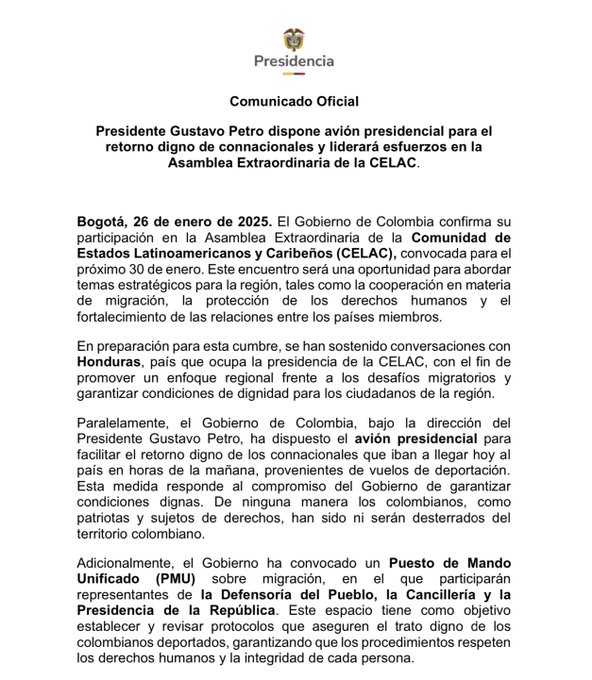
“Despite his public defiance, the Colombian government’s official response includes using the presidential plane for deportations.”
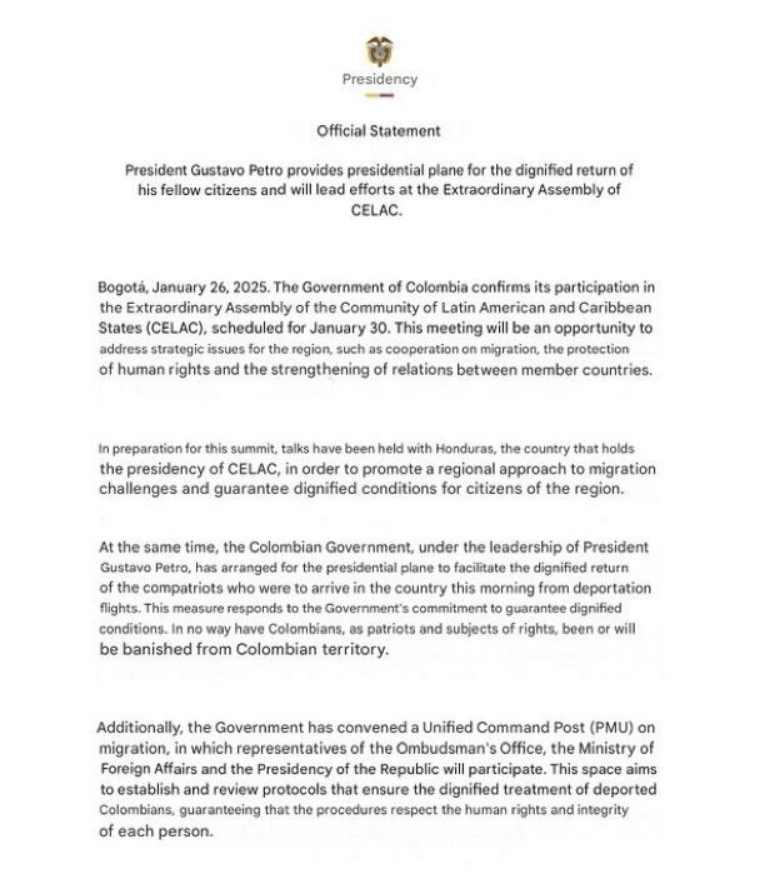
“Official announcement: Colombia’s response to U.S. sanctions includes presidential plane for dignified returns.”
Following intense economic pressure, Foreign Minister Luis Gilberto Murillo announced in a late-night news conference that Colombia and the United States had “overcome the impasse” regarding deportation flights15. Notably, Colombia offered its presidential aircraft to transport deportees back home, marking a significant shift in their stance15.
Despite this apparent concession, President Petro maintained a defiant tone on social media platform X, declaring that American blockades would not intimidate him15. Nonetheless, his government’s actions told a different story, primarily evidenced by their swift reversal of the deportation policy16. The Colombian leader attempted to frame this retreat as a humanitarian gesture, stating they would welcome deported migrants on civilian planes while offering the presidential aircraft for their “dignified return “16.
The historical context underscores the gravity of this capitulation. Colombia, traditionally one of America’s strongest allies in South America, has maintained deep military and security ties with the United States22. Hence, this diplomatic standoff threatened decades of cooperation, ultimately forcing Colombia’s hand in the confrontation.
Colombia’s weakness became increasingly apparent as economic pressures mounted. Already strained by internal challenges, its security infrastructure could ill afford a prolonged conflict with its primary international partner23. The country’s chronic issues, including widespread lawlessness in rural areas and the ongoing struggle against organized crime, made its position particularly vulnerable24.
Ultimately, while visa restrictions on Colombian government officials remained in place pending the first successful deportation flight15, the rapid capitulation demonstrated the effectiveness of America’s economic leverage. This retreat highlighted Colombia’s dependence on U.S. cooperation, especially considering their substantial investments in military and police forces23.
Economic Warfare and Its Consequences
First, the trade confrontation between the U.S. and Colombia exposed their deep economic interdependence. Bilateral trade reached USD 33.80 billion in 2023, with the U.S. maintaining a USD 1.60 billion trade surplus25. In light of this relationship, Colombia’s exports to the U.S. constituted 29% of their total exports in the first 11 months of 2024.
The business community’s reaction underscored the gravity of the situation. Bruce Mac Master, President of the business association ANDI, emphasized that Trump’s proposed measures would have had an “immense impact” on the Colombian economy25. Coupled with this concern, Colombia’s already weak currency showed immediate signs of strain in early trading25.
Key economic sectors facing immediate impact included:
- Coffee exports valued at USD 2.00 billion annually
- Petroleum products worth USD 2.50 billion
- Chemical exports totaling USD 1.00 billion
- Corn exports reaching USD 1.20 billion26
It is essential to realize that the cocaine market experienced significant disruption during this period. The UNODC reported that potential cocaine production in Colombia increased from 1,120 tons in 2018 to 1,738 tons in 2022. This surge represented a USD 1.20 billion increase in source prices in Colombia and at least USD 20.00 billion in international wholesale markets27.
The price disparities in the global cocaine market remained stark, with a kilogram selling for USD 2,000 in Colombia, USD 25,000 in the United States, USD 35,000 in Europe, and reaching up to USD 100,000 in Australia27. The Petro administration reported seizing 697 tons of cocaine in 2023, marking a 13% increase from the previous year27.
The economic warfare’s broader implications extended beyond traditional trade. According to drug expert Sergio Uribe, who previously worked with the U.S. Embassy in Bogota, stockpiles of cocaine in the supply chain could maintain shelf life for up to five years if vacuum-packed27. This situation created a complex economic dynamic where traditional trade sanctions intersected with illicit market forces.
The Nationalist Agenda
President Trump’s decisive action against Colombia exemplifies his broader America First trade policy, prioritizing American workers, manufacturers, and national security interests28. The White House established this robust trade policy through a comprehensive memorandum directing multiple federal agencies to report by April 1, 2025, on measures designed to enhance national industrial advantages29.
The policy framework primarily focuses on three critical areas: protecting American sovereignty through stringent trade measures, maintaining technological superiority by reviewing export control systems and addressing national security concerns through strategic trade actions28. In contrast to previous administrations, Trump’s approach treats trade policy as a fundamental component of national security28.
The administration’s strategic priorities include:
- Reviewing existing trade agreements for reciprocal advantages
- Identifying potential bilateral trade partners
- Conducting economic and security reviews of the industrial base
- Strengthening export control mechanisms28
Given these points, Colombia strengthens America’s global position through multiple channels. The State Department and Commerce Department have been directed to assess and enhance the nation’s technological edge28. Analogous to this approach, Trump’s administration supports increased application of anti-dumping measures, focusing on countries where unfair trade practices threaten American industries30.
The broader implications extend beyond immediate trade concerns. Trump’s campaign promises include raising tariffs by 10-20% on all imports30, with specific threats of up to 100% tariffs on countries abandoning the U.S. dollar as their reserve currency30. Consequently, this stance positions America as dominant in global trade negotiations.
The scheduled 2026 review of the USMCA serves as another strategic focal point30. Key administration figures, including Marco Rubio, advocate utilizing bilateral free trade agreements to advance U.S. national security objectives30. This approach aligns with Trump’s vision of reshaping international trade dynamics to prioritize American interests.
The White House statement declaring “America is respected again “31 underscores the administration’s success in asserting U.S. dominance. By demonstrating a willingness to impose severe economic consequences on even close allies, Trump’s administration has established a precedent reinforcing America’s position as a global economic powerhouse31.
The Global Warming
Beyond Colombia’s swift capitulation, Trump’s trade strategy has rippling effects across global markets. His administration simultaneously targets multiple nations, with proposed 10% tariffs on Chinese imports and potential duties against Canada and Mexico by February 1, 2025.
The White House’s comprehensive approach primarily focuses on three major trading blocs. First, the European Union faces imminent tariffs, with Trump declaring them “very, very bad to us “32. Second, Canada and Mexico confront potential 25% tariffs linked to concerns over illegal migrants and drug trafficking32. Third, China faces renewed pressure over fentanyl distribution through neighboring countries32.
These actions fundamentally reshape international trade dynamics. The administration’s strategy includes:
- Immediate 10% punitive duties on Chinese goods
- Enhanced inspections of imports from targeted nations
- Treasury, banking, and financial sanctions against non-compliant countries
- Travel restrictions and visa revocations for government officials33
Looking ahead, the White House maintains these drafted sanctions “in reserve “33, signaling potential deployment against other nations. Peter Navarro, White House trade adviser, underscores this approach, linking trade measures to broader security concerns, including the tragic toll of “300 Americans dying daily from fentanyl overdoses “32.
The international business community expresses growing concern over these developments. Trade-dependent states face particular pressure, as evidenced by Mexico’s conciliatory response to Trump’s February deadline32. Similarly, European nations grapple with the prospect of retaliatory measures, recognizing the precedent set by Colombia’s experience34.
Regarding broader implications, countries contemplating resistance to U.S. policies now face stark choices. The administration’s use of the International Emergency Economic Powers Act for tariff implementation33 establishes a powerful precedent for future trade disputes. Though unprecedented in trade policy, this legal framework provides extensive authority to address perceived threats to national security33.
The global warning resonates most strongly with China, which is currently engaged in complex trade negotiations. Trump’s threat of immediate 10% tariffs32 reminds us of America’s willingness to employ economic measures to achieve policy objectives. This approach significantly shifts from traditional diplomatic channels, emphasizing economic leverage over conventional negotiation.
For NAFTA members, the stakes appear equally high. Mexican President Claudia Sheinbaum’s measured response, emphasizing sovereignty while acknowledging trade agreement constraints until 202632, illustrates the delicate balance nations must strike. Already anxious about potential disruptions with Mexico, their primary export market32, U.S. corn farmers represent just one sector bracing for possible economic turbulence.
Media Spin vs. The Truth
Mainstream media outlets paint a complex picture of the Colombia crisis, fundamentally differing from the White House’s straightforward victory narrative. Press Secretary Karoline Leavitt’s statement declared, “America is respected again “15, highlighting the administration’s view of this diplomatic confrontation as a clear demonstration of American power.
The White House, primarily focusing on national security concerns, emphasized how Petro’s initial refusal of deportation flights “jeopardized” U.S. safety35. This stance aligns with Trump’s broader immigration strategy, which declared illegal immigration a national emergency16.
Key media narratives versus official positions:
- White House: Emphasizes national security and sovereignty
- Liberal Media: Focuses on humanitarian concerns
- Conservative outlets: Support strong border measures
- International press: Questions diplomatic implications
Evidently, the administration’s perspective centers on protecting American interests. The White House press secretary’s statement underscored that Trump “expects all other nations of the world to fully co-operate in accepting deportation of their citizens illegally present in the United States “15.
The truth behind this diplomatic standoff reveals more profound implications for national sovereignty. UnHerd’s analysis states, “America belongs to Americans, not the world. American taxpayer dollars should be spent on American wants and needs, not every human being “36. This perspective reinforces the administration’s stance that national interests precede international considerations.
While mainstream media might focus on humanitarian aspects, the core issue remains clear: Trump’s administration views this as a fundamental question of American sovereignty. The President’s actions demonstrate that “You can’t come here from any place we can’t send you back to “36, establishing a clear principle for immigration enforcement.
The economic implications support this sovereignty-first approach. The U.S. maintains significant leverage in such confrontations with bilateral trade worth USD 53.50 billion annually. This economic reality underscores why Colombia ultimately accepted U.S. demands, offering their presidential aircraft for deportation flights15.
Conclusion:
America’s Unyielding Stance
Trump’s lightning-fast victory over Colombia proves America’s unmatched economic might. This 10-hour trade war demonstrated how swift, decisive action achieves results that months of traditional diplomacy cannot match. Undoubtedly, Colombia’s rapid surrender after facing 25% tariffs sends a clear message to other nations considering defiance of U.S. immigration policies.
Above all, this victory establishes a powerful precedent for future trade negotiations. China, Mexico, and European trading partners must recalculate their positions, knowing America is ready to deploy similar economic weapons. The results speak volumes – when faced with American economic pressure, even strong allies like Colombia quickly fall in line.
These developments signal a fundamental shift in global trade dynamics. Trump’s willingness to use tariffs, visa restrictions, and financial sanctions as national policy tools has reshaped international relations. Consequently, countries worldwide must adapt to this new reality where America’s economic muscle backs up its diplomatic demands.
The mainstream media might spin this as heavy-handed diplomacy. Still, we see the truth – America has rediscovered its strength under bold leadership. This victory protects our borders, ensures national security, and, most importantly, restores respect for American power on the world stage. The Colombia episode serves as a warning to any nation thinking about challenging U.S. interests: America means business, and we have the economic firepower to prove it.
Legal Disclaimer and Warnings
First and foremost, information bias poses significant risks in today’s rapidly evolving media landscape. Research indicates that 57% of consumers anticipate news on social media to be largely inaccurate. In addition, the proliferation of social media platforms has made accessing vast amounts of information more effortless than ever, fundamentally increasing the risk of information bias1 [39].
This article is opinion-based, not financial or legal advice.
Readers must understand that information bias can significantly affect investment decisions, leading to potentially dangerous financial choices. The spread of misinformation through social media platforms often attracts more attention than factual information3 [38]. Research shows that investors who focus on relevant information and avoid information bias make better investment decisions1.
Using this information for making investment or travel decisions without further research
Making investment or travel decisions based solely on news articles carries substantial risks. Information bias occurs when data is measured or recorded incorrectly, no longer reflecting underlying truths1. To mitigate these risks, consider these verification steps:
- Diversify information sources beyond social media
- Base decisions on objective financial analysis
- Consult professional advisors for guidance
- Verify claims through multiple reliable sources
The risks of misinformation in international relations and the importance of verifying facts
The spread of misinformation represents a critical threat to modern economies. In Colombia’s case, disinformation has been weaponized for political gain, with both sides using data analytics to target distinct groups4. WhatsApp’s encrypted nature makes it particularly challenging for fact-checkers to correct false information, with an estimated 87% of Colombians with internet access using the platform.
The European Union recognizes fact-checking as a crucial pillar in combating disinformation2. The EDMO network provides comprehensive geographic coverage and monitors disinformation trends2. Research demonstrates that fact-checking can effectively reduce belief in misinformation, with effects often lasting more than two weeks8.
Critical verification strategies include:
- Obtaining news from diverse sources
- Setting specific times for checking news
- Focusing on underlying financial health rather than short-term fluctuations
- Avoiding emotional decision-making driven by fear or greed1
The Japanese government emphasizes voluntary private-sector fact-checking efforts and recognizes the importance of international collaboration9. This becomes particularly relevant as disinformation threatens elections, state-sanctioned violence, and health outcomes globally8.
Call for Patriotism and Vigilance
The United States must prioritize diplomatic relations and economic engagement in the Western Hemisphere as foundational elements of Its grand strategy. Whatever threatens Latin America and the Caribbean directly impacts American national security, making regional stability a paramount concern5.
Stay informed and engaged in nationalistic causes.
The pursuit of regional stability, primarily enshrined in the Monroe Doctrine, remains vital for policymakers today5. Strategic priorities for maintaining American dominance include:
- Reviewing existing trade agreements for reciprocal advantages
- Identifying potential bilateral trade partners
- Conducting economic and security reviews
- Strengthening export control mechanisms10
Markedly, Washington’s inattention to its neighborhood proves self-defeating amid struggles to prevent China and its despotic partners from upending the American-led global order5. Thereupon, the United States must exercise common strategic sense and reorient hemispheric relations to maintain its position of strength.
The idea of an America that stands unapologetically for its own interests
Straightaway, America’s approach to international relations emphasizes that sovereign and independent nations are the only vehicles where freedom has survived and democracy has endured11 [40]. Henceforth, protecting American sovereignty and cherished independence stands above all other considerations in foreign policy11.
The administration’s robust defense of American interests manifests through:
- Direct rejection of international bodies claiming authority over U.S. citizens
- Defense of sovereign decisions regarding capital cities
- Assertion of national rights to control borders11
Fourth, this principled realism in foreign policy elevates the protection of the American people above idealized global leadership roles11. Generally, while the United States maintains the world’s best military, spending more on defense than the following seven countries combined, this advantage requires constant vigilance.
The window for defining America’s pivotal role will not remain open indefinitely12. Successfully executing a pivotal power strategy demands strengthening America’s alliances while maintaining technological superiority through strategic trade actions10. This approach sets America apart from lonelier powers like China and Russia, serving as an enormous force multiplier in global affairs12.
References
[1] – https://www.investopedia.com/information-bias-7369314
[3] – https://www.sciencedirect.com/science/article/abs/pii/S1544612323004828
[5] – https://www.hoover.org/research/america-must-put-americas-first
[6] – https://academic.oup.com/pnasnexus/article/3/10/pgae361/7821167
[8] – https://www.pnas.org/doi/10.1073/pnas.2104235118
[9] – https://www.japan.go.jp/kizuna/2024/01/growing_importance_of_fact-checking.html
[10] – https://www.americanprogress.org/article/a-new-horizon-in-u-s-trade-policy/
[15] – https://www.bbc.com/news/articles/c20p36e62gyo
[17] – https://www.youtube.com/watch?v=ULTGKxe2wxo
[18] – https://www.bbc.com/news/articles/cglynrxjyl5o
[20] – https://www.cbsnews.com/news/colombia-deportation-flights-trump-retaliation/
[22] – https://nacla.org/article/retreat-colombia-pentagon-adapts-its-latin-america-strategy
[23] – https://colombiapeace.org/how-colombias-lopsided-approach-to-security-makes-colombians-less-safe/
[24] – https://www.foreignaffairs.com/colombia/what-kind-war-colombia
[27] – https://insightcrime.org/news/gamechangers-2023-cocaine-flash-to-bang-2024/
[28] – https://www.whitehouse.gov/presidential-actions/2025/01/america-first-trade-policy/
[32] – https://www.reuters.com/world/trump-says-he-is-discussing-10-tariff-china-feb-1-2025-01-21/
[35] – https://www.npr.org/2025/01/27/g-s1-44876/colombia-deportations-migrants-trump
[36] – https://unherd.com/newsroom/trumps-colombia-standoff-signals-the-end-of-post-nationalism/
[37] – Colombia’s JEP calls for investigation into alleged illegal surveillance of Magistrates | The City Paper Bogotá. https://thecitypaperbogota.com/news/colombias-jep-calls-for-investigation-into-alleged-illegal-surveillance-of-magistrates/
[38] – Willems, L., Willems, L., Dyzel, V., & Sterkenburg, P. (2022). COVID-19 Vaccination Intentions amongst Healthcare Workers: A Scoping Review. International Journal of Environmental Research and Public Health, 19(16), 10192.
[39] – Longmire, N. H. (2019). Do you care to share? : Risks and rewards of sharing personal information with colleagues. https://core.ac.uk/download/224771256.pdf
[40] – President Trump Denounces Global Governance at UN | Frontpage Mag. https://www.frontpagemag.com/president-trump-denounces-global-governance-un-daniel-greenfield/
[41] – (2024). APEC Workshop on Promoting Energy Efficiency in the Manufacturing Sector. MENA Report, (),.
[44] – https://x.com/infopresidencia/status/1883584285577495034
[45] – https://truthsocial.com/@realDonaldTrump/posts/113896070273857964
 Critical Thinking Dispatch
Leave a comment