Image Source: Yahoo
by L Richardson
Regime change wars have unleashed unprecedented humanitarian disasters, forcing over 37 million people to flee their homes since 2001 (10). We’ve witnessed this destructive pattern repeatedly – over two million Iraqis abandoned their homeland after America “liberated” it11. At the same time, more than six million Syrians escaped during their devastating civil war11. Furthermore, the fall of Muammar Gaddafi transformed Libya into a gateway for millions of African migrants heading to Europe11, with a record 170,000 refugees flooding across the Mediterranean in a single year12. The evidence is undeniable: refugee waves follow when nations collapse after foreign intervention.
Now, war hawks are eyeing Iran – a country of 90 million people – for the next regime change operation. The consequences would dwarf previous migrant crises. Last year alone, Mediterranean crossings from Libya to Italy increased by 60 percent compared to the previous year12. In comparison, Syria’s ongoing catastrophe has left more than 7.4 million internally displaced and 70 percent of the population requiring humanitarian assistance13. The globalist agenda behind these failed state scenarios is clear: create chaos, trigger massive population movements, and undermine Western sovereignty. However, there’s another path forward – one that doesn’t sacrifice our borders and national security on the altar of endless war.
The Neocon Plot: War Hawks Betray America
The neoconservative playbook for Iran mirrors the same deceptive strategy employed before the Iraq War in 2003. As America stumbles toward potential conflict with Iran, an eerie sense of déjà vu has settled over the political landscape – specifically echoing the mendacious pro-war rhetoric that preceded the Iraq invasion14. Despite overwhelming evidence that such interventions create catastrophic consequences, influential senators and media figures recycle dangerous talking points.
Problem: Cruz and Graham’s war cries on Fox News and CBS’s push for Iran’s destruction, recycling the Iraq 2.0 playbook.
The political manipulation of intelligence to justify preemptive war represents a direct replay of the Iraq disaster. Much like in 2003, today’s war hawks selectively interpret intelligence to build a case for military action against Iran, even when it contradicts assessments from America’s own intelligence community15. Despite Director of National Intelligence Tulsi Gabbard stating Iran has not made an explicit decision to build nuclear weapons, certain politicians and media figures have dismissed these professional assessments15.
The rhetoric around Iran today bears striking parallels to the deliberate campaign of misinformation that led to the Iraq War. In both cases, administration officials and supportive politicians have made dubious claims about imminent dangers, connections to terrorism, and the supposed ease of toppling regimes16. This calculated approach represents a dangerous recycling of a failed strategy that previously cost trillions of dollars and countless lives.
Quote Cruz: “It’s in America’s interest to see regime change” (Fox News).
Senator Ted Cruz has explicitly called for the overthrow of the Iranian government, stating bluntly on Fox News that “it’s in America’s interest to see regime change” in Iran. This direct endorsement of foreign intervention echoes the neoconservative position that dominated Bush-era foreign policy. Rather than pursuing diplomatic solutions, Cruz advocates for the destabilization of a nation of over 92 million people8 – a strategy with catastrophic humanitarian implications.
Quote Graham: “Go all in” to wipe out Iran’s nuclear program (CBS).
Equally concerning, Senator Lindsey Graham has urged America to “go all in” to destroy Iran’s nuclear program during a CBS appearance. Graham’s cavalier attitude toward military action mirrors former Vice President Dick Cheney’s infamous pre-Iraq War claim that “we will be greeted as liberators “16. Both statements reflect a dangerous underestimation of the consequences of military intervention and regime collapse.
Deception: They sell “no nation-building” as new, but Libya’s 2011 chaos proves it’s a lie.
The deceptive framing of “limited aims” without nation-building responsibilities represents a particularly cynical tactic. War proponents claim military action can be contained to specific objectives without broader commitments. Nevertheless, as analyst Steve Coll notes, “These kinds of interventions may start out with limited aims, but our recent experience in the Middle East and elsewhere is that they don’t always end there “15.
Libya provides the most unmistakable evidence of this deception. The 2011 intervention began with supposedly limited objectives but “set off a chain reaction that neither President Obama, who ordered American participation, nor many other allies in Europe and the Arab world who participated in the intervention could foresee “15. The result was a collapsed state that became a hub for human trafficking and extremism17.
Opposition: Rand Paul slams Graham’s “game on” warmongering, while Tucker Carlson, Steve Bannon, and Matt Gaetz warn of fracturing Trump’s base.
A growing coalition within the Republican party has resisted these warmongering positions forcefully. Senator Rand Paul has criticized Graham’s cavalier “game on” attitude toward potential conflict18. Meanwhile, influential conservative voices, including Tucker Carlson, Steve Bannon, and Congressman Matt Gaetz, have warned that pursuing war with Iran would fracture Trump’s base and betray his America First principles18.
Carlson specifically challenged war advocates, stating: “There is zero credible intelligence that suggests Iran is anywhere near building a bomb or has plans to. None. Anyone who claims otherwise is ignorant or dishonest “18. He further warned that neoconservatives are attempting to “box the Trump administration into a regime change war in Iran “18.
The political risks of war advocacy are substantial. Recent polling reveals that 60% of Americans, including 53% of Trump voters19, oppose U.S. involvement in a war with Iran. Additionally, 56% of all respondents support negotiations with Iran rather than military action19. These numbers demonstrate the significant electoral peril for politicians pushing an unpopular war agenda.
Risks: Iran’s collapse could spark ethnic wars (51% of the Persian population), revive ISIS, and cost trillions.
The consequences of regime collapse in Iran would be catastrophic on multiple levels. First, Iran’s diverse ethnic composition – with Persians comprising only 51% of the population – creates the potential for devastating ethnic conflicts if central authority disintegrates1. As Israel’s defense minister implied when he stated the military has been instructed to intensify strikes on Tehran to “destabilize the Ayatollah regime “1, such an outcome appears to be a deliberate objective rather than an unintended consequence.
Second, governmental collapse could revive ISIS and other extremist organizations that thrive in power vacuums. Prior U.S. interventions directly contributed to the rise of ISIS in Iraq and Syria, with similar patterns likely to emerge in a destabilized Iran1.
Third, the refugee crisis would dwarf previous catastrophes. With a population exceeding 92 million, Iran’s collapse could increase the worldwide refugee population by 76%. This humanitarian disaster would pressure neighboring countries and European nations already struggling with migration challenges.
Fourth, the financial costs would be staggering. Previous Middle Eastern interventions have cost trillions, with outcomes that have consistently made regions less stable. As Bill Kristol, a leading neoconservative voice, admitted to The New York Times: “If you really think that Iran can’t have nuclear weapons, we have a chance to try to finish the job “2. This cavalier attitude toward “finishing the job” ignores the catastrophic human and financial costs of previous such endeavors.
The neoconservative vision resembles what one analyst called “the old neocon fantasy of building a new Middle East through endless war,” which remains “as delusional as it is destructive of human life” 1. Despite overwhelming evidence from Iraq, Afghanistan, Libya, and Syria that externally imposed regime change produces disastrous outcomes, the same voices continue advocating for identical strategies in Iran.
Fundamentally, “no externally-induced regime change has produced positive results for more than 30 years: not in Afghanistan in 2001, Iraq in 2003, or Libya in 2011… “17. Nevertheless, the neoconservative establishment persists in advocating policies that have consistently created failed states, humanitarian disasters, and breeding grounds for extremism – all at enormous cost to American taxpayers and global stability.
The Migrant Apocalypse: History’s Bloody Lessons
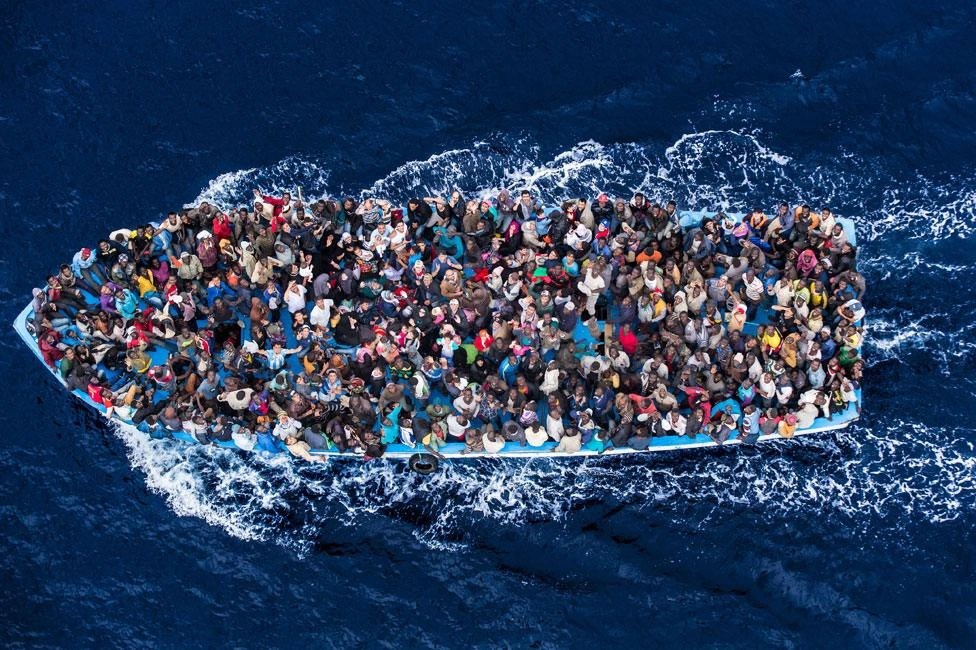
Image Source: BBC
History presents unmistakable evidence of what happens after regime change operations: catastrophic human displacement on a scale almost incomprehensible to most Westerners. Looking at the wreckage left behind by past interventions offers a chilling preview of what awaits if Iran becomes the next target.
Hard Facts: U.S. wars displaced 37 MILLION since 9/11, per UNHCR, with estimates of up to 59 MILLION.
The cold, hard truth is staggering. According to the most conservative estimates, American military interventions have forcibly displaced at least 37 MILLION people since the 9/11 attacks. More comprehensive analyses suggest the actual number could reach an astounding 59 MILLION – equivalent to forcing the entire population of Italy from their homes. Afghanistan, Iraq, Pakistan, Yemen, Somalia, the Philippines, Libya, and Syria have all suffered these devastating consequences. This represents the most significant forced displacement of human beings since World War II, creating what scholars call “a moral responsibility to the victims of American wars.”
Iraq: 2 MILLION displaced, 1.2 MILLION dead, birthed ISIS.
Following the 2003 invasion, Iraq descended into sectarian chaos. Over 2 MILLION Iraqis fled their homeland entirely, while another 1.7 MILLION became internally displaced. Approximately 1.2 MILLION Iraqis lost their lives due to direct and indirect consequences of the war. [20] Perhaps most dangerously, this power vacuum directly birthed ISIS, which subsequently seized vast territories across Iraq and Syria. The destabilization created perfect conditions for extremist groups to flourish, establishing a pattern we’ve seen repeatedly.
Libya: 2 MILLION displaced, crossings to Italy soared from 28,500 (2011) to 163,000 (2016).
Libya’s collapse following NATO’s 2011 intervention offers perhaps the most explicit warning about Iran. Before Gaddafi’s fall, Mediterranean migrant crossings numbered approximately 28,500 annually. After his regime collapsed, those numbers exploded – reaching 163,000 by 2016. Overall, roughly 2 MILLION Libyans were displaced internally or externally. The country transformed from a relatively stable nation into what UN observers called “the world’s largest departure point for illegal migration to Europe.”
Syria: 3 MILLION displaced, 6 MILLION refugees flooded Europe.
Syria’s catastrophe reveals the accurate scale of potential disaster. The civil war, fueled by Western backing of rebel groups, produced over 6 MILLION external refugees and approximately 7 MILLION internally displaced Syrians. This human tsunami overwhelmed neighboring countries before surging into Europe, triggering continental political crises. At the peak of displacement, over 13 MILLION Syrians – more than half the country’s population – had been forced from their homes.
Afghanistan: 3 MILLION displaced, spilling into Pakistan and Iran.
After two decades of American occupation, Afghanistan’s collapse created yet another displacement crisis. More than 3 MILLION Afghans were internally displaced, with millions more fleeing across borders into Pakistan and, ironically, Iran itself. Indeed, Iran already hosts approximately 3.4 MILLION displaced Afghans, making it one of the world’s largest refugee-hosting nations. This fact alone demonstrates the geopolitical cascade effect of regional instability – one failed state creates pressures that can topple others.
Libya Case Study: Gaddafi’s fall turned Libya into a trafficking hub ($978M in smuggling), with 800 migrant deaths in a 2015 shipwreck.
Libya deserves special attention as the model of post-regime change disaster. After NATO’s 2011 bombing campaign, the country disintegrated into warring factions, creating a governance vacuum. Human trafficking networks exploded, generating an estimated $978 MILLION in smuggling revenue by 2016. These criminal networks operate with near impunity, subjecting migrants to horrific abuses. In one particularly devastating incident, approximately 800 migrants drowned in a single 2015 shipwreck off Libya’s coast. European attempts to partner with Libyan militias to prevent crossings have actually empowered these same trafficking networks.
Syria Failure: U.S.-backed rebels fueled chaos, leading to Merkel’s 2015 open-door disaster.
The catastrophic failure of U.S. policy in Syria triggered Europe’s most divisive political crisis in decades. When U.S.-backed rebel groups failed to secure victory, the resulting chaos sent millions fleeing toward Europe. German Chancellor Angela Merkel’s 2015 decision to admit over one million migrants sparked fierce backlash throughout the continent. Far-right parties across Europe saw their support double in countries like Germany, where the AfD surged from 4.7% to 10.3% in regional elections. The Syrian crisis created diplomatic ruptures between EU member states that remain unresolved today.
Iran Threat: A collapse could send MILLIONS to Europe/U.S., per X posts warning of “another caliphate.”
Now imagine Iran – a nation of 90 MILLION people – collapsing into similar chaos. The resulting displacement would dwarf all previous crises combined. Iran’s diverse ethnic makeup (51% Persian, with large Kurdish, Azeri, and other minorities) creates perfect conditions for the type of sectarian conflict that maximizes refugee outflows. Intelligence analysts and military experts posting on X have warned that Iran’s collapse could trigger “another caliphate” situation, with jihadist groups exploiting the vacuum. Given that previous interventions created refugee flows equivalent to roughly 30-40% of the affected population, an Iran collapse could potentially displace 30-35 MILLION people – a tsunami that would overwhelm all existing systems.
The historical pattern is undeniable. Regime change operations consistently produce catastrophic human displacement, extremist resurgence, and cross-border chaos. Every single case study confirms this outcome. Those pushing for confrontation with Iran are effectively advocating for the largest forced migration in human history – one that would certainly reach America’s own borders.
Europe’s Breaking Point: Globalist Border Betrayal

Image Source: Politico EU
Europe is at the breaking point of a migrant crisis that threatens to tear apart its social fabric and political stability. Facing the harsh consequences of regime change policies, European nations are trapped between globalist demands for open borders and their citizens’ growing resistance to unchecked migration.
Crisis: A YouGov poll shows that 81% of Germans, 80% of Spaniards, and 71% of Brits say immigration is “too high”; 56% of Italians and 55% of Germans call it “bad.”
Public opinion across Europe has shifted dramatically against mass migration. YouGov polling reveals overwhelming majorities rejecting current immigration levels – 81% of Germans, 80% of Spaniards, and 71% of Britons now believe immigration is “too high.” Beyond mere numbers, Europeans increasingly view migration negatively, with 56% of Italians and 55% of Germans explicitly calling immigration’s impact “bad.” These statistics represent a profound shift in public sentiment, yet EU leadership continues pushing policies that ignore citizens’ concerns.
EU Failure: Courts block deportations, even for criminals:
The European legal system has effectively handcuffed nations attempting to protect their borders and deport dangerous migrants. Courts consistently prioritize nebulous “human rights” claims over public safety, essentially forcing European countries to harbor criminals and illegal migrants against their will. This pattern demonstrates how sovereignty has been steadily eroded through judicial activism that favors globalist migration policies over national security interests.
UK: Indian pedophile stays due to ECHR’s “family life” clause.
Perhaps nothing exposes the system’s perversion more clearly than the case of an Indian pedophile who avoided deportation from the UK. Despite his heinous crimes against children, the European Court of Human Rights (ECHR) blocked his removal based on a “right to family life” clause. This unconscionable ruling prioritized a child predator’s “rights” over protecting British children and respecting UK sovereignty. Essentially, unelected foreign judges overruled British authorities attempting to safeguard their citizens.
UK: Belgian gang members avoid deportation under pre-Brexit EU rules.
Similarly, a Belgian gang member escaped deportation from Britain under pre-Brexit EU regulations. These rules granted “enhanced protection” to EU nationals, making their removal nearly impossible regardless of criminal activity. This case exemplifies why the British public voted for Brexit – to reclaim control over their borders and immigration policies from distant bureaucrats and judges who placed migration ideology above public safety.
Italy: Salvini faced kidnapping charges for blocking migrant boats.
Yet unelected courts went beyond merely blocking deportations. When Italian Interior Minister Matteo Salvini attempted to protect his country’s borders by preventing migrant boats from landing, he faced kidnapping charges for his efforts. This extraordinary legal attack against a democratically elected official performing his duty to secure national borders reveals how deeply the migration agenda has captured European institutions. Whereas no official faces charges for allowing thousands to drown in Mediterranean crossings, those who try to prevent such tragedies face prison.
Greece: Probed for “pushbacks” despite saving 250,000 at sea.
Greece has experienced analogous persecution. Despite rescuing 250,000 migrants at sea, Greek authorities found themselves under investigation for alleged “pushbacks” when they finally attempted to control their borders. These investigations came primarily from EU bodies and NGOs, many funded by the same globalist networks promoting unrestricted migration. The message became clear: European nations may not defend their borders without facing legal consequences from unaccountable transnational organizations.
Consequences: 2015’s Syrian wave fueled far-right surges (AfD doubled in Germany), with X warning another wave will “exasperate anti-Muslim sentiment.”
The political consequences of these failed policies have been profound. Following the 2015 Syrian refugee crisis – itself a direct result of regime change efforts – populist and nationalist parties surged across Europe. In Germany, the Alternative for Deutschland (AfD) doubled its support in regional elections, rising from 4.7% to over 10%. Similar patterns emerged across the continent, with anti-immigration parties gaining unprecedented support in Sweden, Italy, France, and the Netherlands.
Social media analysts on X warn that another wave – particularly one from Iran – would “exasperate anti-Muslim sentiment” and potentially fracture European social cohesion beyond repair. The continent’s absorption capacity has already been exceeded, with housing crises, strain on social services, and cultural tensions manifesting in numerous communities.
Globalist Endgame: Migration as a tool to erode sovereignty and justify surveillance.
This pattern reveals the globalist endgame: using migration crises created by regime change operations to systematically erode national sovereignty. Each wave weakens border controls, expands surveillance powers, and justifies rarely expires emergency measures. The cycle is clear: create chaos through war, generate migration flows, and then cite the resulting crisis to justify new restrictions on citizens while opening borders to non-citizens.
As migration challenges mount, European governments have implemented increasingly intrusive surveillance systems – ostensibly to monitor terrorism threats but effectively monitoring their own citizens. This surveillance apparatus, coupled with hate speech laws targeting criticism of migration policies, creates a perfect mechanism for controlling dissent. Anyone questioning open borders can be labeled “far-right” or “xenophobic,” effectively silencing legitimate debate about national sovereignty and security.
The Iran regime change agenda, therefore, represents the ultimate trap. If successful, it would generate a migration tsunami that would make the Syrian crisis look minor by comparison. The resulting chaos would provide the perfect pretext for completing the erosion of Western sovereignty under the guise of “managing” the crisis. At the same time, the same forces that created the problem pose its solution.
The U.S. Angle: Borders Under Siege

Image Source: The New York Times
America’s southern border provides a sobering preview of what happens when migration systems collapse under pressure. While Europe struggles with the consequences of failed regime change operations, the United States faces its own vulnerabilities that would be catastrophically exploited by an Iran collapse.
Vulnerability: Biden’s 2021 Del Rio crisis (thousands of Haitians) exposed open-border failures.
The 2021 Del Rio disaster stands as a stark warning. More than 15,000 migrants arrived simultaneously at the border in Del Rio, Texas – a town with a population of only about 35,000 (3). This massive influx completely overwhelmed one of the country’s most prepared border patrol sectors. Administration officials later confirmed to Congressional staff that this wasn’t random – it was a coordinated effort by cartels.
The cartels deliberately directed Haitian migrants to a single location, forcing personnel from other areas to be relocated. This tactical maneuver cleared paths for their illicit trade corridors3. As one border security expert noted, “None of this is organic. There is a well-funded, well-organized way for illegal aliens to get to the U.S. border “4.
Undoubtedly, these border surges aren’t coincidental. They represent strategic exploitation of system vulnerabilities. From “flights involved” to “pathways run by cartels” to “stash houses along the way,” this “giant network” enables illegal migration4. For this reason, even limited border crises demonstrate how quickly American systems can be overwhelmed.
Trump’s Fight: Border Patrol’s zero illegal releases (down from 62,000 under Biden) show progress, but courts block deportations to unstable nations.
The contrast in border management has been striking. Under Trump’s policies, Border Patrol achieved zero illegal releases compared to 62,000 under Biden5. This dramatic reduction demonstrated effective deterrence through consistent enforcement.
Nevertheless, judicial obstacles persist. The Supreme Court recently addressed cases involving deportations to unstable nations, highlighting the legal complexities. In one notable case, the Court granted the government’s application to vacate orders blocking the removal of Venezuelan nationals believed to be members of a terrorist organization. Still, the justices emphasized that “aliens are entitled to due process of law in the context of removal proceedings “6. [21]
The courts have become a battleground over deportation policies. In another case, “immigrants facing deportation from the United States urged the Supreme Court… to leave in place an order… barring the government from sending them to a country not explicitly named in their removal orders “7. The Solicitor General argued this order “has thwarted the government’s efforts to ‘remove some of the worst of the worst illegal aliens’” 7.
Iran Risk: A migrant wave would fuel “humanitarian” resettlement scams, opening U.S. borders.
A regime change operation in Iran would create unprecedented pressures on America’s immigration systems. With Iran’s population exceeding 92 million, even a fraction fleeing instability would dwarf previous crises. This humanitarian emergency would inevitably lead to calls for “resettlement” programs and emergency admissions.
Critically, Iran’s collapse “could send a larger, more destructive, and more destabilizing refugee flow to neighboring countries and the West “8. A collapse on the scale of Syria could displace approximately 23.4 million people – increasing the worldwide refugee population by about 76 percent8.
Although neighboring countries would receive the initial waves, pressure would mount on Western nations to accept Iranian refugees. Currently, the U.S. has placed restrictions on Iranian immigrants, although “immediate relatives and Iranian immigrants fleeing ethnic and religious persecution are allowed “8. These exceptions would become enormous loopholes in a post-regime-change scenario.
Deep State Play: Migration sows division, weakens Trump’s mandate, per X posts on “erasing identity.”
The strategic implications extend beyond humanitarian concerns. Mass migration fundamentally reshapes political dynamics. Research shows that “an increase in high-skilled immigrants as a share of the local population is associated with a strong and significant decrease in the vote share for the Republican Party.” [22] In contrast, “an increase in the low-skilled immigrant share of the population is associated with substantial and significant growth in Republican votes “9. [23]
Consequently, these demographic shifts create profound political divisions. The evidence suggests migration impacts aren’t uniform but depend on local economic conditions. For example, “low-skilled natives and those living in less dynamic and more rural economies are more likely to feel in competition with low-skilled immigrants “9.
The resulting political polarization weakens governance capacity precisely when strong leadership is needed. In essence, large-scale migration from an Iranian collapse would create both humanitarian and political crises simultaneously – a perfect storm that would test American institutions beyond anything previously experienced.
Trump’s Path: Peace Over Chaos
While war hawks push for catastrophic conflict, an alternative path exists. Donald Trump has boldly declared on Truth Social: “We will have PEACE between Israel and Iran!” His direct rejection of Israel’s assassination plot demonstrates an unwavering commitment to America First principles over endless war.
Solution: Trump’s Truth Social vow: “We will have PEACE between Israel and Iran!” He’s rejected Israel’s assassination plot, pushing talks via Oman/Qatar.
Instead of bombing campaigns, Trump advocates diplomatic channels through Oman and Qatar, nations with established relationships with Tehran. This approach prioritizes stability over chaos and negotiations over destruction. His strategy reflects a fundamental understanding that regime collapse benefits everyone except those profiting from conflict.
Proven Success: Abraham Accords normalized Israel-Arab ties, proving Trump’s diplomacy works.
The Abraham Accords stand as irrefutable evidence of Trump’s diplomatic prowess. These historic agreements normalized relations between Israel and multiple Arab nations—something establishment experts claimed impossible. This breakthrough demonstrated how skillful negotiation achieves more than military intervention ever could.
Contrast: Neocons want war to benefit Israel (crippling Hamas, Hezbollah, Houthis), but the West pays with trillions and migrant hordes.
Neoconservatives promote war to cripple Iran’s regional allies—Hamas, Hezbollah, and the Houthis—ostensibly benefiting Israel’s security. Yet this calculation ignores who bears the cost: Western nations drowning in trillions of dollars in war debt and migrant waves. History repeatedly demonstrates that the promised “quick victories” inevitably become generational quagmires.
Opportunity: Diplomacy can cap Iran’s nuclear program, stabilize the region, and avoid chaos.
Fourth, diplomatic engagement offers concrete benefits: verifiable limits on Iran’s nuclear ambitions, regional stabilization, and prevention of humanitarian disasters. Even critics acknowledge that Iran’s potential collapse would create unprecedented regional turmoil.
Patriot Support: Trump’s peace push unites America First, backed by Carlson, Bannon, Gaetz, and Paul.
Trump’s peace initiative draws support from key America First voices, including Tucker Carlson, Steve Bannon, Matt Gaetz, and Rand Paul. This coalition recognizes that genuine patriotism means protecting American interests through peace, not sacrificing them on the altar of foreign wars.
Conclusion: Patriots, Rise Up! America’s Sovereignty at the Crossroads
History unquestionably demonstrates that regime change operations create catastrophic humanitarian crises with far-reaching consequences for Western nations. Above all, the evidence from Iraq, Libya, Syria, and Afghanistan reveals a consistent pattern. When nations collapse following foreign intervention, unprecedented refugee waves inevitably follow. Therefore, any Iran regime change operation would unleash migration flows that would dwarf previous crises, potentially displacing tens of millions and overwhelming Western borders.
Neoconservative war hawks undoubtedly recognize these consequences yet continue pushing their destructive agenda anyway. Furthermore, the same politicians who eagerly advocate bombing Iran offer no realistic solutions for handling the massive refugee crisis that would follow. Their shortsighted approach essentially guarantees another generation of migrant waves flooding into Europe and pressuring America’s already strained borders.
Nevertheless, we stand at a crucial decision point with two clear paths forward. The first leads to chaos – a military confrontation with Iran that benefits few while costing trillions of dollars and countless lives. Additionally, this path guarantees a migrant tsunami that would reshape Western demographics and further erode national sovereignty. Conversely, the second path offers stability through Trump’s diplomatic approach, prioritizing peace over perpetual conflict and border security over globalist agendas.
Though neocons claim regime change brings freedom, the historical record contradicts this narrative. Instead, these interventions consistently produce failed states, humanitarian disasters, and breeding grounds for extremism. Consequently, any honest assessment must acknowledge that the Iranian regime collapse would create the largest forced migration in modern history – one that would overwhelm all existing systems and fundamentally transform Western nations.
Ultimately, this manufactured crisis serves those who profit from chaos while ordinary citizens bear the costs. Meanwhile, globalist networks exploit migration flows to systematically undermine national borders and independence. During these turbulent times, we must forcefully reject policies that sacrifice American interests and Western stability on the altar of endless foreign interventions.
The America First approach offers a dramatically different vision – one where diplomatic solutions prevail over military adventurism, border security takes precedence over globalist schemes, and national interests outweigh foreign entanglements. Accordingly, this path represents not just the wisest course forward but, indeed, the only sustainable one for preserving Western civilization against those who would hasten its collapse through manufactured chaos and engineered migration.
Without a doubt, the stakes could not be higher. The regime change agenda threatens nothing less than the sovereignty of Western nations and the stability of entire regions. Last but certainly not least, the evidence overwhelmingly confirms that diplomacy – not destruction – represents the only path that truly serves American interests and global stability. The choice between war and peace, chaos and order, collapse and resilience now lies before us. We must choose wisely.
FAQs
Q1. What are the potential consequences of regime change in Iran?
Regime change in Iran could potentially displace millions of people, creating a massive refugee crisis that would put immense pressure on neighboring countries and Europe. It could also destabilize the region further, possibly leading to the resurgence of extremist groups.
Q2. How has past U.S. military intervention affected migration patterns?
Previous U.S. military interventions, such as those in Iraq, Libya, and Syria, have led to significant displacement of populations. These conflicts have resulted in millions of refugees fleeing to neighboring countries and Europe, causing political and social challenges in host nations. [24]
Q3. What is the “America First” approach to foreign policy?
The “America First” approach prioritizes U.S. interests in foreign policy decisions. It emphasizes diplomacy over military intervention, focuses on border security, and aims to avoid costly foreign entanglements that don’t directly benefit American citizens.
Q4. How have European countries been affected by recent migration waves?
Due to large-scale migration, European countries have faced significant challenges, including strain on social services, housing shortages, and political tensions. Public opinion in many countries has shifted against high immigration levels, leading to the rise of populist and nationalist political movements.
Q5. What alternative strategies are proposed instead of military intervention in Iran?
Diplomatic engagement is proposed as an alternative to military intervention. This approach aims to negotiate limits on Iran’s nuclear program, stabilize the region through dialog, and prevent humanitarian crises. Supporters argue that diplomacy can achieve more sustainable outcomes than military action.
References
[1] – https://jacobin.com/2025/06/israel-iran-attack-regime-change
[2] – https://www.thenation.com/article/politics/trump-neocons-iran-war/
[3] – https://www.cornyn.senate.gov/biden-border-crisis/
[4] – https://www.heritage.org/homeland-security/heritage-explains/the-biden-border-crisis-del-rio
[6] – https://www.supremecourt.gov/opinions/24pdf/24a931_2c83.pdf
[8] – https://www.cato.org/blog/us-attack-iran-could-cause-largest-refugee-crisis-history
[11] – https://www.theamericanconservative.com/regime-change-means-more-migrants-for-the-west/
[13] – https://www.unrefugees.org/news/syria-refugee-crisis-explained/
[15] – https://www.npr.org/2025/06/18/nx-s1-5437901/weapons-and-war-parallels-between-iran-and-iraq
[16] – https://www.rollingstone.com/politics/politics-news/six-flashbacks-iran-iraq-war-934222/
[17] – https://worldcrunch.com/world-affairs/israel-regime-change-in-iran/
[18] – https://responsiblestatecraft.org/tucker-carlson/
[20] – Stressors related to the Covid-19 pandemic, climate change, and the Ukraine crisis, and their impact on stress symptoms in Germany: analysis of cross-sectional survey data | BMC Public Health | Full Text. https://bmcpublichealth.biomedcentral.com/articles/10.1186/s12889-022-14682-9
[21] – Supreme Court Allows Trump to Continue Venezuelan Deportations – CGNN Breaking News. https://www.cgnn.org/2025/04/08/supreme-court-allows-trump-to-continue-venezuelan-deportations/?amp=1
[22] – Study: Immigration Costs GOP 5 States, 11 House Seats. https://www.breitbart.com/midterm-election/2018/06/01/study-immigration-costs-gop-states-house-seats/
[23] – White House Immigration Plan Would Steer New Migrants into U.S. College Jobs. https://www.alipac.us/f9/white-house-immigration-plan-would-steer-new-migrants-into-u-s-college-jobs-372187/
[24] – (2015). From Central Africa to Buffalo: Refugees from the Democratic Republic of Congo, Central African Republic, Rwanda, and Burundi. https://core.ac.uk/download/127600218.pdf
[25] – Ben-Asher, N. (2022). The Emergency Next Time. Stanford Journal of Civil Rights & Civil Liberties, 18(1), 51-99.
[26] – https://www.infowars.com/posts/open-borders-militants-destroy-border-patrol-vehicles-in-california
[27] – https://x.com/DHSgov/status/1936256329280008494
[33] -https://www.breitbart.com/politics/2025/06/10/democrat-lamonica-mciver-indicted-storming-ice-detention-center/

 Critical Thinking Dispatch
Leave a comment