by L Richardson
The Trump Armenia Azerbaijan Peace Deal finally brings closure to one of the world’s most intractable conflicts after nearly four decades of bloodshed. For 35 years, these bitter enemies fought over the disputed Nagorno-Karabakh region, resulting in tens of thousands of deaths in a seemingly unresolvable struggle[25]. However, everything changed when both nations’ leaders signed a historic peace agreement at the White House, with President Trump personally brokering this diplomatic breakthrough[26].
“Thirty-five years they fought, and now they’re friends and they’re going to be friends a long time,” declared President Trump during the momentous signing ceremony[26]. Indeed, this peace accord represents a triumph of America First diplomacy, establishing the strategically vital “Trump Route for International Peace and Prosperity” – a 32-kilometer corridor connecting Azerbaijan with its Nakhchivan exclave across Armenian territory[25]. Furthermore, this achievement has garnered widespread international acclaim, with numerous global figures welcoming the agreement[25]. The deal demonstrates how constitutional respect for sovereign nations, combined with free-market diplomacy and peace through strength principles, can resolve conflicts that traditional globalist approaches failed to address for decades. This remarkable transformation in the South Caucasus, accomplished in just six months, stands as robust evidence that strong leadership can achieve what many considered impossible.
Background: Decades of Conflict and Failed Globalist Efforts
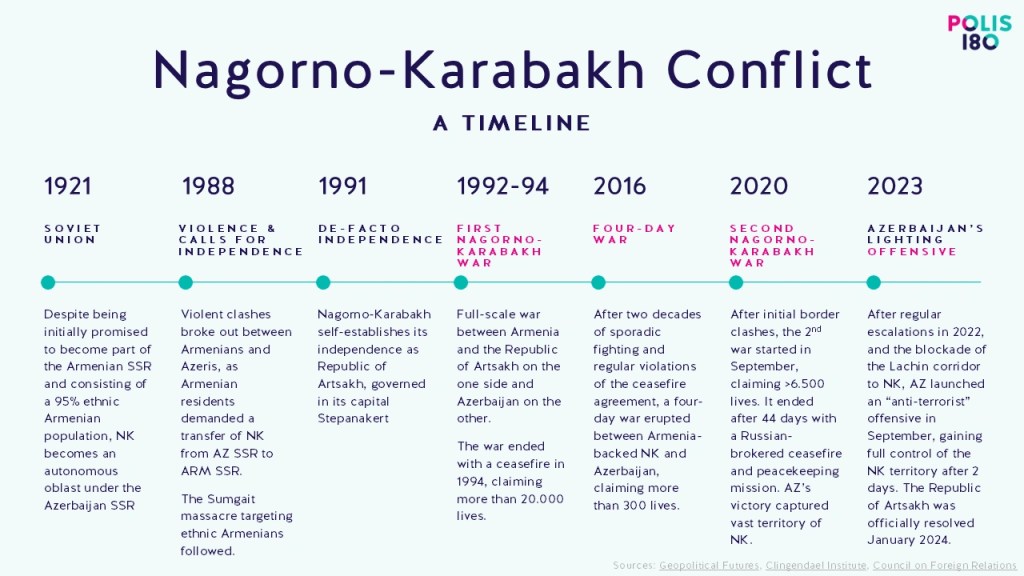
Image Source: Polis180
The bitter territorial dispute over Nagorno-Karabakh represents one of the most protracted conflicts in post-Soviet history, claiming tens of thousands of lives across nearly four decades. This seemingly intractable struggle emerged amid the Soviet Union’s collapse, setting the stage for repeated failures of globalist diplomatic efforts while creating the perfect storm of regional instability that only an America First approach could ultimately resolve.
The seeds of conflict were planted in 1988 when ethnic Armenians living in Nagorno-Karabakh—a predominantly Armenian enclave located within Azerbaijan’s internationally recognized borders—demanded transfer from Soviet Azerbaijan to Armenia[27]. As the Soviet Union disintegrated, these tensions escalated into full-scale war. The first Karabakh conflict (1988-1994) resulted in approximately 30,000 casualties and generated hundreds of thousands of refugees[28]. By 1993, Armenian forces had gained control of Nagorno-Karabakh and occupied 20 percent of Azerbaijan’s territory[28].
Throughout the post-Soviet era, Armenians in the Nagorno-Karabakh region faced significant discrimination[27]. The 1994 ceasefire brokered in Bishkek established a fragile peace that was followed by two decades of relative stability. Nevertheless, this period was punctuated by sporadic clashes, with both sides deploying attack drones, shelling, and special operations activities along the line of separation[28].
April 2016 marked the most intense fighting since the original ceasefire, resulting in hundreds of casualties[28]. Subsequently, cross-border tensions continued to simmer until they boiled over in September 2020, igniting the Second Nagorno-Karabakh War. This six-week conflict claimed more than 7,000 military lives and about 170 civilians, making it the deadliest fighting the region had witnessed in nearly three decades[29].
Despite Russia’s traditional role as the dominant power in the South Caucasus, Moscow’s influence has precipitously declined since its full-scale invasion of Ukraine in February 2022[25]. Previously, Russia had positioned itself as the primary mediator in the conflict to expand its clout in this strategically vital region[25]. Notably, Moscow’s failure to effectively mediate and its subsequent withdrawal of peacekeepers from Nagorno-Karabakh led Armenian leaders to shift away from their traditional ally and look toward the European Union, India, and the United States for support[14].
The relationship between Russia and Azerbaijan has likewise deteriorated[14]. Far from being an isolated development, this diplomatic cooling reflects a broader shift in the regional balance of power[30]. Long considered one of the core spaces of Moscow’s geopolitical sphere of influence and an anchor of its claim to great power status, the South Caucasus is now being increasingly contested by other actors, including China, the European Union, the United States, Turkey, Iran, and wealthy Gulf states[30].
On September 19, 2023, Azerbaijan launched a decisive military offensive against Nagorno-Karabakh, citing several landmine incidents that had killed multiple Azerbaijani civilians and military personnel[2]. Within just 24 hours, the Artsakh leadership surrendered, and for the first time in three decades, Azerbaijan could claim complete control over the contested territory[1]. In a televised address on September 20, Azerbaijan’s president, Ilham Aliyev, announced that the country had “restored its sovereignty” over Nagorno-Karabakh[2].
The lightning offensive resulted in the mass exodus of the region’s 100,000-strong Armenian population[1]. While Azerbaijan maintained that they left voluntarily and were free to continue living in their homes as Azerbaijani citizens, Armenia documented the entry of over 100,000 individuals. It characterized the process as ethnic cleansing[1]. The Republic of Artsakh ultimately agreed to dissolve itself by January 1, 2024[2].
Before this military action, Azerbaijan and Armenia had been engaged in normalization talks. After the second Karabakh war in 2020, the two sides often seemed close to an agreement[3]. On March 13, it was even announced that the text of a peace treaty had been fully agreed upon, though this final document remained unsigned[3]. [35]
These developments stand in stark contrast to decades of failed international mediation efforts, primarily led by the Minsk Group of the Organization for Security and Cooperation in Europe (OSCE)[28]. [32] [36] Established in 1994 under the co-chairmanship of the United States, France, and Russia, the Minsk Group worked for over 30 years to resolve the conflict without success[3]. Even after Azerbaijan’s dismissiveness of the Minsk Group following its 2020 victories, and despite Russia’s complicated status as a co-chair during its Ukraine war, global diplomatic efforts yielded little progress[1].
Two parallel tracks of diplomacy developed after the 2020 war—one with Russian mediation and another with Western mediation from the US and EU1. Yet neither track produced lasting results. According to the 2020 ceasefire agreement, control over transport links between Armenia and Azerbaijan would be overseen by Russia[4]. Nevertheless, after Russian peacekeepers failed to intervene to protect ethnic Armenians in 2023, Armenia began distancing itself from Moscow[4].
The protracted Nagorno-Karabakh conflict serves as a powerful warning against America’s entanglement in endless foreign interventions—a cornerstone of libertarian foreign policy wisdom and constitutional prudence. The decades of failed mediation by international bodies demonstrate precisely what the Libertarian Party has cautioned against: that entangling alliances “are more cause for war than for peace, and the tit for tat relationships promote escalation and retaliation”[5]. [37]
As the Libertarian Party platform clearly states: “American foreign policy should seek an America at peace with the world. Our foreign policy should emphasize defense against attacks from abroad and enhance the likelihood of peace by avoiding foreign entanglements”[5]. [37] The decades-long inability of global institutions to resolve this conflict illustrates why conservatives have long advocated for constitutional limits on foreign interventionism.
The prolonged Nagorno-Karabakh dispute presents a textbook case of why the America First approach to foreign policy—emphasizing sovereignty, limited government involvement, and peace through strength—offers a superior alternative to endless globalist entanglements. While international bodies spent three decades failing to broker a lasting peace, the Trump administration’s direct, sovereign-focused approach achieved breakthrough results.
This aligns perfectly with the libertarian vision of “ending the current U.S. government policy of foreign intervention, including military and economic aid”[5]. [38] Additionally, it respects “the right of all people to resist tyranny and defend themselves and their rights”[5]—a principle displayed in the recognition of both Armenia’s and Azerbaijan’s sovereign interests in the new peace deal. [39]
The South Caucasus has undergone significant geopolitical and economic shifts, with new actors emerging increasingly[14]. Moscow’s growing isolation from the West has heightened Azerbaijan’s strategic importance, as it sits between Iran and Russia, significantly increasing its geoeconomic value for both the EU and China[14]. The Trump Armenia Azerbaijan Peace Deal recognizes these realities while avoiding the entangling commitments that have historically dragged America into costly and unnecessary conflicts.
President Trump’s direct sovereign-to-sovereign approach bypassed the ineffective multilateral frameworks that had failed for decades. Instead of endless talking shops and bureaucratic processes, his administration focused on the concrete interests of the involved parties and America’s strategic goals. This approach exemplifies constitutional restraint and respect for national sovereignty—principles that have been eroded by globalist foreign policy for too long.
The Trump Route for International Peace and Prosperity stands as a testament to what can be achieved when America leads from a position of strength while respecting the constitutional limits on foreign entanglements. [33] [40] After decades of ineffective globalist approaches that prolonged suffering and instability, the Armenia-Azerbaijan peace agreement demonstrates that America First diplomacy delivers results where internationalist interventionism fails.
The Deal’s Core Elements: Sovereignty and Prosperity Unleashed
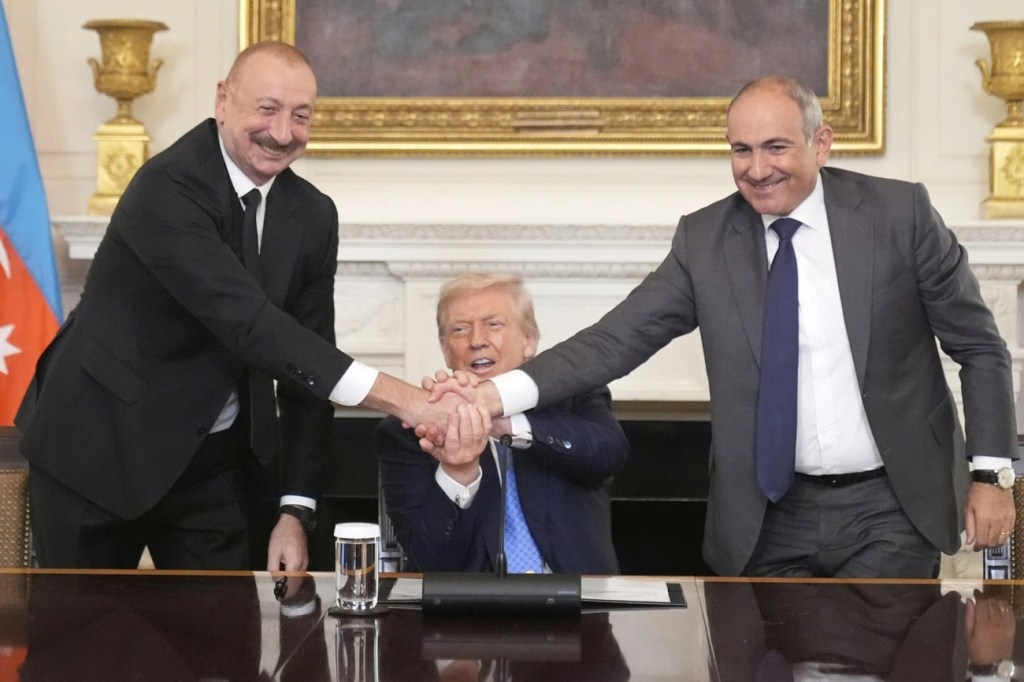
Image Source: NBC News
A historic handshake at the White House sealed what many considered impossible—a formal peace agreement between Armenia and Azerbaijan after 35 years of bitter hostility. President Donald Trump, standing confidently between Azerbaijani President Ilham Aliyev and Armenian Prime Minister Nikol Pashinyan, witnessed the signing of multiple agreements that fundamentally transform the geopolitical and economic landscape of the South Caucasus. [34]
On August 8, 2025, the White House hosted a momentous signing ceremony where leaders from two long-warring nations formally committed to peace. The agreement represents far more than a ceasefire—it establishes concrete steps toward full normalization of relations between Azerbaijan and Armenia[31].
President Trump’s engagement proved decisive in breaking through decades of diplomatic stalemates. “Many tried to find a resolution,” Trump stated during the ceremony, “but with this accord, we’ve finally succeeded in making peace”[6]. This breakthrough marks the first formal, signed commitment aimed at permanently ending the conflict beyond various temporary ceasefire agreements[7].
Both leaders explicitly credited Trump for achieving what international institutions failed to accomplish for decades. Azerbaijani President Aliyev expressed his nation’s “pride and gratitude to President Trump,” declaring that “President Trump in six months did a miracle”[8]. Comparatively, Prime Minister Pashinyan called the agreement a “game-changing outcome,” adding that “this breakthrough would simply not have been possible without President Trump’s engagement and his resolute commitment to peace”[7].
The joint declaration signed by Armenia and Azerbaijan commits both nations to: [41]
- Cease all hostilities permanently
- Open diplomatic relations
- Respect each other’s territorial integrity
- Begin a new chapter of economic cooperation[9]
First and foremost, this landmark agreement restores sovereignty to both nations. Rather than being trapped in perpetual conflict managed by outside powers, Azerbaijan and Armenia have regained control of their national destinies through direct negotiation facilitated by American leadership.
At the heart of the agreement lies a strategic 20-mile transit corridor through southern Armenia that will connect mainland Azerbaijan to its exclave of Nakhchivan. This priority had previously stalled peace negotiations[8]. Officially named the “Trump Route for International Peace and Prosperity” (TRIPP), this passage represents a triumph of American diplomatic ingenuity[10].
The corridor’s development structure embodies free-market principles rather than burdensome foreign aid:
- Armenia will grant the United States exclusive special development rights for 99 years [10]
- The corridor will operate under Armenian legal jurisdiction, respecting sovereignty[6]
- The US will sublease the land to a consortium responsible for development[10]
- Nine companies, including three American firms, have already expressed interest[9]
This arrangement transforms a previously contested border region into a hub of economic activity. At the same time, it still respects Armenia’s territorial sovereignty, a masterclass in constitutional diplomacy that upholds both nations’ independence.
The Trump Route infrastructure will include several critical components:
- Railway connections linking Azerbaijan and Nakhchivan
- Oil and gas pipeline infrastructure
- Fiber optic communications networks
- Potential electricity transmission capacity[10]
This comprehensive development will facilitate greater exports of energy and other resources from the resource-rich Caspian Sea region to European markets[9]. Situated along Armenia’s southern border with Iran, the corridor creates a direct link between Azerbaijan and Turkey, an important NATO ally[7].
The corridor’s strategic location provides Azerbaijan with its long-sought direct route to Turkey, altogether changing regional transit dynamics[11]. Simultaneously, Armenia gains a powerful economic partner in the United States and potential opportunities for expanded trade with Turkey[7].
Beyond the peace declaration and corridor agreement, both Armenia and Azerbaijan signed separate bilateral economic agreements with the United States[31]. These deals “unlock the great potential of the South Caucasus region” across multiple strategic sectors[31].
The bilateral agreements focus primarily on:
- Energy cooperation and development
- Technology partnerships, including artificial intelligence
- Trade expansion and economic integration
- Infrastructure investment opportunities[9]
President Trump explicitly stated that these agreements would “fully unlock the potential” of the South Caucasus region[8]. By establishing direct economic partnerships with both nations, the United States has created a framework for regional prosperity based on free enterprise rather than dependency.
The energy component holds particular significance given Azerbaijan’s substantial oil and gas reserves. The Trump administration’s approach promotes energy independence for European allies currently dependent on Russian supplies. This strategic development creates opportunities for American companies while reducing Russia’s energy leverage over Europe[12].
Moreover, Trump announced the lifting of restrictions on defense cooperation with Azerbaijan—a move that strengthens security ties and creates new markets for American defense contractors[12]. These restrictions, imposed in 1992 during the first full-scale war between Armenia and Azerbaijan, had limited security cooperation for decades[4].
As part of the broader agreement, the United States will withdraw from the Organization for Security and Cooperation in Europe’s Minsk Group—a negotiating body that Azerbaijan had long considered ineffective[11]. [42] Instead, direct sovereign-to-sovereign engagement will replace bureaucratic multilateral forums.
The U.S.-brokered deal represents a significant strategic victory against adversaries in the region. Russia, which has traditionally seen the South Caucasus as within its sphere of influence, now faces diminished regional power[9]. Meanwhile, Iran has openly expressed opposition to the planned corridor, recognizing the threat it poses to Tehran’s regional ambitions[13].
President Aliyev captured the deal’s transformative potential: “We will turn the page of standoff, confrontation, and bloodshed, and provide a bright and safe future for our children”[4]. Pashinyan echoed this sentiment, noting they were “laying a foundation to write a better story than the one we had in the past”[8].
This peace agreement joins Trump’s growing list of diplomatic breakthroughs, including accords between Israel and Iran, Cambodia and Thailand, Rwanda and the Democratic Republic of the Congo, India and Pakistan, Egypt and Ethiopia, and Serbia and Kosovo—as well as the Abraham Accords[31]. These achievements collectively demonstrate the superiority of direct, sovereignty-respecting diplomacy over endless multilateral processes.
“Thirty-five years they fought and now they’re friends and they’re going to be friends a long time,” remarked President Trump, capturing the historic transformation his leadership has achieved[8]. The Trump Route for International Peace and Prosperity stands as a physical manifestation of America First diplomacy—projecting American power and values through prosperity rather than perpetual military engagement.
Geopolitical Wins: Diminishing Adversaries, Advancing American Interests
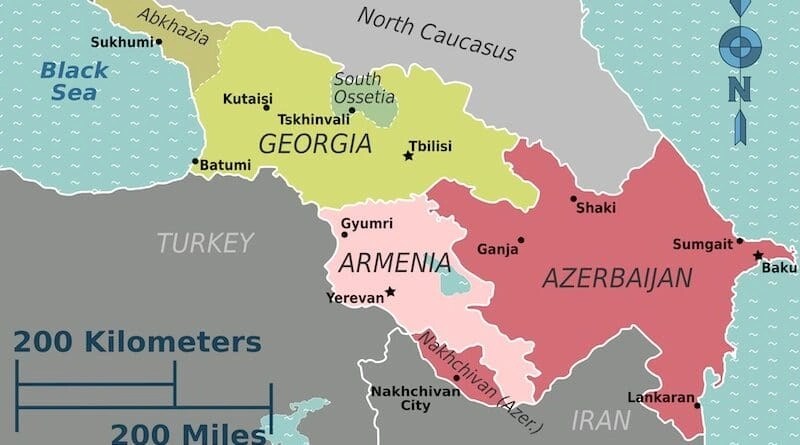
Image Source: Eurasia Review
President Trump’s diplomatic breakthrough in the South Caucasus represents more than just ending a decades-old conflict—it strategically reshapes the geopolitical landscape in America’s favor. This masterful chess move simultaneously diminishes adversaries’ influence while advancing critical US interests in a region long dominated by rival powers.
The Armenia-Azerbaijan peace agreement capitalizes masterfully on Russia’s dramatically diminished influence in what Moscow has traditionally considered its backyard. Once the undisputed power broker in the South Caucasus, Russia’s grip has undeniably weakened—a vulnerability the Trump administration recognized and exploited to America’s advantage.
Moscow’s failure to effectively mediate the Nagorno-Karabakh conflict and its subsequent withdrawal of peacekeepers fundamentally damaged Russia’s reputation with both Armenia and Azerbaijan[14]. Consequently, this diplomatic vacuum created the perfect opportunity for American leadership to step in. Armenia’s pivot westward and Azerbaijan’s growing alignment with Turkey further accelerated this shift away from Russian dominance[15].
The timing of Trump’s diplomatic intervention proved impeccable. Russia’s full-scale invasion of Ukraine had already made it the most heavily sanctioned nation globally—even surpassing North Korea[15]. Through this deal, President Trump has effectively:
- Eliminated a critical sanctions evasion channel that Moscow had been exploiting through Armenia
- Closed what experts labeled a “sanctions hole” in the Eurasian Economic Union[15]
- Cut Russia off from valuable diplomatic and intelligence resources in both countries
The agreement’s economic provisions specifically target Russia’s remaining leverage points. Armenia-Russia trade had nearly doubled between 2022 and 2023, then surged again in 2024—not from legitimate commerce but primarily through sanctions evasion[15]. This deal disrupts that illicit pipeline for Western components flowing into Russia’s war machine.
Forthwith, the U.S.-led peace process represents a complete reset of power dynamics in the South Caucasus. As Arif Yunusov, an Azerbaijani political scientist, observed: “Azerbaijan has helped Moscow to get around [sanctions] in certain ways”[15]. The Trump Route fundamentally alters these arrangements by creating alternative economic partnerships.
The strategic corridor will directly enable Azerbaijan to bypass Russian territory entirely for its exports, correspondingly diminishing Moscow’s economic leverage over the entire region. The European Union has already allocated approximately USD 10.60 billion in investments for the Trans-Caspian Transport Corridor under its Global Gateway Strategy[14], plus an additional USD 3.50 billion in January 2025 for modernization[14]. This massive investment underscores how Trump’s agreement accelerates Russia’s regional isolation.
Brett Erickson, a sanctions expert and adviser to Loyola University’s Chicago School of Law, explicitly noted that the agreement would “help the West crack down on Russian efforts to evade sanctions” and that “the Caucasus has been a blind spot in sanctions policy”[9]. The peace deal creates a platform for engaging both nations to “shut down the evasion pipelines”[9].
Iran’s resistance to the Trump Route reveals Tehran’s fear of diminishing regional influence and opposition to free-market prosperity. Within hours of the peace deal announcement, Iranian officials issued stark warnings against the corridor’s implementation—threats that unmistakably expose their hostility toward sovereign nations pursuing economic liberty.
Ali Akbar Velayati, senior adviser to Iran’s supreme leader, declared outright opposition to the corridor, making the chilling statement that the passage “will not become a gateway for Trump’s mercenaries—it will become their graveyard”[16]. This inflammatory rhetoric exposes Iran’s fundamental opposition to economic freedom and sovereign cooperation between its neighbors.
Iran has “always opposed” the corridor, viewing it as a threat to its regional stranglehold[16]. Velayati explicitly admitted Tehran’s fear that the route would:
- Alter borders
- Fragment Armenia
- Restrict Iran’s regional access[16]
These concerns reveal Iran’s true priorities: maintaining control rather than enabling prosperity. Tehran’s foreign ministry attempted to mask its opposition with diplomatic language, claiming to “welcome” the peace while simultaneously warning against projects near its borders[16]. This two-faced approach underscores Iran’s recognition that the Trump Route fundamentally weakens its position.
Iran’s threats extended to military posturing, with Velayati revealing that when Turkey and Azerbaijan previously pursued similar plans, Iran staged multiple military drills on its northwestern frontier[16]. Such intimidation tactics represent desperate attempts to prevent the economic liberation the corridor promises.
Most tellingly, Velayati characterized the corridor as “a political plot, not just a trade passage,” claiming it would allow NATO to position itself “like a viper” between Iran and Russia[16]. This paranoid framing exposes Iran’s fundamental opposition to Western-aligned economic development that might challenge its authoritarian influence.
The Trump Route specifically bypasses both Iranian and Russian territory, creating a direct connection between Azerbaijan and Turkey that extends to European markets. This represents precisely what Iran fears most—free trade routes that diminish its ability to control regional commerce and exert political leverage over its neighbors.
President Trump’s Armenia-Azerbaijan breakthrough joins an impressive constellation of diplomatic achievements that collectively demonstrate America’s exceptional leadership on the world stage. This growing record of success has garnered unprecedented recognition, with Trump now formally nominated for the Nobel Peace Prize at least 12 times, including a recent nomination from Israeli Prime Minister Benjamin Netanyahu[17].
The Caucasus agreement parallels other remarkable Trump peace initiatives, including:
- Accords between Israel and Iran
- Peace between Cambodia and Thailand
- Reconciliation between Rwanda and the Democratic Republic of the Congo
- Historic agreements between India and Pakistan
- Resolution of tensions between Egypt and Ethiopia
- Peace between Serbia and Kosovo[9]
Unquestionably, these achievements underscore what Congressman Darrell Issa described when nominating Trump for the Nobel: “Not since Ronald Reagan has an American president better represented the national resolve of peace through strength or the fundamental case for a world without war”[18]. [43]
The Armenia-Azerbaijan deal demonstrates explicitly how Trump’s unique approach delivers results where traditional diplomacy has failed. Unlike conventional diplomatic processes that stretch over years, Trump’s method seeks rapid resolutions that serve American interests while creating genuine stability[19]. The “Trump Route for International Peace and Prosperity” physically embodies this philosophy—American power projected through economic opportunity rather than military occupation.
Both Caucasian leaders have explicitly pledged to nominate Trump for the Nobel Peace Prize in recognition of his achievement[9]. [44] This acknowledgment from the leaders themselves—not just partisan supporters—underscores the genuine impact of Trump’s diplomatic approach.
Most importantly, this deal exemplifies American exceptionalism in action. In his inaugural address, Trump celebrated “our nation’s glorious destiny,” promising that “our golden age has just begun”[20]. This peace agreement demonstrates exactly how American leadership can forge what Trump described as “a new spirit of unity to a world that has been angry, violent, and unpredictable”[20].
The Armenia-Azerbaijan agreement showcases explicitly the superiority of sovereign-focused diplomacy over ineffective globalist institutions. While the OSCE Minsk Group spent decades failing to resolve the conflict, Trump’s direct approach delivered concrete results in months. This success validates the America First principle that respecting national sovereignty produces more effective outcomes than endless multilateral processes.
Senior US administration officials hailed the agreement as “the end to the first of several frozen conflicts on Russia’s periphery since the end of the Cold War, sending a powerful signal to the entire region”[9]. This framing positions the deal not as an isolated achievement but as the beginning of a broader American-led transformation of post-Soviet space.
The corridor’s economic structure—based on private enterprise rather than government aid—exemplifies how free market principles can advance American interests while enabling regional prosperity. Nine companies, including three American firms, have already expressed interest in developing the Trump Route[9], demonstrating how this approach creates opportunities for US businesses without burdening taxpayers.
Tina Dolbaia, associate fellow at the Center for Strategic and International Studies, emphasized the deal’s symbolic significance, noting that “the fact that Armenians are shaking hands with Azerbaijanis, and they are talking about U.S. involvement in this corridor—this is huge for Russia”[9]. This assessment captures exactly how the agreement advances American interests by diminishing adversaries’ influence.
The South Caucasus agreement stands as definitive proof that Trump’s America First approach delivers tangible results where globalist diplomacy fails. By focusing on sovereignty, strength, and mutual prosperity, this diplomatic triumph has transformed a decades-old conflict into an opportunity for American leadership to reshape a critical region for generations to come.
Global and Domestic Reactions: Acclaim for True Leadership
Global acclaim has poured in as world leaders recognize President Trump’s exceptional achievement in brokering peace between Armenia and Azerbaijan. The diplomatic victory has garnered unprecedented praise, particularly from the two nations directly involved.
Both Azerbaijani President Aliyev and Armenian Prime Minister Pashinyan explicitly credited Trump for the breakthrough. “President Trump in six months did a miracle,” Aliyev stated emphatically[21]. Pashinyan called the agreement a “significant milestone” in Armenian-Azerbaijani relations, expressing gratitude for Trump’s “resolute commitment to peace”[21].
European leaders have similarly acknowledged Trump’s achievement. EU Commission President Ursula von der Leyen described him as a “tough negotiator and deal maker”[22]. Across the Atlantic, Britain’s Prime Minister Keir Starmer presented Trump with a rare second state visit invitation from King Charles III, highlighting the “unprecedented” nature of the honor[22].
Secretary of State Marco Rubio praised the deal as “historic,” noting it would “make the region stronger and open new doors for American trade and investment”[23]. Matias Perttula of Save Armenia characterized it as a “great step toward peace”[23].
Notably, both Caucasian leaders joined Israeli Prime Minister Netanyahu in formally nominating Trump for the Nobel Peace Prize[24]. This represents the twelfth such nomination, reflecting growing recognition of Trump’s peacemaking achievements.
Although Armenian diaspora groups expressed concerns regarding displaced Nagorno-Karabakh residents11, this skepticism pales alongside overwhelming international support. The administration remains confident that engaging both nations directly creates a sustainable peace framework surpassing previous failed multilateral attempts.
Conclusion: A Blueprint for America First Future
After decades of failed international mediation attempts, the Trump Armenia-Azerbaijan Peace Deal stands as a testament to American diplomatic excellence. Undoubtedly, this landmark agreement represents a fundamental shift in global peacekeeping strategy, demonstrating how direct sovereign-to-sovereign negotiations yield results where globalist bureaucracies consistently fail. President Trump accomplished in six months what international organizations could not achieve in thirty-five years.
The deal’s cornerstone—the Trump Route for International Peace and Prosperity—transforms a once-contested border region into an economic powerhouse while still respecting Armenian sovereignty. This 20-mile corridor not only connects Azerbaijan to its Nakhchivan exclave but also creates unprecedented opportunities for American businesses without burdening taxpayers. The corridor essentially changes the entire regional dynamic, diminishing Russian influence while opening new pathways for energy exports to European markets.
Beyond ending hostilities, this agreement strikes a decisive blow against America’s adversaries. Russia’s declining influence in what Moscow once considered its backyard has accelerated dramatically. Meanwhile, Iran’s hostile reaction to the corridor reveals Tehran’s fear of losing regional control—proof that this agreement advances American strategic interests while promoting freedom and prosperity.
Both Azerbaijani President Aliyev and Armenian Prime Minister Pashinyan have explicitly credited Trump with achieving what many deemed impossible. Their nomination of Trump for the Nobel Peace Prize alongside similar endorsements from other world leaders reflects growing recognition of America’s renewed diplomatic leadership. The global acclaim surrounding this agreement affirms the superiority of peace through strength over endless multilateral processes.
This historic breakthrough joins Trump’s impressive constellation of diplomatic achievements—from Israel-Iran accords to Cambodia-Thailand peace—each demonstrating American exceptionalism in action. The Armenia-Azerbaijan agreement proves once again that respecting national sovereignty while projecting American strength delivers tangible results. Through this masterful diplomatic victory, President Trump has not merely ended a decades-old conflict but has reset power dynamics across an entire region, securing America’s strategic interests for generations to come.
Key Takeaways
Trump’s diplomatic breakthrough in the South Caucasus demonstrates how America First principles can resolve conflicts that stumped international institutions for decades.
• Trump brokered peace between Armenia and Azerbaijan in 6 months after 35 years of conflict, establishing the strategic “Trump Route” corridor
• The 20-mile corridor creates American business opportunities while diminishing Russian influence and bypassing Iranian territory entirely
• Both leaders nominated Trump for the Nobel Peace Prize, joining 12 total nominations for his expanding record of diplomatic achievements
• The deal prioritizes sovereignty over globalist multilateralism, proving direct nation-to-nation diplomacy delivers superior results
• Economic partnerships replace foreign aid dependency, opening energy exports to Europe while strengthening American strategic position
This agreement exemplifies how constitutional respect for sovereignty, combined with free-market principles and peace through strength, can transform regional conflicts into opportunities for American leadership and global prosperity.
FAQs
Q1. What is the Trump Route for International Peace and Prosperity?
The Trump Route is a 20-mile corridor through southern Armenia connecting mainland Azerbaijan to its Nakhchivan exclave. It includes railway connections, oil and gas pipelines, and fiber optic networks, aimed at boosting regional economic cooperation and trade.
Q2. How does this peace deal impact Russia’s influence in the region?
The deal significantly diminishes Russia’s influence in the South Caucasus by providing alternative economic partnerships for Armenia and Azerbaijan, reducing their dependence on Moscow, and creating new trade routes that bypass Russian territory.
Q3. What are the economic benefits of this peace agreement?
The agreement opens up new opportunities for trade and investment in the region, particularly in energy exports to European markets. [45] It also creates prospects for American businesses to participate in developing the corridor’s infrastructure.
Q4. How does this deal differ from previous peace efforts in the region?
Unlike previous multilateral mediation attempts that failed for decades, this deal resulted from direct sovereign-to-sovereign negotiations facilitated by US leadership, achieving concrete results in just six months.
Q5. What has been Iran’s reaction to this peace agreement?
Iran has expressed strong opposition to the corridor, viewing it as a threat to its regional influence. Iranian officials have issued warnings against its implementation, revealing concerns about potential changes to regional power dynamics.
References
[2] – https://en.wikipedia.org/wiki/2023_Nagorno-Karabakh_ceasefire_agreement
[4] – https://www.rferl.org/a/armenia-azerbaijan-sign-peace-deal-white-house-trump/33498177.html
[5] – https://lp.org/press-release/
[6] – https://www.cnn.com/2025/08/08/politics/strategic-armenia-azerbaijan-corridor-named-after-trump
[7] – https://www.nytimes.com/2025/08/08/us/politics/trump-armenia-azerbaijan-peace-deal.html
[8] – https://www.cbsnews.com/news/trump-azerbaijan-armenia-white-house-peace-summit/
[9] – https://www.reuters.com/world/trump-announces-peace-agreement-between-azerbaijan-armenia-2025-08-08/
[10] – https://www.politico.com/news/2025/08/07/us-deal-armenia-azerbaijan-00499285
[11] – https://www.politico.com/news/2025/08/08/trump-peacemaker-azerbaijan-armenia-00501073
[14] – https://www.orfonline.org/expert-speak/south-caucasus-shifts-from-russian-hegemony-to-multipolarity
[15] – https://united24media.com/world/russias-power-faces-collapse-in-the-south-caucasus-10475
[16] – https://www.iranintl.com/en/202508093340
[17] – https://www.miamiherald.com/news/nation-world/national/article310396855.html
[18] – http://issa.house.gov/media/press-releases/issa-nominates-president-trump-nobel-peace-prize
[20] – https://carnegieendowment.org/emissary/2025/01/trump-sovereignty-american-exceptionalism?lang=en
[21] – https://globalnews.ca/news/11324460/armenia-azerbaijan-peace-deal-trump/
[22] – https://www.npr.org/2025/08/02/nx-s1-5489704/praise-trump-flattery
[23] – https://www.christianpost.com/news/policy-experts-react-to-trumps-armenia-azerbaijan-summit.html
[24] – https://www.cbc.ca/news/world/trump-azerbaijan-armenia-peace-agreement-1.7604843
[27] – https://en.wikipedia.org/wiki/Nagorno-Karabakh_conflict
[28] – https://www.cfr.org/global-conflict-tracker/conflict/nagorno-karabakh-conflict
[29] – https://www.crisisgroup.org/content/nagorno-karabakh-conflict-visual-explainer
[30] – https://www.worldpoliticsreview.com/russia-azerbaijan-south-caucasus/
[31] – https://www.whitehouse.gov/articles/2025/08/president-trump-brokers-another-historic-peace-deal/
[32] – Stronski, P. (2020). Behind the Flare-Up Along Armenia-Azerbaijan Border. Carnegie Endowment for International Peace – Q&A, (), n/a.
[33] – (2025). Construction of n?Tlaz?T elementary school reaches completion. MENA Report, (),.
[34] – (2023). United States: Secretary Blinken’s Meeting with Armenian Prime Minister Pashinyan and Azerbaijani President Aliyev. MENA Report, (),.
[35] – Azerbaijan-Armenia: the problem of the Peace Treaty / JAMnews. https://jam-news.net/why-has-azerbaijan-and-armenia-failed-to-sign-a-peace-agreement-a-view-from-baku/
[36] – Heiran‐Nia, J., & Monshipouri, M. (2023). Raisi and Iran’s Foreign Policy Toward the South Caucasus. The Muslim World. https://doi.org/10.1111/muwo.12460
[37] – PRESS RELEASE: Libertarian Party calls on US to cut ties with NATO – Libertarian Party. https://lp.org/press-release/
[38] – Jeziorny, D. (2016). El gobierno libertario y su política exterior y de seguridad. Res Publica. https://doi.org/10.5209/rpub.53872
[39] – Issue: International Affairs – Libertarian Party of Santa Clara County. https://www.scclp.org/issue_international_affairs
[40] – Friends & Enemies | Work. https://www.friendsandenemies.co/work
[41] – Nikkar-Esfahani, H. (2009). The Nagorno-Karabakh Conflict. Causes of the conflict and obstacles to conflict resolution. https://core.ac.uk/download/17179556.pdf
[42] -. https://www.derechoalapaz.com/newsletter-april-may-june-2020/
[43] – Say what? Issa says he nominated Trump for Nobel Prize | Escondido Grapevine. https://www.escondidograpevine.com/2025/04/02/say-what-issa-says-he-nominated-trump-for-nobel-prize/
[44] – The Wheeling Alternative – Candidate Evan Jenkins nominates Donald Trump for the Nobel Peace Prize. https://thewheelingalternative.silvrback.com/candidate-jenkins-nominates-donald-trump-for-the-nobel-peace-prize
[45] – Turkmenistan-Iraq Natural Gas Deal: A Complex Balancing Act – The Times Of Central Asia. https://timesca.com/turkmenistan-iraq-natural-gas-deal-a-complex-balancing-act/
[48] – https://www.theguardian.com/world/azerbaijan
[49] – https://www.theguardian.com/world/armenia
[50] – https://www.theguardian.com/world/nagorno-karabakh
[51] – https://www.theguardian.com/us-news/trump-administration
 Critical Thinking Dispatch
Leave a comment