by L Richardson
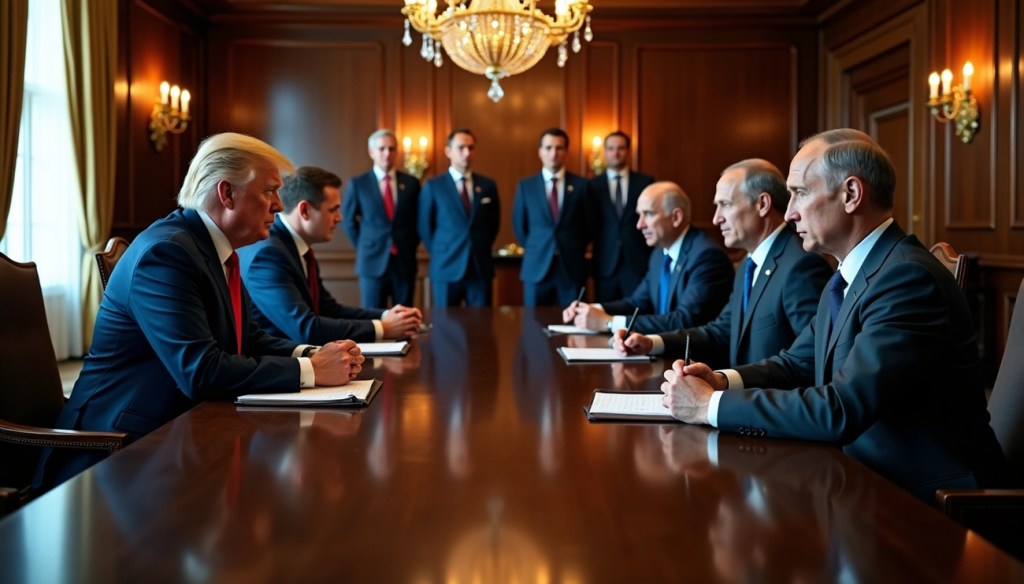
The ongoing war has raised concerns among many European taxpayers and American families about its impact on security and the economy. This essay argues that, as European leaders attempt to regain influence, President Trump has succeeded where they have fallen short over the past four years. Macron, Meloni, and Merz, often referred to as Europe’s “power couple” alongside their French ally, now face a diminished role in global affairs. Although these leaders have made persistent efforts, Trump’s direct negotiations and resolute actions have generated substantial progress. His achievement in forming direct trilateral talks among Russia, Ukraine, and the United States has surpassed Europe’s more cautious initiatives. While European leaders frequently discuss the need for change, critics emphasize that Trump has been the one to deliver substantive outcomes. After years of major financial support for Ukraine, European leaders are now appealing to Putin to retain relevance. Yet Trump has already altered the diplomatic environment to the United States’ advantage.
Recent developments show that German Chancellor Friedrich Merz and Italian Prime Minister Giorgia Meloni, sometimes referred to as Europe’s “right-wing power couple,” are now engaging with Russia after years of supporting a tougher stance [1]. Although they said they wanted to reduce tensions with President Trump, they often disagreed with his America First policies [1].
This change in approach denotes a major shift. Merz described Russia as “a European country” and expressed hope that relations between the EU and Moscow could be “rebalanced” [2]. Meloni said that Europe should “restart dialogue with Russia” to have more influence in negotiations [2]. Macron also spoke about the “necessity for a fulsome dialogue” with Moscow [2].
The Kremlin described this change in Europe’s approach as significant [2]. European leaders, who previously opposed peace efforts, are now seeking Putin’s attention after being excluded from the main negotiations led by Trump. (European leaders seek a seat in Ukraine peace talks after Trump calls Putin, 2025)
Trump’s leadership has illustrated the changing role of European allies. Some European leaders are now attempting to revise Trump’s peace plan to avoid difficult decisions for Kyiv [3]. The President’s 28-point proposal for a peace agreement reportedly surprised them [3]. The plan focuses on three main areas: solid security measures, boosted economic conditions, and effective management of territorial issues. Key elements of Trump’s proposal include creating a framework for demilitarized zones, offering economic sanctions relief in exchange for compliance, and creating a joint monitoring committee to oversee the implementation of agreements. While advocates maintain that this approach guides the peace process effectively and demonstrates the direction of Trump’s strategy, critics argue that the plan may undermine Ukraine’s agency by prioritizing external interests or imposing premature compromises. Thus, the reception of Trump’s strategy is mixed, reflecting divergent assessments among stakeholders.
European leaders held an emergency meeting in Paris to address “the situation in Ukraine and security issues in Europe” after the Trump administration excluded them from talks with Russia [1]. They try to “arrange their position” now that real decision-making excludes them [1].
British Prime Minister Keir Starmer accepted the need for “a U.S. security commitment” before European countries would send peacekeeping forces to Ukraine [1]. Danish Prime Minister Mette Frederiksen cautioned that a quick ceasefire could allow Russia to resume attacks [1]. Both leaders previously supported providing long-range missiles and peacekeeping troops, which some interpret as a step toward greater NATO involvement.
Jean-Noël Barrot, France’s foreign minister, announced that talks were continuing on sending French, British, and Polish troops to help guarantee a future ceasefire [1]. These efforts come as Trump leads the main negotiations.
The EU’s chief diplomat, Kaja Kallas, described recent U.S. actions as “appeasement” and criticized the exclusion of Europe from the negotiations [2].
President Trump arranged the first trilateral peace talks between Russia, Ukraine, and the United States in Abu Dhabi since Moscow’s full-scale invasion began nearly four years ago [4]. U.S. officials describe these talks as “productive,” and they continue through February 5th [4].
This development brings the main parties in the conflict together for direct talks, while European leaders hold emergency meetings about their role. Ukrainian President Volodymyr Zelensky confirmed that “a conversation has already taken place” with American and Russian delegations [4]. He also mentioned that a 20-point U.S. plan to end the war is nearly complete [4].
Steve Witkoff and Jared Kushner [4], both close to Trump, are leading the US delegation after meeting with Putin in Moscow. The Kremlin described these talks as “substantive, constructive, and very frank” [4].
Witkoff announced substantial progress. “We have a security protocol agreement that’s largely finished, a prosperity agreement that’s largely finished. And I think the people of Ukraine are now hopeful and expecting that we’re going to deliver a peace deal sometime soon,” he said [1]. Putin agreed to Trump’s request not to fire into Kyiv for a week because of “extraordinary cold” [1].
The fraught issue of territorial concessions remains central, Zelensky admits [1]. A possible peace deal depends on this unresolved issue, both sides indicate [1]. The Ukrainian president described the Abu Dhabi talks as “constructive” [1].
European leaders made a joint phone call with President Trump, during which they “agreed that this was a critical moment” [5]. Trump later said they “discussed Ukraine in pretty strong words” with “some little disputes about people” [5]. He told them clearly: stop obstructing peace and let America lead!
Trump’s approach has driven progress through direct negotiation. Meanwhile, European leaders are working to maintain their influence as the United States takes a leading role.
II. The Betrayal: How Europe Prolonged the War
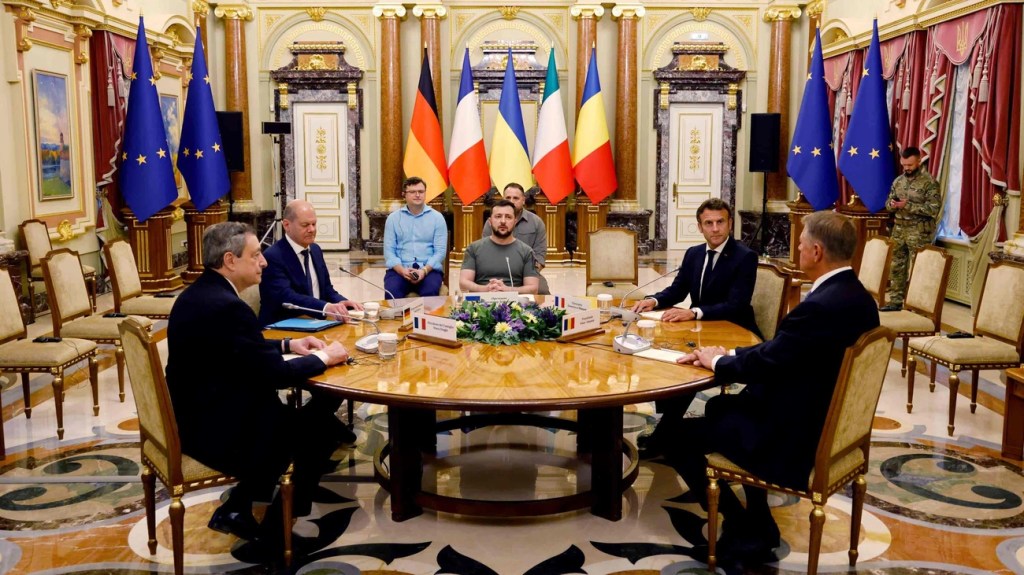
Image Source: The New York Times
Some critics claim that European support for Ukraine has been inconsistent. While the timing of military aid may have affected the conflict, it is important to separate the aid schedule from events on the battlefield. The pattern of delayed and limited support has raised questions about Europe’s devotion to peace. (Haesebrouck, 2024, pp. 1-20)
Some believe that European support for Ukraine, including military aid and funding, has contributed to the prolongation of the conflict rather than focusing on peace. (EU Member State Support to Ukraine, 2024, pp. 1-20)
Scholarly analyses have documented that European military aid to Ukraine was initially limited in both range and timing, with significant categories of advanced weaponry delivered only after notable delays (Haesebrouck, 2024). This pattern of slow response has drawn criticism for undermining Ukraine’s defensive capabilities at crucial stages of the conflict (EU Member State Support to Ukraine, 2024, pp. 1-20). For instance, Germany and the United Kingdom each allocated less than 0.2% of their GDP annually to Ukraine’s defense—a figure comparable to Germany’s national expenditure on outdoor recreation (Haesebrouck, 2024). Essential equipment, including ATACMS missiles, Leopard 2 tanks, F-16 jets, and Patriot missile systems, was delivered only at later stages, thereby limiting its potential impact on the conflict’s early phases [4].
The numbers tell a shocking story. Europe’s largest economies—Germany and the UK—have committed less than 0.2% of their GDP annually to Ukraine’s defense [4]. France, Italy, and Spain can’t even reach 0.1% [4]. The Baltics, Poland, and Finland contribute much more in relation to their size [4].
Some commentators argue that the limited support from Europe has allowed Ukraine to continue fighting but not to achieve a decisive victory. This situation may benefit Moscow, as Russia’s larger reserves of manpower and weapons are better suited for an extended conflict [4]. As the war continues, Ukraine’s position may become more difficult. (European Union overcomes threat of Hungary veto to seal $54 billion aid package for Ukraine, 2024)
There is criticism that European leaders focus more on public statements than on delivering considerable support. Some argue that their actions have not matched their promises to stand with Ukraine. (Leaders’ statement on Ukraine, 2025)
A strategic question arises: Is it wiser to end a war quickly or ensure it never reignites? This dilemma calls for thorough consideration, as the White House has expressed wariness toward European intentions: “The Europeans don’t get to prolong this war… expecting America to bear the cost.”
President Trump spoke plainly about European leaders. “I think they’re weak,” he stated [1]. “I also think that they want to be so politically correct. I think they don’t know what to do. Europe doesn’t know what to do” [1].
The Trump administration‘s patience with these fair-weather allies has run out. Senior White House officials grow frustrated with European leaders who privately push Zelensky toward unrealistic peace deals [1]. A top official explained: “Getting to a deal is an art of the possible. But some of the Europeans continue to operate in a fairy-tale land that ignores the fact that it takes two to tango” [1].
Trump cut through the nonsense: “They talk, but they don’t produce, and the war just keeps going on and on” [1]. He saw what patriots knew all along—Russia stands “obviously in a stronger position than Ukraine” [1]. European leaders met with Zelensky and rejected any territorial concessions instead of facing reality [1].
The White House believes Europe actively undermines Trump’s quest for peace by convincing Zelensky to reject reasonable terms [1]. Their frustration grows with European countries that expect America to carry the full cost while refusing to pay their fair share [1].
Some observers point out a contradiction: while the UK and France support sending peacekeeping troops and advanced weapons to Ukraine, they have also continued to purchase Russian oil, which Trump criticized during a recent call. (Walker, 2026)
The UK and France’s public commitment of troops toward policing a potential peace deal in Ukraine shows peak European hypocrisy [6]. This so-called “Coalition of the Willing” comprises about 30 countries (excluding the United States) that claim to provide security guarantees to Ukraine [3]. Their flawed plan establishes military hubs across Ukraine to impede forthcoming invasions [3], despite Moscow’s clear warnings about foreign troops becoming legitimate combat targets [3].
Their grand plan has five components:
- A multinational force to strengthen Ukraine’s military
- US-led ceasefire monitoring
- Support for Ukraine’s military
- Commitments to back Kyiv against future Russian attacks
- Long-term defense cooperation [3]
The proposed Anglo-French peacekeeping force would consist of about 15,000 troops, which some experts say is insufficient compared to the estimated 64,000 needed to effectively secure Ukraine’s territory. The British Army can only provide 7,500 personnel. Former UK Security Minister Tom Tugendhat commented, “You’ve got hundreds of miles to guard. The maths just don’t add up.”
Trump exposed their energy hypocrisy most effectively. European countries lecture others about Russian sanctions while buying massive amounts of Russian fuel through intermediaries [4]. Brussels postponed new sanctions right after Trump called them out [4].
The first half of 2024 saw G7 and EU countries buy approximately €1.8 billion worth of fuel made from Russian crude through Turkish refineries [7]. This “refining loophole” lets them legally buy Russian products processed in third countries [7]. The UK, US, and EU increased these purchases by 62% compared to last year [7].
Europe’s pipeline deliveries dropped, but its Russian liquefied natural gas purchases jumped from 12 to 20 billion cubic meters. French, Spanish, and Belgian ports received most shipments. Europe paid Russia an estimated $8.40 billion for liquefied natural gas in 2025. According to a report by the Energy Information Administration, Europe continued such purchases, eliciting inquiries about its allegiance to sanctions.
Some critics contend that European countries’ continued purchase of Russian energy while simultaneously sanctioning Moscow may have inadvertently prolonged the conflict by providing Russia with considerable revenue streams to support its war effort. For example, reports indicate that in the first half of 2024, G7 and EU nations collectively spent approximately €1.8 billion on fuel derived from Russian crude oil processed through third countries, despite stated intentions to limit Russian income (Reuters, 2024). This ongoing financial relationship has triggered debate about whether such energy purchases undermine the effectiveness of sanctions and extend Russia’s capacity to sustain military operations. In contrast, proponents of President Trump’s approach contend that his policy of direct negotiations with both Russia and Ukraine represents a more practicable pathway to peace by engaging the primary actors in the conflict and seeking to reduce economic entanglements that could prolong hostilities.
III. Trump’s America First Masterstroke
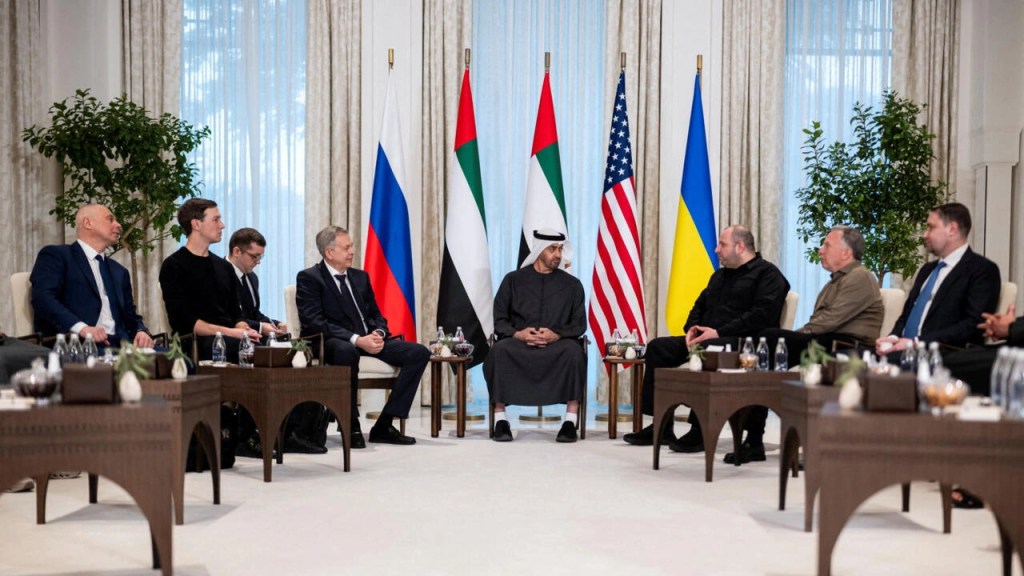
Image Source: France 24
President Trump has assumed a prominent role in the Ukraine peace process and implemented reductions in foreign expenditures. Although his leadership method contrasts with that of his predecessors, it remains necessary to acknowledge that Moscow continues to exercise considerable influence owing to its energy resources, strategic geographic position, and nuclear power. Reflecting on these factors is important for developing an objective understanding of the current balance of power.
President Trump has helped broker direct trilateral negotiations between the U.S., Ukraine, and Russia in Abu Dhabi, following his earlier attempts to secure a temporary truce during the cold weather.
Ukrainian, Russian, and American negotiators met face-to-face in Abu Dhabi for the first time since Russia’s invasion [1]. This historic breakthrough happened because Trump made it happen. The UAE Foreign Ministry confirmed these talks started on January 23rd and would last two days [1]. Trump’s direct approach succeeded where others failed.
These talks stand out because they’re the first genuine trilateral discussions between Ukraine and Russia directly, not through middlemen [1]. Trump’s trusted team, including Steve Witkoff and Jared Kushner, sits at the table to protect America’s interests [1].
Trump showed real leadership before these landmark talks. Ukraine faced record cold temperatures that left many without heat or electricity. He called Putin directly and asked him to halt strikes on Kyiv for a week [9]. Putin agreed right away, which shows that strength commands respect [9]. Trump recalled, “A lot of people said, ‘ Don’t waste that call. You’re not going to get that. And he did it” [10].
Steve Witkoff, the President’s envoy, reported major progress: “We have a security protocol agreement that’s largely finished. A prosperity agreement that’s largely finished” [10]. This shows what success looks like!
After the temporary truce ended, Russia resumed attacks on Kyiv’s energy infrastructure. Supporters of Trump’s approach argue that continued diplomacy is the best way to move forward. (Trump pauses US military aid to Ukraine while pressuring Zelenskyy to move toward a quick end to the war, 2025)
Russia went back to testing Ukraine’s resolve after the temporary truce. They launched over 100 drones and missile strikes at energy infrastructure [10]. More than 1,300 apartment buildings lost heat during freezing temperatures [10]. Trump’s diplomatic approach remains the only way to end this suffering.
A Ukrainian power executive warned that the situation was close to a “humanitarian catastrophe” [6]. Supporters of Trump argue that his recent efforts have produced more progress toward peace than previous European initiatives. (Lutsevych & Giles, 2025)
The Abu Dhabi talks focused on “The possible parameters for ending the war” [1]. Ukrainian President Zelensky valued “American monitoring and oversight of the process” [1]. He knows U.S. leadership brings results.
The Kremlin called the meetings with Trump’s team “exceptionally substantive, constructive, and extremely frank and trusting” [6]. Putin’s foreign policy advisor said the conversation was “beneficial in every way for both our and the American sides” [6]. This mutual respect shows how well Trump’s direct diplomacy works.
The new approach intends to avoid deploying more U.S. troops overseas and to limit spending absent clear results. Security guarantees will be established on American terms, and support for European border forces will be gradually reduced. Funds previously used for these projects will be redirected to infrastructure projects in the United States, such as bridge and road repairs, to benefit American communities. For example, part of the redirected funds could be used to revitalize the aging highways across the Midwest or to upgrade water infrastructure in cities like Flint, Michigan. Additionally, these monies could support the construction of new schools and community centers in underserved areas, enhancing both education and local economic growth. This strategy is intended to protect taxpayer money and prioritize domestic needs.
Trump delivers on his America First promise by stopping the endless spending on European defense. The White House will phase out support programs that helped prepare armies in Eastern Europe to defend against possible Russian offensives [3]. This includes hundreds of millions previously given to countries near Russia [3].
Trump’s administration crafts security guarantees for Ukraine that put American interests first:
- A 15-year security guarantee framework that Ukraine’s president called essential to ending the war [11]
- Trump might prolong these guarantees beyond 15 years if needed [11]
- Protection systems that Witkoff calls “meant to deter any attacks” and “as strong as anyone has ever seen” [12]
- Guarantees that would receive formal approval by the U.S. Congress [11]
This approach corresponds with Trump’s view that European nations rely too much on America’s military and financial support [3]. His second term will lead Europe to increase military spending and assume greater responsibility for its own security [3].
European leaders now accept Trump’s position about protecting their nations [3]. The Baltic states and Poland promise to spend 5% of GDP on defense starting in 2026 [13]. Trump’s tough approach gets results.
Trump explained, “The action has been coordinated with European countries in line with the Executive Order and the President’s longstanding emphasis on ensuring Europe takes more responsibility for its own defense” [4]. America First means America leads through strength, not endless handouts.
IV. Zelensky’s Stalling vs. Putin’s Openness
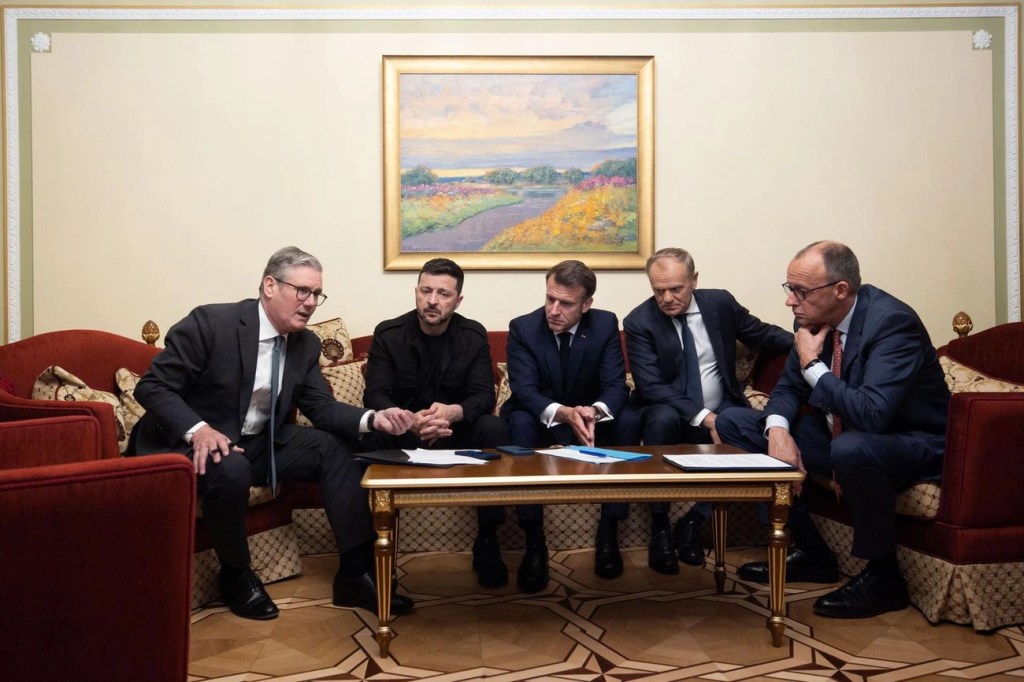
Image Source: Le Monde
During negotiations, Zelensky has maintained a steady stance, while Putin has shown some willingness to consider Trump’s peace framework. This difference in approach has become more noticeable in recent talks.
Zelensky has been criticized for insisting on strong security guarantees and for being inflexible on territorial issues, which some say prolong the conflict. During recent negotiations, President Zelensky explicitly refused to accept any proposal that would involve ceding control over regions such as Donetsk and Luhansk, maintaining his stance on the non-negotiability of these territories. He stated, ‘Our borders and sovereignty are non-negotiable,’ which has reinforced perceptions of his inflexibility in reaching a compromise. Some observers argue that this steadfast position is a major factor in the ongoing stalemate.
Some argue that Zelensky’s firm position on not recognizing any occupied territories as Russian, which he called his absolute “red line” [14], makes it difficult to reach a peace agreement. According to the RAND Corporation, Russia captured 12 to 17 square kilometers of Ukrainian territory per day throughout 2025 [15].
Zelensky has stated that “the most important thing is that any steps we take must be backed by strong security guarantees” [6]. Some believe that these demands for NATO-style protection could complicate peace efforts and run counter to the America First approach.
Ukrainian officials believe Russia is merely “manipulating the peace process” and called negotiations a “game from their side” [7]. A Ukrainian source didn’t mince words, saying they “expect another trick” [7]—a clear attempt to justify more fighting at America’s expense.
Zelensky’s real priorities became obvious when he sought to expand Ukraine’s future military without limits. He rejected reasonable caps that would keep the region stable [16]. His team keeps adding complex demands:
- Insisting on the return of Ukrainian children from Russia
- Demanding that Russia cease its “Russification” policies in contested regions
- Attempting to secure control of the Zaporizhzhia Nuclear Power Plant [7]
Zelensky has rejected holding a referendum or elections in disputed territories [6]. Certain critics claim that this decision may limit options for resolving the conflict. Meanwhile, Putin has kept consistent demands, while Zelensky’s positions have changed during negotiations. (Putin’s uncompromising demands emerge after the latest round of Russia-Ukraine peace talks, 2025)
Russia’s consistent stance: open to good-faith talks if West respects Moscow’s security red lines—no strategic defeat via Ukraine.
Putin has stayed remarkably consistent throughout the conflict. His basic conditions haven’t changed: Ukraine must leave the four regions Russia annexed (Donetsk, Luhansk, Kherson, and Zaporizhzhia), accept neutrality, and give up NATO membership [17]. To sharpen strategic perception, it’s important to differentiate these demands. Among these conditions, Putin may consider acceptance of neutrality a core demand, the relinquishment of NATO ambitions a secondary one, and the Ukrainian withdrawal from annexed regions a potentially symbolic move that could serve as a bargaining chip. These terms seemed extreme at first, but turned out to be real negotiating positions—unlike Zelensky’s moving targets.
Putin welcomed Trump’s proposed framework, saying that U.S. proposals “could be the basis of a resolution of the conflict” [1]. His foreign policy aide, Yuri Ushakov, confirmed that “not all, but many provisions of this (U.S.) plan seem quite acceptable to us” [1]. This new approach shows that Putin sees Trump’s strength and practical thinking.
Putin backed his words with action by implementing a 30-hour Easter truce earlier this year [14]. Both sides pointed fingers at violations, but this move showed Russia wanted peaceful solutions. Putin said it clearly: “We have a positive attitude towards a ceasefire” [14], signifying his genuine interest in a diplomatic solution.
The Kremlin described Europe’s recent change in approach as a “positive evolution,” suggesting that Russia recognizes the impact of Trump’s involvement in the negotiations.
The Kremlin saw Europe’s desperate about-face as proof that Trump’s approach works. After years of European warmongering, their sudden willingness to dialogue represents what Moscow calls a “positive evolution” in attitudes toward Russia. Putin recognizes how Trump’s leadership has altered the diplomatic map. (Kremlin welcomes European U-turn on talks with Russia, 2026)
The difference between European and American approaches stands out clearly. The Kremlin rejected Europe’s counter-proposal to Trump’s peace plan as “completely unconstructive” and unsuitable [1]. Ushakov didn’t hold back: “at first glance, it is completely unconstructive; it does not suit us” [18].
Putin’s view of Trump’s initiative tells a different story. His advisor confirmed that Steve Witkoff, Trump’s envoy, will visit Moscow again after already having “three long meetings with Putin on prospects for ending the war” [19]. Trump’s team got what Kremlin officials called an “exceptionally substantive, constructive, and extremely frank and trusting” reception.
The best proof of progress? President Trump announced on Truth Social that both sides would “hopefully” make a deal this week [19]. Zelensky admitted that U.S.-led talks in Abu Dhabi were “constructive” and that a 20-point plan to end the war is “90% ready” [19].
As trilateral negotiations continue in Abu Dhabi, some observers believe that Trump’s recent efforts have produced more progress toward peace than previous European initiatives. Zelensky remains firm on his demands, and European leaders are working to maintain their influence, while the America First approach focuses on reducing American involvement and seeking a resolution.
V. Victory Lap: Why Trump Wins & Europe Loses
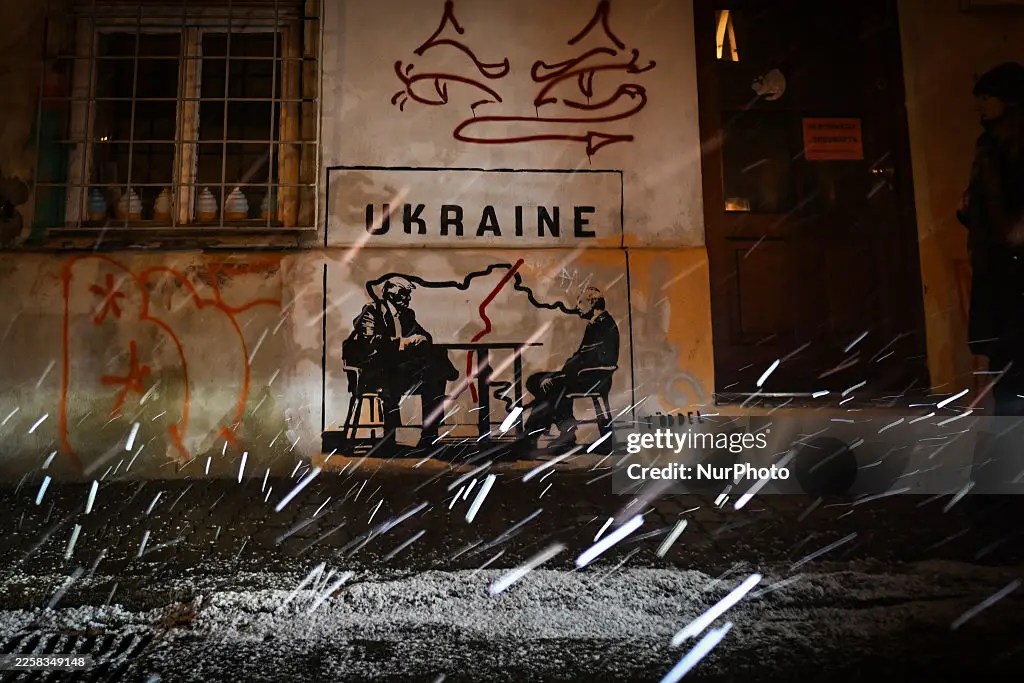
Image Credit: NurPhoto / Contributor / Getty https://www.gettyimages.com/detail/news-photo/mural-titled-divided-by-oligarchy-by-anonymous-norwegian-news-photo/2258349148
Trump’s leadership in the Ukraine peace process has shifted the balance of influence, with the United States taking a more prominent role. European leaders now face a reduced role in these negotiations.
A win worth celebrating: Trump’s leadership shows Europe’s powerlessness—Kaja Kallas admits EU has “nothing to offer” Russia.
EU’s top diplomat Kaja Kallas made a remarkable confession that MAGA patriots knew all along: “I don’t think there is anything that we can offer to Russia” [20]. This severe admission of weakness comes after European leaders wasted billions on empty promises.
European leaders have expressed concern that the U.S. might reach a peace deal with Ukraine without their involvement [9]. Their efforts to participate in the negotiations reflect their desire to stay involved in the process.
“It is clear that any deal behind our backs will not work,” Kallas claimed anxiously [9]. Yet this is exactly what’s happening! The EU’s foreign policy chief admitted they have no sway with Russia, which proves Trump was right from the start.
Analysts have argued that Trump’s peace strategy has demonstrated tangible results. For example, one expert observed, “The winner here is the US as an arbiter. Russia gets maybe 70 percent of what it wants, Ukraine gets other things which, considering the situation on the battlefield, it could be worse” [21]. According to these assessments, European leaders have struggled to confront the difficult realities reflected in these outcomes.
Supporters of Trump believe that his efforts are leading to real progress toward peace in Ukraine. They argue that, after years of American involvement, the focus is now on U.S. interests. (Hartig, 2025)
The mural tells all: Trump and Putin at the table, deciding on American terms—Europe dreads this future.
A mural in Krakow depicting Trump and Putin dividing Ukraine has ignited debate. Some interpret it as a symbol of European leaders’ worries about losing influence in global decision-making.
Trump ally Pete Hegseth praised this approach, saying the world should feel lucky to have “the best negotiator on the planet, bringing two sides together in finding a negotiated peace” [9]. No wonder Europeans panic—they know they don’t matter anymore.
This goes beyond Ukraine. Trump said European leaders “talk, but they don’t produce” and warned many European countries “will not be viable countries any longer” if they stay on their current path [10]. He praised only Hungary and Poland for doing a “very good job,” while describing most European nations as “decaying” [10].
To summarize, the America First approach seeks peace through strong leadership and by focusing on domestic priorities rather than continued foreign spending.
To support this vision and guarantee the continued success of American leadership, readers are encouraged to actively participate in discussions about America’s role on the global stage. Share the America First message with your community, and let’s advocate for our nation’s interests together. Your support is important to forming policies that support American values and security.
Dutch Defense Minister Ruben Brekelmans showed Europe’s desperation: “There is no option to not be at the table, because we are very important in the actual implementation of those security guarantees” [9]. They need Trump’s deal because they have no other choice.
Kallas’s words say it all – any peace must focus on “what Russia, the aggressor, must do” [22]. Yet she lacks the power to make this happen. Trump alone has the strength and skill to get real concessions from Putin.
The current approach stresses American leadership and a concentration on strength. Supporters believe that Trump’s peace plan denotes a shift away from extensive spending in Ukraine and a return to a more assertive U.S. role.
.
VI. ll towards Action & & Share Magnet
Americans nationwide are witnessing a historic moment. Trump’s “peace through strength” principle [23] demonstrates leadership that focuses on American interests.
The main message is that Trump is taking a strong stance in global politics while stressing American values. Supporters are encouraged to express their views on American leadership.
Trump’s strategic decision to send Patriot missiles to Ukraine [23] while championing peace talks t talks demonstrates his m m negotiation expertise. His candid assessment of Putin reflects this approach: “We get a lot of bullshit thrown at us by Putin… He’s very nice all the time, but it turns out to be meaningless” [24].
Some analysts believe that Trump’s approach has highlighted weaknesses in Europe’s strategy. An economic expert commented that Trump “exposes Europe’s delusions, its lack of strategic thinking and action. This is why the Europeans hate him so much” [25]. (Trump’s Ukraine plan destroys alliance with Europe, 2025)
That famous “Make Everything Great Again” mural depicting Trump and Putin kissing seems prophetic now. The artist said it best: “We are in a sort of Cold War again, and America may get a president who will want to be friends with Russia” [26].
Supporters are encouraged to read the full article, share it on social media platforms, and comment with their thoughts on European funding and Trump’s peace strategy. What are your views on Trump’s approach to peace and Europe’s involvement in the ongoing negotiations? Do you see a different way forward, or do you believe the current strategies will lead to a resolution? The message stresses supporting American leadership and domestic interests.
Key Takeaways
• Trump’s direct diplomacy shows results: Historic trilateral talks in Abu Dhabi between the US, Ukraine, and Russia represent the first face-to-face negotiations since the invasion began.
• European leaders scramble for relevance: After years of military aid to Ukraine, EU officials admit they have “nothing to offer” Russia in peace negotiations.
• America First emphasizes U.S. interests: Trump is phasing out European defense funding while developing security guarantees designed primarily to advance American national objectives.
• Territorial concessions remain the key sticking point: Despite progress on the protocols, a f, the fundamental issue of disputed Ukrainian territories continues to challenge negotiators.
• Peace through strength replaces endless funding: The administration shifts from open-ended financial commitments to time-limited agreements with clear American oversight and exit strategies.
FAQs
Q1. What is the current status of peace negotiations for Ukraine? According to recent reports, trilateral talks between the US, Ukraine, and Russia have taken place in Abu Dhabi. These represent the first face-to-face negotiations between all parties since Russia’s invasion began. Progress has reportedly been made on the protocols, but territorial disputes remain a key sticking point.
Q2. How has the US’s approach to Ukraine aid changed? The current US administration has shifted away from open-ended financial commitments to Ukraine. Instead, it is focusing on time-limited security guarantees and agreements with clear American oversight. There are also plans to phase out some funding for European defense programs.
Q3. What role are European leaders playing in Ukraine peace efforts? European leaders appear to have diminished influence in the current peace process. Some European officials have admitted they have little leverage with Russia in negotiations. There are reports of European leaders scrambling to gain relevance and a seat at the negotiating table.
Q4. What are the main obstacles to reaching a peace agreement? The issue of territorial concessions remains the main challenge. Ukraine. Ukraine has expressed reluctance to cede any occupied territories, while Russia maintains its claims on annexed regions. Agreeing on security guarantees that satisfy both sides has also proven difficult.
Q5. How have Russia’s tactics changed during peace negotiations? While participating in peace talks, Russia has continued military pressure on Ukraine, including strikes on energy infrastructure. However, there have been periods of reduced attacks, such as a temporary Easter truce. Russian leaders have shown openne openness to some US proposals while rejecting European counteroffers.
References
[1] – https://www.reuters.com/world/europe/kremlin-says-european-counter-proposal-ukraine-peace-does-not-work-russia-2025-11-24/
[2] – https://www.atlanticcouncil.org/blogs/new-atlanticist/experts-react/what-europeans-think-of-trumps-approach-to-ukraine-and-what-they-might-do-next/
[3] – https://www.nytimes.com/2025/09/04/us/politics/trump-europe-russia-security.html
[4] – https://www.reuters.com/world/us-cut-some-security-funds-countries-bordering-russia-sources-say-2025-09-04/
[5] – https://www.bbc.com/news/articles/c5y20p7xweko
[6] – https://www.kyivpost.com/post/67026
[7] – https://www.ukrainianworldcongress.org/the-independent-ukraine-defines-red-lines-in-negotiations-with-russia/
[8] – https://www.bbc.com/news/articles/cddg7100ym2o
[9] – https://www.reuters.com/world/europeans-seek-ukraine-talks-role-after-trump-calls-putin-2025-02-13/
[10] – https://www.bbc.com/news/articles/clydlwldkvko
[11] – https://www.pbs.org/newshour/politics/u-s-offers-ukraine-15-year-security-guarantee-as-part-of-peace-plan-zelenskyy-says
[12] – https://www.nbcnews.com/world/europe/us-backs-security-guarantees-ukraine-summit-kyivs-allies-paris-rcna252737
[13] – https://www.military.com/daily-news/2025/09/06/european-countries-near-russia-puzzled-us-plans-cut-defense-funding.html
[14] – https://www.cnn.com/2025/04/22/europe/putin-russia-ukraine-talks-hnk-intl
[15] – https://www.hindustantimes.com/world-news/us-news/kremlin-says-peace-prospects-not-improved-by-europe-ukraine-changes-to-us-proposals-101766352255458.html
[16] – https://kyivindependent.com/ukraine-reiterates-its-red-lines-amid-discussions-on-military-size-territory/
[17] – https://www.huri.harvard.edu/june-peace-summit
[18] – https://kyivindependent.com/kremlin-rejects-european-counter-proposal-to-us-peace-plan/
[19] – https://www.nbcnews.com/news/world/russia-ukraine-war-putin-ceasefire-talks-zelenskyy-trump-peace-deal-rcna202303
[20] – https://www.facebook.com/euronews/videos/kallas-i-dont-think-there-is-anything-that-we-can-offer-to-russia/1215095737378230/
[21] – https://www.aljazeera.com/news/2025/11/21/trumps-28-point-ukraine-plan-in-full-what-it-means-could-it-work
[22] – https://www.politico.eu/article/russia-must-make-concrete-concessions-for-any-peace-deal-eu-kaja-kallas-says/
[23] – https://www.nbcwashington.com/news/national-international/trump-envoy-arrives-in-kyiv-as-u-s-pledges-patriot-missiles-to-ukraine/3955705/
[24] – https://www.theguardian.com/world/2025/jul/08/ukraine-russia-us-military-weapons-pentagon
[25] – https://www.wsws.org/en/articles/2025/12/04/qkpj-d04.html
[26] – https://en.wikipedia.org/wiki/Make_Everything_Great_Again
[27] – (February 12, 2025). European leaders seek a seat in Ukraine peace talks after Trump calls Putin. Al Jazeera. https://www.aljazeera.com/news/2025/2/13/european-leaders-seek-seat-in-ukraine-peace-talks-after-trump-calls-putin
[28] – Haesebrouck, T. (2024). EU Member State Support to Ukraine. Foreign Policy Analysis 20(2), pp. 1-20. https://doi.org/10.1093/fpa/orae005
[29] – (2024). EU Member State Support to Ukraine. Foreign Policy Analysis 20(2), pp. 1-20. https://doi.org/10.1093/fpa/orae005
[30] – (January 31, 2024). European Union overcomes Hungary’s veto threat to seal $54 billion aid package for Ukraine. Associated Press. https://apnews.com/article/6d0f11bc16b4b21073f92925de2046e4
[31] – (2025). Leaders’ statement on Ukraine. European Council. https://www.consilium.europa.eu/en/press/press-releases/2025/12/15/leaders-statement-on-ukraine/
[32] – Walker, S. (January 5, 2026). UK and France ‘ready to deploy troops’ to Ukraine after ceasefire. The Guardian. https://www.theguardian.com/world/2026/jan/06/uk-france-ready-to-deploy-troops-to-ukraine-after-ceasefire/
[33] – (March 2, 2025). Trump pauses US military aid to Ukraine while pressuring Zelenskyy to move toward a quick end to the war. Associated Press. https://apnews.com/article/a15a459c9a3a393d040478ebbe250a9e
[34] – Lutsevych, O. & Giles, K. (November 21, 2025). Trump pressures Ukraine to accept peace deal: Early analysis from Chatham House experts. Chatham House. https://www.chathamhouse.org/2025/11/trump-pressures-ukraine-accept-peace-deal-early-analysis-chatham-house-experts
[35] – (June 2, 2025). Putin’s uncompromising demands emerge after the latest round of Russia-Ukraine peace talks. KSAT. https://www.ksat.com/news/world/2025/06/03/putins-uncompromising-demands-emerge-after-the-latest-round-of-russia-ukraine-peace-talks/
[36] – (January 15, 2026). Kremlin welcomes European U-turn on talks with Russia. RT Russia & Former Soviet Union. https://www.rt.com/russia/631046-kremlin-europe-u-turn-talks/
[37] – Hartig, H. (August 13, 2025). The majority of Americans lack confidence in Trump on the Russia-Ukraine war, ahead of his Alaska meeting with Putin. Pew Research Center. https://www.pewresearch.org/short-reads/2025/08/14/americans-views-of-trumps-decision-making-us-policy-toward-russia-ukraine-war/
[38] – (December 3, 2025). Trump’s Ukraine plan destroys the alliance with Europe. World Socialist Web Site. https://www.wsws.org/en/articles/2025/12/04/qkpj-d04.html
[40] – https://www.rt.com/news/631916-macron-putin-eu-talks/
[41] – https://www.dw.com/en/ukraine-updates-strikes-on-kyiv-resume-amid-deep-cold/live-75777840
[42] – https://www.dw.com/en/ukraine-overnight-russian-attack-cuts-off-power-in-kyiv/a-75574053
[43] – https://www.dw.com/en/elon-musks-starlink-talks-with-italy-raise-concerns/a-71251164
[44] – https://www.dw.com/en/russia-instrumentalizing-soviets-victory-over-nazi-germany/a-72465426
[45] – https://www.dw.com/en/germany-arrests-5-over-violation-of-russia-sanctions/a-75775387
[47] – https://www.dw.com/en/mariupol-theater-ukraine-russia-reopens/a-75337653
[48] – https://www.dw.com/en/too-close-to-trump-fifa-president-infantino-under-pressure/a-75089873
[49] – https://www.dw.com/en/european-union-eu/t-17440066
[50] – https://www.dw.com/en/russias-war-in-ukraine/t-60931789
[51] – https://www.dw.com/en/moscow/t-19038132
[52] – https://www.dw.com/en/ukraine/t-17295382
[53] – https://www.dw.com/en/volodymyr-zelenskyy/t-65603134
[54] – https://www.dw.com/en/france/t-19065412
[55] – https://www.dw.com/en/united-states-of-america/t-19065189
[56] – https://www.dw.com/en/vladimir-putin/t-17449200
[57] – https://www.dw.com/en/emmanuel-macron/t-38774225
[59] – https://www.rt.com/russia/624112-zelensky-europe-trump-talks/
[60] – https://www.cbsnews.com/news/trump-committed-to-russia-ukraine-peace-deal/
[61] – https://www.ft.com/content/0157d5f9-1b27-4d6c-b44e-f0a77da59b5d
[62] – https://www.infowars.com/posts/india-offers-to-slash-tariffs-to-make-new-deal-with-trump
[63] – https://www.infowars.com/posts/trump-says-tariffs-could-replace-federal-income-tax
[66] – https://www.rt.com/russia/624112-zelensky-europe-trump-talks/
[69] – https://www.rt.com/news/624116-nato-ukraine-long-range-missiles/
[70] – https://www.rt.com/russia/624112-zelensky-europe-trump-talks/
[71] – https://www.rt.com/russia/624112-zelensky-europe-trump-talks/
[72] – https://www.infowars.com/posts/uk-and-france-plan-to-send-30000-peacekeepers-to-ukraine-report
[74] – https://www.rt.com/russia/624112-zelensky-europe-trump-talks/
[77] – https://www.washingtonpost.com/world/2025/11/21/ukraine-war-peace-proposal-witkoff-thanksgiving/
[79] – https://x.com/ZelenskyyUa/status/1998843094637384037
[85] – https://www.infowars.com/posts/zelensky-flip-flops-will-not-cede-territory-to-russia
[86] – https://www.cnn.com/2025/12/09/europe/ukraine-elections-zelensky-trump-russia-proposal-intl-latam
[87] – https://www.infowars.com/posts/zelensky-claims-hell-allow-elections-but-theres-a-catch
[90] – https://x.com/ZelenskyyUa/status/1999165880970682596?s=20
[91] – https://x.com/SecGenNATO
[92] – https://x.com/jaredkushner
[93] – https://x.com/SteveWitkoff
[94] – https://x.com/SecWar
[95] – https://x.com/SecRubio
[96] – https://x.com/ZelenskyyUa/status/1999175251528241369?s=20
[97] – https://www.infowars.com/posts/european-leaders-conspire-to-undermine-trumps-plan-to-end-ukraine-war
[99] – https://x.com/ZelenskyyUa/status/1999165880970682596?s=20
[101] – https://x.com/ZelenskyyUa/status/1999175251528241369?s=20
[102] – https://www.infowars.com/posts/white-house-europeans-trying-to-prolong-ukraine-war
[106] – https://www.nytimes.com/2025/07/01/world/europe/putin-macron-ukraine-iran.html
[108] – https://www.infowars.com/posts/france-green-lights-ukrainian-missile-strikes-deep-within-russia
[110] – http://en.kremlin.ru/events/president/news/77337
[111] – https://www.borna.news/en/news/3924/france-wants-eu-to-talk-to-russia
[112] – https://menafn.com/1110682757/France-Urges-EU-to-Reopen-Talks-with-Russia
[113] – https://menafn.com/1110682757/France-Urges-EU-to-Reopen-Talks-with-Russia
[114] – https://menafn.com/
[115] – https://www.rt.com/news/629852-france-russia-potential-talks/
[116] – https://www.rt.com/news/630768-eu-russia-talks-meloni/
[117] – https://www.rt.com/news/630760-trump-putin-wants-peace-deal-ukraine/
[118] – https://www.rt.com/news/631014-germany-merz-calls-for-dialogue-russia/
[119] – https://www.rt.com/russia/631046-kremlin-europe-u-turn-talks/
[120] – https://www.rt.com/news/631075-eu-russia-about-turn/
[121] – https://www.rt.com/news/631782-kallas-russia-negotiations-pressure/
[113] – https://www.infowars.com/posts/us-to-mediate-another-peace-negotiation-between-ukraine-russia
[116] – https://x.com/ZelenskyyUa/status/2018034289699369285?s=20
[117] – https://x.com/ZelenskyyUa/status/2018034289699369285?s=20
[118] – https://x.com/ZelenskyyUa/status/2018357001479147856?s=20
[119] – https://x.com/ZelenskyyUa/status/2018357001479147856?s=20
[120] – https://x.com/ZelenskyyUa/status/2017906757511659583?s=20
[121] – https://x.com/ZelenskyyUa/status/2017906757511659583?s=20
[125] – https://www.infowars.com/posts/zelensky-floats-his-20-point-peace-proposal-russia-has-yet-to-respond
[126] – https://www.infowars.com/posts/watch-live-zelensky-meeting-with-trump-peace-plan-on-the-table
[129] – https://www.infowars.com/posts/russia-ukraine-fail-to-make-major-progress-at-peace-talks-in-turkey
[131] – https://www.infowars.com/posts/trump-again-says-he-will-walk-away-from-ukraine-peace-talks
[132] – https://www.infowars.com/posts/washington-wants-direct-ukraine-russia-peace-negotiations
[133] – https://www.infowars.com/posts/ukraine-drone-bombs-sleeping-civilians-in-moscow-as-kiev-talks-peace
[143] – https://www.foxnews.com/politics/trump-whispers-crazy-putin-deal-theory-macron-hot-mic-moment
 Critical Thinking Dispatch
Leave a comment