
by – L. Richardson
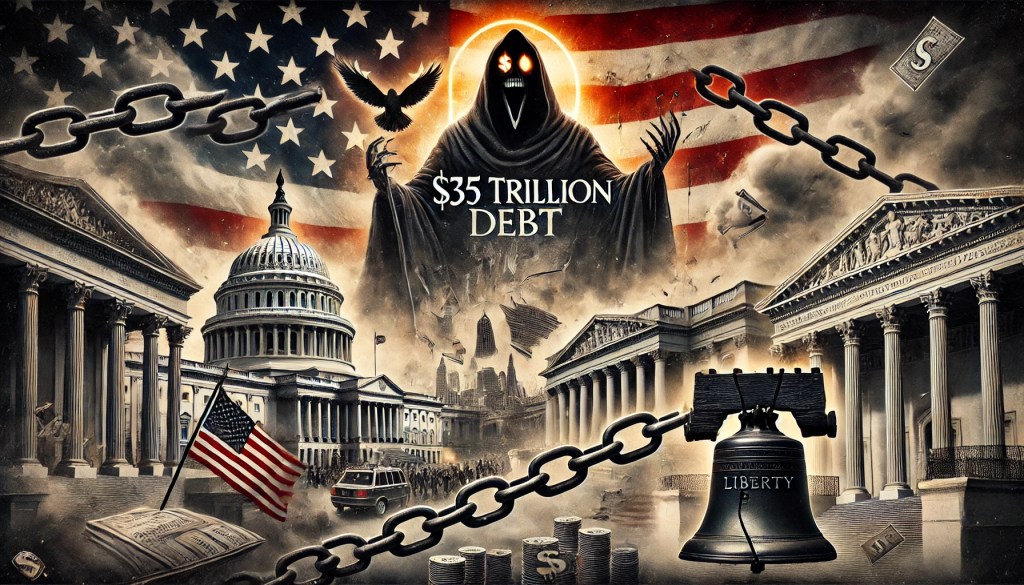
America’s economic crisis has reached a staggering milestone, with the national debt soaring to an unprecedented 35 trillion dollars. This is not just a number on a balance sheet; it’s a dire threat to our nation’s future and the personal liberty of its citizens. Washington’s silence, particularly from President Biden and Democratic leaders, is a clear sign of the urgent need for action against this pattern of fiscal irresponsibility that impacts every American.
While deeply concerning, this economic crisis also presents an opportunity to advocate for a society with minimal government interference and maximum liberty. The growing influence of Bernie Sanders’ New Left agenda and the dangerous embrace of Modern Monetary Theory are pushing the nation toward economic disaster. However, there is hope in the expanding liberty movement, which champions sound money principles, rejects government overreach, and promotes the benefits of a free market. To ensure economic sanity and forge a path to maximum liberty, Americans must educate themselves on fiat money, central bank money printing, and dollar devaluation risks.
The Current Crisis
The United States faces an unprecedented economic crisis as the national debt has skyrocketed to a staggering $35 trillion 1. This alarming milestone was reached just seven months after hitting $34 trillion 2, highlighting the rapid acceleration of debt accumulation. In perspective, the national debt crossed the $1 trillion mark in October 1981, nearly 200 years after the Constitution’s ratification 2. This exponential growth is evident when comparing the current debt to historical figures: in 2008, it stood at $9.2 trillion, and in 1981, it had just reached $1 trillion 3. The debt-to-GDP ratio has now climbed to 98%, signaling a potentially unsustainable fiscal path 3.
Government Silence and Fiscal Irresponsibility
The deafening silence from President Biden, Vice President Harris, and Democratic leaders on the national debt crisis is alarming. This lack of response reflects a broader pattern of fiscal irresponsibility in Washington. Past attempts to address the deficit, such as the Tea Party movement, have proven illusory. The 1990s saw budget “surpluses” achieved through accounting gimmicks rather than genuine fiscal discipline 4. This crisis demands leadership and honest fiscal practices, yet our current leaders must prepare to respond to today’s challenges 5. The contrast with past administrations, like Clinton’s, which achieved a balanced budget, is stark 6.
Influence of the New Left and Modern Monetary Theory
The rise of Bernie Sanders has marked a significant shift in Democratic fiscal policy. His progressive agenda, including universal healthcare and higher taxes on the wealthy, has energized young leftists 7. This new left movement, often associated with progressive and socialist policies, has embraced Modern Monetary Theory (MMT). This radical approach, which has gained traction in recent years, claims the government can spend without limits 8. MMT proponents argue that central banks can print money without triggering dangerous inflation, ignoring historical evidence of hyperinflation 8 [15]. This dangerous embrace of MMT by Democrats poses significant risks, as interest on the national debt could soon consume a large portion of federal revenue, threatening America’s economic stability and future.
Economic Risks and Dollar Devaluation
The U.S. dollar’s global dominance faces unprecedented challenges. Geopolitical shifts, including the Russia-Ukraine crisis, have reignited concerns about de-dollarization 9. U.S. sanctions on Russia have made some countries wary of greenback dependency 9. A strong dollar, amid rising interest rates, is becoming costly for emerging nations, prompting them to trade in alternative currencies 9. This shift could reshape the global economy and markets, potentially causing the dollar’s value to fall, leading to higher import costs and potential inflation. The impact on U.S. equities could be severe, with adverse effects on returns due to divestment and loss of confidence 9. Additionally, upward pressure on real yields may result from partial divestment of U.S. fixed income by investors 9.
Authoritarianism vs. Liberty
The economic crisis presents a critical juncture for America’s future, potentially leading to increased authoritarianism or enhanced liberty. Global freedom faces dire threats as authoritarian regimes become more effective at circumventing norms and institutions meant to support fundamental liberties 10. The deployment of wartime language during crises has historically been used to restrict individual freedoms 11. However, this crisis also offers an opportunity for a society with minimal government interference. Countries with higher levels of economic freedom tend to have better educational outcomes, higher literacy rates, and cleaner environments 12 [16]. The path forward requires vigilance and education on sound financial principles to preserve liberty and combat authoritarian tendencies.
Call to Action
Educate and Empower
Patriots, it’s time to take action. We must persist in educating the public about the risks of fiat money, expanding government power, and escalating government debt 13. The free market, personal liberty, and sound money are cornerstones of a prosperous society 13. Organizations like The Fund for American Studies and the Foundation for Teaching Economics offer vital youth outreach and education programs 14. These initiatives serve as an “alternative university,” providing students with opportunities to learn about freedom and free markets 14.
Engagement
Engage with this content and share the message with those around you 13. Visit RonPaulInstitute.org for more insights into America’s economic crisis and the path to liberty 13. Remember, freedom is never more than one generation away from extinction 14 [17]. By staying informed and vigilant, we can fight for a future where liberty and economic sanity reign supreme. Together, we can turn this crisis into an opportunity for increased freedom and prosperity, inspiring hope for a brighter future.
Conclusion
The economic crisis facing America, marked by the staggering $35 trillion national debt, is a stark reminder of the urgent need for fiscal responsibility and preserving individual liberty [18]. This milestone highlights the dangers of unchecked government spending and the potential threats to economic stability and personal freedom. The embrace of the Modern Monetary Theory by some political factions further underscores the risks to America’s financial future and the importance of adhering to sound economic principles.
As we navigate these challenging times, it’s crucial to remain vigilant and informed about the impacts of government policies on our economic well-being and personal liberties. By educating ourselves and others on the benefits of free markets, sound money, and limited government intervention, we can work towards a future that prioritizes individual freedom and fiscal sanity. To get more insights into America’s economic crisis and the path to liberty, check out RonPaulInstitute.org here. Together, we can turn this crisis into an opportunity to build a stronger, more accessible society that values economic responsibility and personal autonomy [19].
FAQs
1. What is the current state of economic freedom in the United States?
The United States has an economic freedom score of 70.1, ranking it the 25th freest economy according to the 2024 Index of Economic Freedom. This represents a slight decline of 0.5 points from the previous year. In the Americas region, the U.S. ranks third among 32 countries.
2. What are the fundamental economic freedoms enjoyed by Americans?
Americans enjoy several essential economic freedoms, which include personal choice, the ability to engage in voluntary exchanges within markets, the right to enter and compete in markets, and the protection of individuals and their property against aggression.
3. What economic challenges did the United States face following the American Revolution?
After the American Revolution, the United States experienced a severe economic depression during 1784 and 1785. Many states sought to generate revenue by imposing duties on goods from other states, leading to increased financial strain. For example, Connecticut imposed higher duties on goods from Massachusetts than those from Britain. During this period, the national government was also nearing bankruptcy.
4. What fueled the economic growth of America before the Civil War?
Before the Civil War, the primary drivers of American economic growth included the adoption of steam power in factories and the continued use of water as a primary industrial power source. The era saw significant developments in transportation, such as the construction of roads and canals, the introduction of steamboats, and the early development of railroads, all of which significantly contributed to economic expansion throughout the 19th century.
References
[1] – https://www.pgpf.org/infographic/the-national-debt-is-now-more-than-35-trillion-what-does-that-mean
[2] – https://www.dailynews.com/2024/08/05/america-reaches-a-sad-milestone-with-35-trillion-national-debt/
[3] – https://www.visualcapitalist.com/u-s-national-debt-reaches-35-trillion/
[7] – https://www.investopedia.com/articles/investing/110915/review-bernie-sanders-economic-policies.asp
[8] – https://www.nationalaffairs.com/publications/detail/the-weakness-of-modern-monetary-theory
[9] – https://www.jpmorgan.com/insights/global-research/currencies/de-dollarization
[10] – https://freedomhouse.org/report/freedom-world/2022/global-expansion-authoritarian-rule
[13] – https://fee.org/
[14] – https://www.donorstrust.org/developing-libertys-next-generation/
[15] – The Weakness of Modern Monetary Theory | National Affairs. https://www.nationalaffairs.com/publications/detail/the-weakness-of-modern-monetary-theory
[16] – Economic Freedom: Definition, Pros, Cons & Examples. https://boycewire.com/economic-freedom/
[17] – Is it time to give up on California? Possibly – The Thinking Conservative. https://www.thethinkingconservative.com/is-it-time-to-give-up-on-california-possibly/
[18] – U.S. Congress temporarily averts debt default, but at what cost? – Dimsum Daily. https://www.dimsumdaily.hk/u-s-congress-temporarily-averts-debt-default-but-at-what-cost/
[19] – Two Minute Reads from CEO Lynn Jurich | Sunrun. https://www.sunrun.com/quick-reads-from-ceo/modern-technology-offers-everything-we-need-to-avoid
[20] – https://www.infowars.com/posts/ron-paul-america-reaches-a-sad-milestone/
[21] – https://ronpaulinstitute.org/america-reaches-a-sad-milestone/
 Critical Thinking Dispatch
Leave a comment