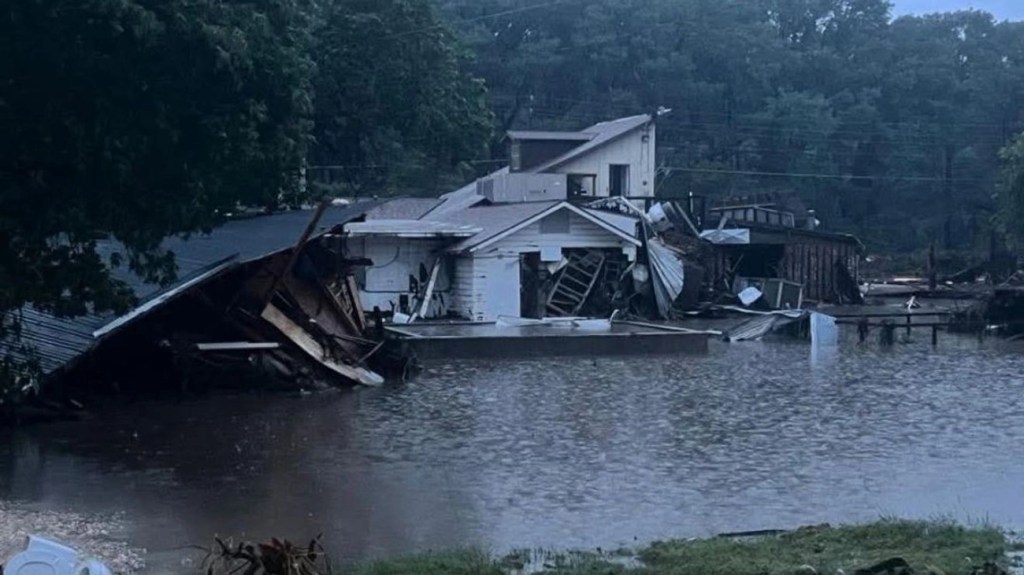
Image Source: KOMO News
by L Richardson
The Texas Flood Apocalypse has unleashed biblical destruction across Kerr County, transforming the peaceful Hill Country into a watery graveyard on July 4. In just six hours, approximately 130–255 mm (5–10 inches) of rain pummeled the region, causing the Guadalupe River to surge with terrifying speed. As the waters rose, the Guadalupe River at Hunt reached a height of over 7.3 m (24 feet)1, marking its second-highest recorded level in history and surpassing the devastating 1987 flood2.
Meanwhile, the disaster continues to unfold with deadly consequences. By early morning, the river had risen 20 feet in approximately an hour and a half, reaching a staggering 29.45 feet as it swelled to nearly 8.6 meters (28.21 feet) by 04:30 local time. Most importantly, this isn’t merely a natural disaster—it’s a catastrophic system failure that has already claimed multiple lives. In fact, over 7 inches of rain fell in just 4.5 hours, from 1 to 5:30 am, overwhelming communities and prompting officials to issue a disaster declaration for Kerr County. Consequently, the flooding forced Kerrville to cancel its planned Fourth on the River event2 as the waters continued to rise. The most heart-wrenching development, however, is the report of 23 little girls missing from a summer camp after the massive storm created mega floods—innocent victims of a disaster that exposes the woefully inadequate preparation and warning systems meant to protect Texas citizens.
The Deluge of Destruction
A wall of water descended upon the Texas Hill Country during the early hours of July 4, unleashing meteorological chaos of historic proportions. Approximately 130-255 mm (5-10 inches) of rain pummeled the region in just six hours, with some areas reporting up to 15 inches overnight. This torrential rainfall prompted the National Weather Service to issue multiple Flash Flood Warnings across Bandera and Kerr Counties at 1:14 am, quickly escalating to a Flash Flood Emergency with a catastrophic damage threat by 4:03 am.
The meteorological chaos: 15 inches of rain overnight, triggering Flash Flood Emergencies across the Hill Country.
The deluge transformed normally peaceful waterways into raging torrents with frightening speed. By 4:03 am, the situation had deteriorated so drastically that the NWS issued a Flash Flood Emergency, their most severe flood alert, warning of a “catastrophic damage threat.” Rainfall intensified throughout the early morning hours, with reports indicating over 7 inches falling in just 4.5 hours between 1:00 and 5:30 am. Law enforcement began reporting flooded low-water crossings throughout Kerr County as the disaster unfolded. At the same time, San Saba County dispatch noted flooding that prevented firefighters from reaching a house fire.
The Guadalupe River’s record-breaking rise to 45 feet, dwarfing the 1987 flood, with Llano and San Saba Rivers also breaking records.
The Guadalupe River’s transformation was both swift and deadly. Water level monitoring reveals the terrifying timeline:
- 2:20 am: River begins rising, reaching 8.54 feet
- 2:50 am: Approaches minor flood stage at 9.15 feet
- 3:20 am: Hits moderate flooding at 13.99 feet
- 4:20 am: Reaches major flood status at 24.7 feet
- 4:35 am: Continues climbing to 29.45 feet
The river ultimately surged to approximately 45 feet, according to Acting Governor Dan Patrick, dwarfing the infamous 1987 flood that claimed 10 young lives. This marks the second-highest recorded level in history for the Guadalupe at Hunt.
The catastrophe wasn’t limited to the Guadalupe. The Llano River at Mason reached 29.68 feet by 2:26 pm, exceeding central flood stage by 2 feet. Simultaneously, the San Saba River near Brady shattered its previous record of 29.1 feet, cresting at 29.65 feet. These concurrent flooding events overwhelmed entire communities and rescue systems throughout the region.
Shocking visuals: homes, RVs, and a Kerrville gazebo were swept away in 40 minutes, according to KXAN and KSAT reports.
The visual evidence of destruction emerged as daylight revealed the full scope of the disaster. Shocking footage captured homes being swept completely downstream with occupants still inside. At 7:58 am, Kerrville officials reported multiple street closures, including Francisco Lemos, G Street, Schreiner Street at Town Creek, and all crossings on Town Creek, as water overwhelmed the city’s infrastructure.
Perhaps most disturbing were the reports from Hunt at 5:44 am, where Emergency Management officials documented ongoing high-water rescues along the Guadalupe River and South Fork of the Guadalupe River. Desperate residents were found trapped on rooftops awaiting evacuation. Photojournalist Alex Gamez captured footage of homes along Riverside Drive near Kerrville completely submerged. At the same time, videos showed a Kerrville gazebo vanishing beneath the water in approximately 40 minutes.
The destruction extended to Ingram’s RV parks, which were decimated, with entire families swept downstream, their trailers transformed into twisted debris. All this occurred while many Texans were arriving in the Hill Country for Fourth of July celebrations, unaware of the danger rapidly developing.
The ongoing threat: The NWS forecasts more rain and flooding in the areas of Comfort and Spring Branch.
Despite the devastation already witnessed, the threat remains far from over. At 11:44 am, KXAN meteorologists reported that the Llano River near Mason continued to rise rapidly, approaching 16 feet. Flash Flood Warnings remained in effect for portions of San Saba, Mason, and Gillespie County. [5]
At 10:30 am, KXAN Meteorologist Tommy House warned that although high-resolution models showed the heaviest rain potentially winding down before 3 pm, the river flooding threat would remain throughout the night. The deadly flood wave continued moving downstream, threatening communities such as Comfort and Spring Branch.
Particularly concerning is the forecast for the Guadalupe River at Spring Branch, expected to reach 37 feet. The Llano River at Llano was projected to peak at 7 pm, nearly reaching central flood stage at 22.8 feet. At the same time, the San Saba River at San Saba was forecast to hit 32.6 feet by 7 am the following day.
Acting Governor Dan Patrick’s 3:30 pm statement emphasized the continued danger: “There is an ongoing threat for possible flash flooding from San Antonio to Waco for the next 24 to 48 hours in addition to the continued risks in west and central Texas.”
The Texas Flood Apocalypse serves as a stark reminder of the Hill Country’s natural vulnerability to flash flooding and the danger of meteorological conditions that can transform peaceful waterways into deadly torrents with little warning. With water continuing to flow downstream and additional rainfall possible, communities must remain vigilant as rescue operations continue and the full extent of this catastrophic event unfolds.
Camp Mystic Nightmare: A Heart-Wrenching Tragedy

Image Source: Reach FM
Panic and desperation grip hundreds of families as Camp Mystic becomes the epicenter of a heart-wrenching search operation. The picturesque Christian summer camp, usually a haven for young girls seeking adventure and spiritual growth, now stands as ground zero for one of the most devastating aspects of the Texas Flood Apocalypse.
The horror at Camp Mystic: 23 girls missing from a camp of 750, possibly stranded or swept away.
Camp Mystic, located along the now-raging Guadalupe River, houses approximately 750 young female campers who were asleep when the floodwaters began their swift and merciless rise. As daylight revealed the catastrophe’s scope, camp officials made the horrifying discovery that 23 girls remained unaccounted for. Acting Governor Dan Patrick confirmed this nightmare scenario during his 3:30 pm briefing, explaining that “missing” could mean different things – the children might be stranded on higher ground, clinging to trees, or swept downstream by the raging currents.
The timeline of terror unfolded rapidly. Initially, at 5:44 am, Emergency Management officials reported ongoing high-water rescues along the Guadalupe River and South Fork of the Guadalupe River in Hunt, where Camp Mystic is located. People were found trapped on rooftops awaiting evacuation as the river surged to unprecedented levels.
The camp, which had been full of Independence Day celebration plans, transformed overnight into an emergency evacuation zone. First responders battled treacherous conditions to reach the camp, where rising waters had cut off regular access routes and communication systems had failed. Fourteen helicopters were deployed for the search operation, along with nine rescue teams that included trained swimmers.
Emotional parent reactions: chilling emails from camp officials and desperate pleas from moms like those of Lainey Landry and Janie Hunt.
“If your daughter is missing, we’ve called you.” This chilling message from camp officials arrived in parents’ inboxes early on July 4, triggering waves of panic across Texas and beyond. For parents who hadn’t received calls, temporary relief was overshadowed by the knowledge that other families were living their worst nightmare.
“My daughter Lainey is only nine years old. She’s been looking forward to Camp Mystic all year,” sobbed Melissa Landry at the reunification center established at Ingram Elementary School. “We’ve heard nothing since 2 am when the camp sent an emergency alert. Please, if anyone has seen her…” Her plea trailed off as volunteers guided her toward Red Cross officials.
Equally heartbreaking was James Hunt’s frantic search for his daughter Janie. “She was in Cabin 7, near the riverside,” he explained to emergency workers. “Her counselor managed to call briefly before the lines went down. She said they were moving to higher ground, but then nothing.” Hunt had driven three hours from San Antonio, only to find roads blocked by floodwaters and debris.
The reunification efforts became a central focus as parents converged on both Ingram Elementary School and the local Walmart, designated as gathering points. Red Cross volunteers worked alongside sheriff’s deputies to create a system for matching rescued children with their desperate families. Electronic devices were scarce due to power outages that affected the entire region, forcing officials to rely on paper records and in-person identification.
Other camps (La Junta, Waldemar) reported safety, but Ingram’s RV parks were decimated.
Remarkably, not all camps in the region suffered the same fate. Camp La Junta, another popular summer destination in the Hill Country, reported all campers and staff safe after implementing emergency protocols. Similarly, Camp Waldemar confirmed via emergency satellite communications that their facilities, situated on slightly higher ground, had avoided the worst of the flooding.
This contrast only highlighted the cruel randomness of the disaster’s impact. In the nearby town of Ingram, RV parks filled with Fourth of July vacationers were utterly decimated. Entire families who had arrived for holiday celebrations found themselves swept downstream in their trailers, which were later spotted as twisted metal debris along the riverbanks.
At 10:34 am, the Kerr County Sheriff’s Office announced the establishment of a reunification center at Ingram Elementary School. Additionally, the First United Methodist Church opened its doors at 7:58 am as an emergency shelter for those displaced, including families from the devastated RV parks.
The disaster’s toll on the region’s children has prompted an unprecedented emergency response. Governor Greg Abbott mobilized the National Guard, Texas Department of Public Safety, Texas Parks & Wildlife, and over 400-500 responders to search for the missing. Twelve drones equipped with thermal imaging technology scan areas inaccessible to ground teams, while specialized search dogs work alongside human rescuers.
For the families of the 23 missing Camp Mystic girls, each passing hour brings both hope and dread. As darkness approaches again, rescue officials face the grim reality that time is working against them. Yet the search continues with undiminished urgency, as Texans from across the state volunteer equipment, expertise, and prayers for those caught in the grip of this catastrophic event.
Given these points, the Camp Mystic tragedy is perhaps the most emotionally devastating aspect of the Texas Flood Apocalypse. This disaster has exposed glaring weaknesses in warning systems and emergency preparedness across the region.
System Collapse: Bureaucracy’s Betrayal

Image Source: The Economic Times
Behind the tragic death toll and devastation lies a catastrophic failure of systems meant to protect Texans. As floodwaters recede, officials’ admissions expose how bureaucratic negligence amplified this disaster to apocalyptic proportions.
The lack of flood alert systems, with Mayor Joe Herring admitting Kerrville’s unpreparedness.
“We’ll keep you all updated as much as we can, as fast as we can, but y’all got to understand right now the only concern we have is rescuing everybody and all these kids out here,” stated Kerr County Sheriff Larry Leitha during a 4:14 pm press conference at Kerrville City Hall. This desperate plea came hours after the catastrophe had already claimed at least 13 lives.
Standing alongside Sheriff Leitha, Kerrville Mayor Joe Herring Jr. made the shocking admission that the city lacked adequate flood warning infrastructure. At no point did residents receive emergency alerts before waters surged through their homes. Many families were literally asleep when the deadly wall of water struck, leaving them no chance to evacuate.
Remarkably, the first Flash Flood Warning wasn’t issued until 1:14 am for portions of Bandera and Kerr County, yet by then, the Guadalupe River had already begun its deadly rise. Officials escalated to a Flash Flood Emergency with “catastrophic damage threat” by 4:03 am, long after many victims had already been swept away.
NWS’s failure: underreporting river gages and inability to verify due to safety risks.
The National Weather Service’s monitoring systems collapsed utterly as the disaster unfolded. At 2:33 pm, the NWS confirmed the Kerrville river gage was not reporting correct measurements, meaning all publicly available data severely underreported the actual flood danger. Furthermore, NWS officials admitted they couldn’t even verify the gauge readings “due to safety reasons” – effectively abandoning their core responsibility during the crisis.
This technical failure proved deadly. While officials later determined the Guadalupe River had risen a staggering 26 feet in just 45 minutes, this critical information never reached residents in time. The river’s monitoring timeline reveals the terrifying speed:
- 2:20 am: River begins rising, reaching 8.54 feet
- 4:35 am: Continues climbing to 29.45 feet
Yet throughout this rapid rise, accurate river level data weren’t being properly transmitted or communicated to endangered communities.
Infrastructure breakdowns: Kerrville’s water plant is offline, forcing water rationing pleas.
Beyond the immediate flood response, fundamental infrastructure crumbled under pressure. At 5:02 pm, the city of Kerrville announced its surface water treatment plant had gone completely offline, compromising water service to thousands of residents still reeling from the disaster. Officials made an urgent plea for residents to “minimize non-essential water usage,” stating they were “not currently at a critical stage” but warned citizens to “be prepared in case the situation worsens.”
This breakdown in basic utilities compounded the tragedy for survivors, many of whom are now homeless and desperate for clean water. First responders faced the impossible task of conducting rescues while essential services faltered.
Critically, Kerrville’s emergency response capabilities were overwhelmed within hours. By 8:41 am, the First United Methodist Church at 321 Thompson Drive had been hastily converted into an emergency shelter as official facilities proved inadequate. Kerrville Fire Department personnel were forced to personally monitor nursing homes along the Guadalupe River, stretching limited resources even thinner.
Historical negligence: ignoring 1987’s lessons from the Pot O’ Gold camp tragedy.
Perhaps most damning is how this catastrophe echoes the 1987 flood that claimed 10 young lives at the Pot O’ Gold camp along the same river. Despite that historical warning, officials failed to implement adequate early warning systems or enforce stricter building codes in flood-prone areas along the Guadalupe.
The current disaster surpasses that of the previous tragedy, with the Guadalupe River reaching its second-highest recorded level in history. Acting Governor Dan Patrick confirmed during his 3:30 pm briefing that “there is an ongoing threat for possible flash flooding from San Antonio to Waco for the next 24 to 48 hours in addition to the continued risks in west and central Texas.”
This systemic collapse wasn’t merely a failure of technology but of institutional memory and preparedness. After decades of implementing better warning systems, improved river monitoring, and stricter construction standards in flood-prone areas, the Texas Hill Country remains as vulnerable today as it was nearly 40 years ago, with deadly consequences.
Heroes in the Fray: Texas Fights Back
Amid the catastrophic devastation, Texas has mobilized an unprecedented rescue operation across the flood-ravaged Hill Country. The state’s complete emergency apparatus now converges on Kerr County in a desperate race against time to find survivors and bring relief to shattered communities.
The massive response: Governor Abbott’s deployment of National Guard, Texas DPS, Parks & Wildlife, 14 helicopters, 12 drones, and 400-500 responders.
“Texas is providing all necessary resources to Kerrville, Ingram, Hunt, and the entire Texas Hill Country dealing with these devastating floods,” declared Governor Greg Abbott in an official statement as the disaster unfolded. His decisive action immediately activated the state’s emergency response network, including the Texas Division of Emergency Management (TDEM), the Department of Public Safety (DPS), the Military Department, and the Parks & Wildlife Department.
The scale of this response is genuinely remarkable. Acting Governor Dan Patrick revealed during his 3:30 pm briefing that 14 helicopters now scan the floodwaters from above, while nine rescue teams with trained swimmers navigate the treacherous currents below. An impressive force of between 400 and 500 responders has converged on the disaster zone, supported by 12 drones equipped with advanced search capabilities.
The Texas National Guard’s deployment marks the most significant mobilization for flood response in the state’s recent history. Their specialized high-water vehicles now traverse areas conventional rescue equipment cannot reach, effectively turning the operation into a military-scale mission.
Acting Governor Dan Patrick’s vow to find missing children and President Trump’s pledge of federal aid.
Acting Governor Dan Patrick, visibly moved during his emergency briefing, made a solemn vow to the parents of missing Camp Mystic children: “We’ll do anything humanly possible to find your daughters.” His 3:30 pm statement emphasized the gravity of the ongoing threat, warning that “there is an ongoing threat for possible flash flooding from San Antonio to Waco for the next 24 to 48 hours in addition to the continued risks in west and central Texas.”
Moreover, Patrick confirmed that President Donald Trump had personally reached out with a direct pledge that “federal resources would be provided to the state.” This critical promise of federal assistance opens access to FEMA resources, military assets, and disaster relief funding that Texas desperately needs as the scope of this catastrophe continues expanding.
At 5:22 pm, officials announced that Governor Abbott would hold a press conference in Kerrville at 9 pm, joined by TDEM Chief Nim Kidd, Adjutant General of Texas Major General Thomas Suelzer, and DPS Colonel Freeman Martin to coordinate the next phase of rescue operations.
Local efforts include the Red Cross reunification at Ingram Elementary and Walmart, the Community Foundation’s Flood Relief Fund, and Austin Pets Alive’s animal rescues.
Notably, local heroes have emerged throughout this crisis. The Red Cross established a vital reunification center at Ingram Elementary School (125 Brave Run W) at 10:34 am, creating a central location where desperate families could reconnect with rescued loved ones. A secondary reunification point at the local Walmart provides additional support as the number of displaced residents grows hourly.
The First United Methodist Church (321 Thompson Drive) opened its doors at 8:41 am as an emergency shelter for those who had lost their homes to the raging waters. [6] Church volunteers rapidly transformed the building into a haven for shell-shocked survivors, providing food, clothing, and emotional support.
Responding to the overwhelming financial needs ahead, the Community Foundation of the Texas Hill Country launched its Kerr County Flood Relief Fund Friday evening, establishing a trusted channel for donations earmarked explicitly for “relief and rebuilding efforts.” This fund will provide critical support for residents who lost everything in a matter of minutes.
Even the animal victims found champions in Austin Pets Alive! Issued an urgent appeal for Austin residents to serve as emergency fosters and to help evacuate animals from Kerrville’s overwhelmed shelters. Their swift action has already saved countless pets that were separated from their owners during the chaotic evacuations.
Through this unprecedented catastrophe, I’ve witnessed Texans coming together with remarkable courage and determination. The response demonstrates that even as bureaucratic systems failed, the human will to save lives persists through the heroic actions of professional rescuers and everyday citizens alike.
A Warning Ignored: History Repeats

Image Source: Houston Public Media
History has delivered a devastating verdict across the Texas Hill Country—a prophetic warning, ignored for nearly four decades, has now manifested as a deadly reality. The Texas Flood Apocalypse of July 4, 2025, stands as irrefutable proof that those who forget the past are condemned to relive its horrors—at an even more catastrophic scale.
The Texas Flood Apocalypse and the 1987 flood that killed 10 teens ignored lessons.
Back in 1987, the Guadalupe River unleashed its fury upon the Hill Country, claiming 10 young lives at the Pot O’ Gold summer camp. That tragedy should have served as a watershed moment for flood preparedness throughout the region. Yet instead, critical lessons were brushed aside by bureaucrats and officials who prioritized development over safety.
The current catastrophe utterly dwarfs its predecessor. Whereas the 1987 flood represented a once-in-a-generation event, today’s apocalyptic deluge has shattered records with the Guadalupe River surging an unimaginable 26 feet in just 45 minutes. The river gage at Hunt reached over 29.45 feet—marking the second-highest level ever recorded—as floodwaters transformed vacation paradises into watery graves overnight.
Most alarmingly, this disaster mirrors its predecessor with frightening precision. Once again, it’s children at summer camps bearing the brunt of nature’s wrath. The parallels cannot be dismissed as coincidence; instead, they represent the terrible price of institutional amnesia.
Warn of ongoing risks: NWS predicts more rain, with the Guadalupe River forecast to hit 37 feet downstream.
The nightmare remains far from over. At 10:30 am, KXAN meteorologists warned that even as the heaviest rainfall potentially winds down, the deadly flood wave continues to move downstream, threatening communities like Comfort and Spring Branch. The Guadalupe River at Spring Branch is forecast to reach a staggering 37 feet. In comparison, the Llano River at Llano is projected to peak near central flood stage at 22.8 feet by 7 pm.
Even more concerning, Acting Governor Dan Patrick confirmed at 3:30 pm that “there is an ongoing threat for possible flash flooding from San Antonio to Waco for the next 24 to 48 hours.” This ominous forecast means that communities currently breathing a sigh of relief may soon face their own battle against rising waters.
A wake-up call for systemic reform and preparedness.
This Texas Flood Apocalypse must become the final wake-up call that fundamentally transforms how the state approaches flood risk. For too long, development has proceeded unchecked along waterways with known flood histories. Early warning systems remain inadequate or nonexistent, as admitted by Kerrville’s own mayor. Furthermore, river gages—the very equipment meant to provide life-saving data—failed at the most critical moment.
Unlike the aftermath of the 1987 tragedy, today’s reckoning demands more than empty promises and temporary fixes. The Hill Country’s unique geography creates a natural flood funnel that requires specialized preparation, unlike anywhere else in Texas. Henceforth, every summer camp, RV park, and riverside development must implement mandatory evacuation protocols tied to automated early warning systems.
The bloodshed in Kerr County represents not merely a natural disaster but a man-made catastrophe born of willful neglect. Only through immediate, sweeping reform can we ensure these sacrifices weren’t in vain.
Call to Action: Patriots Rise Up
Now is the moment for patriots to rise up and take decisive action as the Texas Flood Apocalypse continues to unfold. The sheer scale of this disaster demands more than just sympathy—it requires immediate mobilization from every American who values truth and justice.
Pray for the Kerrville, Ingram, Hunt, and Comfort families.
First and foremost, we must lift up the devastated families of Kerr County in prayer. The heart-wrenching reports of 13+ confirmed deaths and 23 missing girls from Camp Mystic represent real families torn apart overnight. Say a prayer specifically for the communities of Kerrville, Ingram, Hunt, and Comfort—towns transformed into disaster zones by the Guadalupe River’s wrath. Remember especially the parents of those missing Camp Mystic girls who received those chilling emails: “If your daughter is missing, we’ve called you.”
donations to the Kerr County Flood Relief Fund and the Red Cross
Beyond prayers, these devastated communities urgently require financial support. The Community Foundation of the Texas Hill Country has launched its Kerr County Flood Relief Fund specifically for “relief and rebuilding efforts.” [7] When donating to the Red Cross, explicitly specify “Guadalupe River flood” or “Texas Flood Apocalypse” to ensure your donation reaches the specific victims rather than being absorbed into general funds.
Austin Pets Alive! has also issued an urgent appeal for emergency foster homes. Countless animals were separated from their owners during evacuations, adding another layer to this humanitarian crisis.
Accountability for systemic failures and support for first responders.
This catastrophe exposes undeniable systemic failures. Where were the early warning systems that could have saved lives? Why did river gages fail at the most critical moment? Hold local officials accountable for these failures while simultaneously supporting the brave 400-500 responders risking everything in rescue operations.
The 14 helicopters and nine rescue teams, each with trained swimmers, deserve our unwavering support as they battle treacherous conditions. These heroes represent the best of Texas while bureaucratic systems crumbled.
Sharing the truth to counter mainstream media’s silence.
Finally, please share this information widely. The mainstream coverage fails to capture the true scope of this biblical-scale disaster. Share these facts with everyone you know—the Guadalupe River rose 26 feet in just 45 minutes, entire families were swept away in RV parks, and children remain missing from Camp Mystic.
This is not merely a weather event but a reckoning that exposes critical failures in our emergency systems. The fight continues, and only through unity and truth can Texans overcome this apocalyptic flood. #TexasStrong #FloodReckoning
Conclusion: The Fight Continues
The Texas Flood Apocalypse unquestionably stands as one of the most devastating natural disasters in Hill Country history. Additionally, this catastrophe exposes the shocking unpreparedness of systems meant to protect innocent lives. Floodwaters rose with terrifying speed – 26 feet in just 45 minutes – transforming peaceful vacation spots into watery graves overnight. Undoubtedly, the heart-wrenching tragedy at Camp Mystic, where 23 young girls remain missing, represents the most devastating aspect of this unfolding nightmare.
Although massive rescue operations continue, with 14 helicopters scanning from above and nine specialized rescue teams braving treacherous waters below, many questions remain unanswered. Why did early warning systems fail so catastrophically? How could river gages malfunction during the most critical moments? Most importantly, why were the painful lessons from the 1987 flood, which claimed 10 young lives along the same river, blatantly ignored for nearly four decades?
Meanwhile, the flood wave continues its deadly march downstream, threatening communities like Comfort and Spring Branch, where the Guadalupe River could reach a staggering 37 feet. Furthermore, Acting Governor Dan Patrick warns of possible flash flooding threats extending from San Antonio to Waco over the next 24 to 48 hours. This nightmare remains far from over.
Patriots across Texas must rise up now! Pray fervently for the devastated families of Kerrville, Ingram, Hunt, and Comfort. Donate generously to the Kerr County Flood Relief Fund to support those who lost everything in a matter of minutes. Above all, demand accountability from officials who failed to implement proper warning systems despite decades of knowledge about the risks.
The Texas Flood Apocalypse has revealed the catastrophic consequences of bureaucratic negligence. Nevertheless, the heroic response from rescuers, volunteers, and everyday Texans demonstrates the unbreakable spirit that will ultimately rebuild these shattered communities. Therefore, we must stand united – supporting victims, honoring heroes, and ensuring that such preventable tragedies never strike again. The fight continues, and only through truth and unity can we overcome this biblical-scale disaster. #TexasStrong #FloodReckoning
Key Takeaways
The Texas Flood Apocalypse reveals critical failures in emergency preparedness while showcasing heroic rescue efforts across the devastated Hill Country region.
• Historic flooding devastated the Texas Hill Country: Guadalupe River surged 26 feet in 45 minutes, reaching 45 feet total—the second-highest level ever recorded, dwarfing the deadly 1987 flood.
• Emergency systems catastrophically failed: River gages malfunctioned during the crisis, early warning systems were inadequate, and officials admitted complete unpreparedness despite decades to learn from past disasters.
• 23 children remain missing from Camp Mystic: The most heartbreaking aspect involves young girls unaccounted for at the summer camp, prompting massive search operations with 14 helicopters and 400+ responders.
• Systemic negligence amplified the tragedy: Officials ignored lessons from the 1987 flood that killed 10 teens, failing to implement proper warning systems or flood preparedness measures along the same dangerous waterway.
• Massive rescue mobilization showcases Texas’s resilience: Governor Abbott deployed the National Guard, specialized rescue teams, and unprecedented resources, while communities rallied with relief funds and volunteer support efforts.
This disaster serves as a stark reminder that natural hazards become human catastrophes when proper preparation and early warning systems are neglected. [8] The ongoing threat to downstream communities, such as Comfort and Spring Branch, underscores the urgent need for comprehensive flood management reform across the Texas Hill Country.
FAQs
Q1. What caused the catastrophic flooding of the Guadalupe River?
The flooding was triggered by hefty rainfall, with up to 15 inches falling overnight in some areas. This deluge overwhelmed the river system, causing the Guadalupe to rise 26 feet in just 45 minutes.
Q2. How many people were affected by the Texas Flood Apocalypse?
The disaster impacted thousands across the Texas Hill Country. At least 13 deaths were confirmed, with 23 girls missing from Camp Mystic. Hundreds of homes and businesses were destroyed, and entire communities were evacuated. [9]
Q3. What emergency response measures were implemented?
The state mobilized an unprecedented rescue operation, including 14 helicopters, 12 drones, and 400-500 responders. The National Guard was deployed, and specialized high-water rescue teams were sent to the most affected areas.
Q4. How does this flood compare to previous disasters in the region?
This flood far surpassed the devastating 1987 flood, with the Guadalupe River reaching its second-highest recorded level in history. The rapid rise of water levels and widespread destruction make it one of the worst natural disasters in Texas Hill Country history.
Q5. What long-term impacts might this disaster have on the affected communities?
The flood is likely to have significant long-term effects, including economic hardship from destroyed businesses and homes, potential changes in flood management policies, and a need for extensive rebuilding of infrastructure. It may also lead to reforms in emergency preparedness and early warning systems for the region.
References
[1] – https://watchers.news/2025/07/04/multiple-fatalities-historic-floods-kerrville-texas/
[3] – https://weather.com/storms/severe/news/2025-07-04-deadly-flash-flood-emergency-central-texas
[4] – https://www.infowars.com/posts/fatalities-in-texas-flooding-amid-catastrophic-july-4th-rainfall
[5] – Stunning rainfall, mudslides, flooding, trash SoCal, but dangerous storm isn’t done yet | American Military News. https://americanmilitarynews.com/2024/02/stunning-rainfall-mudslides-flooding-thrash-socal-but-dangerous-storm-isnt-done-yet/
[6] – David Crowton Obituary July 16, 2021 – Bandera Funeral Chapel. https://www.grimesbandera.com/obituaries/david-crowton
[7] – FHFH Awarded Grant by the Community Foundation of the Texas Hill Country – Farmers and Hunters Feeding the Hungry. https://feedingthehungry.org/fhfh-awarded-grant-by-the-community-foundation-of-the-texas-hill-country/
[8] – Eaton Fire: Lessons Learned and Calls for Urgent Action in the Face of Wildfire Threat | News. https://us.headtopics.com/news/eaton-fire-lessons-learned-and-calls-for-urgent-action-in-65070032
[9] – Larson, S. (2015). City floats latest Cass Blvd. Plan at the community meeting. The Boston Banner, 50(38), 8.
[10] – https://x.com/RealAlexJones/status/1941277550959001710
[11] – https://x.com/RealAlexJones/status/1941279280660709759
[12] – https://www.kxan.com/weather/live-blog-historic-river-flooding-in-the-hill-country/
[13] – https://x.com/GregAbbott_TX/status/1941179943532233172
[14] – https://x.com/hernandoarce/status/1941186912406077662
[15] – https://x.com/SAsportshonk/status/1941162057979875360
[16] – https://x.com/RealAlexJones/status/1941173922524782809
[17] – https://x.com/RevengOfThe4th/status/1941143234622988460
[18] – https://x.com/JulesDiner/status/1941178301969727809
[19] – https://x.com/WeatherMonitors/status/1941152380273463712
[20] – https://www.youtube.com/watch?v=9_YRjLamWRU
[21] – https://x.com/RealAlexJones/status/1941178148454080856

 Critical Thinking Dispatch
Leave a comment