By L. Richardson
Key Takeaways
This article urges America First patriots to act, emphasizing that defending representative self-government is urgently needed to protect our Constitution. It stresses that only grassroots patriots can ensure the consent of the governed decides when America goes to war. Debates about Iran focus on who has authority over Americans’ lives and liberties, not just partisan divisions. The article argues that executive power that bypasses constitutional checks threatens self-rule and challenges patriots to defend constitutional rights, their families’ futures, and the Republic’s survival.
Constitutional violation: The article claims that Trump’s military action against Iran bypassed Congress’s Article I war declaration powers. It notes that congressional attempts to rein in unauthorized action failed in both the Senate (47-53) and House (212-219).
Economic consequences: The article argues that each day of war costs $1 billion, diverting funds from domestic priorities such as infrastructure, healthcare, and education. It states that gas prices increased by 30 cents per gallon due to instability around the Strait of Hormuz, a key global oil route. This price rise raises transportation costs and prices of daily goods for Americans.
• Public opposition: Only 27% of Americans approve of the military action compared to 43% who disapprove, exhibiting marked domestic resistance to the conflict
Regional escalation risks: The article asserts that conflict now involves Lebanon, Syria, Yemen, and Gulf states, increasing the risk of a wider war and causing potential refugee displacement.
Grassroots backlash: Trump’s base fractures as prominent supporters like Tucker Carlson and MTG condemn the military action as betraying “America First” campaign promises. (Kaloi, 2026)
The author argues that recent military actions break with constitutional governance and non-interventionist policies. The article calls on Congress to act quickly to reclaim its war-making authority.
No War With Iran must be our battle cry, fellow patriots. Stand up now—demand Congress halt Trump’s February 28, 2026, “Operation Epic Fury” strikes that betray our Republic, with only about 27 percent of Americans approving and 43 percent disapproving. This is a constitutional crime against Article I, Section 8 war powers. Unchecked strikes risk spiking gas prices, as 20 percent of the world’s oil supply passes through the Strait of Hormuz. Iran is a neutral, sovereign state with over 90 million people and poses no direct threat to our shores (Iran Population (1950-2025), 2025). Globalist forever wars endanger American families due to foreign entanglements. Stand with us to expose this betrayal and prevent economic ruin. Patriot dissent must lead the fight to protect the prosperity of everyday Americans. Act now—raise your voice for our nation.
II. Founders’ Warnings Ignored: The Constitutional Crime of Uncontrolled Empire
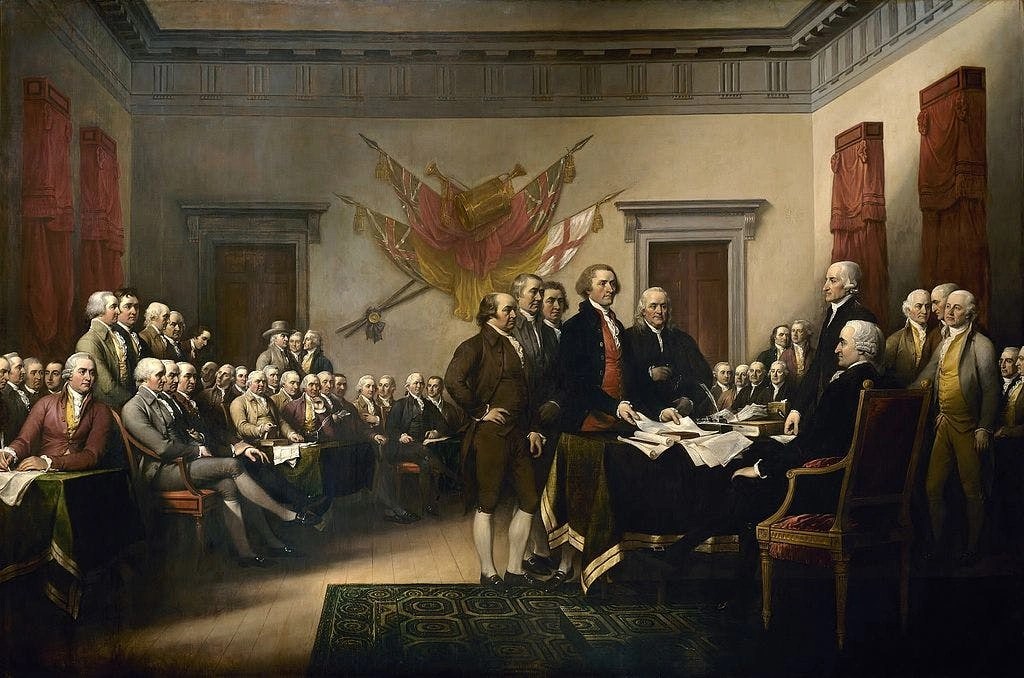
Image Source: The New Republic
The article states that by failing to stop the president’s strikes, Congress weakened its Article I war powers and expanded executive authority. It points out that the House rejected a war powers resolution, 212 to 219, and the Senate did not pass a similar measure, 47 to 53. The text suggests these votes shift the balance away from Congress’s right to declare war and toward unchecked executive action.
The violation: The article claims Congress did not authorize recent military action, noting that both the Senate and the House attempted to limit executive action but failed. This may raise concerns about limits on federal power and Congress’s constitutional role.
The Senate vote split almost perfectly along party lines. Senator Rand Paul of Kentucky was the lone Republican to vote for the war powers resolution [1]. Senator John Fetterman of Pennsylvania was the only Democrat to vote against the measure. He cited his pro-Israel position and his reluctance to limit presidential authority used in defense of that foreign nation [3]. Senator Tim Kaine of Virginia, who co-sponsored the resolution invoking the 1973 War Powers Act, argued that Trump launched an illegal regime-change war without congressional approval [4]. The War Powers Resolution (Northup, 2026) allows any lawmaker to force a vote to withdraw military forces from conflict within 60 to 90 days. This secures a full floor vote in the House within 15 days and the Senate within 10 days of resolution introduction [4].
Democratic leaders flared up in fury over the constitutional overreach. House Democratic leader Hakeem Jeffries stated that w (Jeffries, 2026)hile Iran poses threats to U.S. allies, the administration “must seek authorization for the preemptive use of military force that constitutes an act of war” [4]. Representative Gregory Meeks, top Democrat on the House Foreign (H.Amdt.1223 to H.R.3334 – 118th Congress (2023-2024), 2024) Affairs Committee, declared bluntly: “Donald Trump is not a king, and if he believes the war with Iran is in our national interest, then he must come to Congress and make the case” [1]. Representative Jamie Raskin of Maryland stressed the Founders’ intent and argued they “weren’t fooling around” when they wrote that only Congress can decide matters of war [1].
Article I, Section 8, Clause 11 of the Constitution grants Congress the exclusive authority to declare war [2]. Most scholars agree that Presidents cannot initiate wars on their own, though recent Presidents have used military force without formal declarations, as in the Korean War, Vietnam War, Operation Desert Storm, and the wars in Afghanistan and Iraq [5]. These actions, missing explicit congressional authorization, establish a dangerous precedent that threatens to draw us into another endless conflict [5].
Here’s how the congressional votes broke down:
| Chamber | Vote Result | Key Details |
| Senate | 47-53 (Failed) | Rand Paul (R-KY) only GOP yes; Fetterman (D-PA) only Dem no [1] |
| House | 212-219 (Failed) | GOP majority blocked resolution; Rep. Warren Davidson (R-OH) expected to support [1] |
The War Powers Resolution of 1973 was enacted during the Vietnam War era to reinforce Congress’s constitutional authority over the decision to go to war. It affirms checks already granted under Article I, Section 8 [4]. The President must get a declaration of war or specific authorization from Congress before sending troops overseas, unless the United States or its arm (The War Powers Resolution, 1973)ed forces are attacked [4]. The President can initiate hostilities, but they can last only 60 days and must then end unless Congress authorizes continuation [4]. Administrations have regularly sidestepped these requirements by merely informing, not consulting, Congress—while continuing military operations without proper authorization [4].
Senator Chris Van Hollen, serving (War Powers Resolution: Expedited Procedures in the House and Senate, n.d.) on the Senate Foreign Relations Committee, condemned the operation as an “illegal, regime-change war against Iran” [4]. Democratic Senate leader Chuck Schumer requested immediate briefings on the administration’s plans [4]. Senat (Leader Schumer Demands Immediate Classified Briefing From Trump Administration As Iran Begins Their Counterattacks Targeting American Troops, 2025)or Tim Kaine appeared on CBS’s Face the Nation and stated, “The United States should not be in an offensive war against Iran without a vote of Congress. The Constitution is completely clear on it. And I am so disappointed that the president has acted so prematurely” [4].
Republican defenders countered with historical examples and arguments about executive authority. Senator Lindsey Graham of South Carolina spoke on the Senate floor about scores of military actions taken by past presidents without congressional votes [1]. Senator Markwayne Mullin of Oklahoma argued that Trump properly notified Congress and earned lawmakers’ trust. He pointed out that “Barack Obama dropped 26,000 bombs in at least 7 countries in 2016 without a word from Congress” [1]. Senator Mitch McConnell stated that “the powers of the president for the use of military force, with or without prior congressional approval, are actually well established” [3].
This situation reflects longstanding concerns about foreign entanglements undermining national sovereignty. In his Farewell Address, George Washington advised Americans to avoid lasting alliances that could entangle the nation in costly wars, observing that such conflicts can deplete resources. This perspective remains relevant as demonstrated by recent military engagements and their extensive financial and human costs. Thomas Jefferson echoed this viewpoint, advocating peaceful, honest dealings with other nations while rejecting entangling alliances. For more than a century and a half, the United States adhered to this approach, aside from its alliance with France during the Revolutionary War.
The Founders incorporated safeguards against foreign influence in national leadership, expressing concern that a president could be swayed by outside interests. Professor Stephen Saltzburg of George Washington University Law School notes this as a fundamental risk. Gouverneur Morris, contributor to the Constitution’s Preamble, cited historical examples of such corruption and warned of the dangers. Washington himself advised skepticism toward expecting genuine benefit from other nations, reinforcing the importance of political independence.
Some Americans believe that honoring the Constitution safeguards families and personal liberties. But the risks of uncontrolled war powers reach into our daily lives. If presidents bypass Congress to launch wars at will, every family’s future is put at the mercy of a distant executive decision. Parents worry their sons and daughters could be drafted or sent to fight in wars they never agreed to. Hard-earned savings and jobs could vanish as war budgets exhaust resources from local areas. Many oppose military conscription, fearing forced service in unauthorized wars that tear families apart or leave loved ones with unseen burdens. Beyond the economic toll, activists and everyday people both face the threat of government retaliation: those who speak out may be watched, labeled as unpatriotic, and see their freedoms to protest or organize restricted under the cover of “national security.” If war powers remain unchecked, the right to dissent (Sinnar, 2023, pp. 1-15)ent, to keep families safe, and to protect a stable livelihood could disappear—not in distant legal debates, but in the real and personal crises faced by American households.
We, inheritors of the devotion and endurance that built this Republic, voice concern about the direction of constitutional authority. House Speaker Mike Johnson opposed the war powers resolution and indicated that limiting presidential powers could be problematic during times of conflict [1]. Johnson said, “Congress would vote to tell the commander-in-chief that he was no longer allowed to complete this mission” [1]. However, this debate shows enduring issues concerning the balance between executive power and congressional oversight.
Trump has refused to rule out deploying ground troops and raised fears of drafts ripping families apart while the administration floats vague timelines ranging from four weeks to indefinitely [1]. Senator Andy Kim of New Jersey fumed after the Senate vote: “Senate Republicans once again failed to hold Trump accountable. Today’s vote sends us down a dangerous path into a potentially endless war. The American people don’t want this war. Trump has no plan” [1].
The specter of martial law looms when wars spiral beyond control. Martial law allows the military to replace the civilian government and exercise jurisdiction over civilians in a particular area during emergencies, though the concept lacks an established definition in federal statute [7]. The Supreme Court has never stated whether the federal government has the power to declare martial law or whether the president could do so unilaterally, without congressional authorization [7]. The 1952 Youngstown Sheet & Tube Company v. Sawyer ruling held that when Congress has addressed an issue by statute, the president cannot act against Congress’s will unless the Constitution gives the president “conclusive and preclusive” power over that issue [7].
Congress has enacted detailed laws regulating when and where the military may be used domestically and has “occupied the field” [7]. The Posse Comitatus Act makes it illegal for federal military forces to participate in civilian law enforcement activities unless Congress provides express authorization [7]. A presidential declaration of martial law would violate these restrictions and likely not survive legal challenge, since the Constitution does not grant the president conclusive power over domestic military deployment [7]. The controlling precedent is Youngstown Sheet & Tube Co. v. Sawyer, in which the Supreme Court rejected President Truman’s attempt to seize steel mills during wartime, ruling that the president cannot override congressional will unless granted clear constitutional authority [7]. Yet, history shows presidents have claimed emergency powers at times of crisis: Lincoln famously suspended habeas corpus without prior Congressional approval during the Civil War, and Roosevelt issued Order 9066 placing Japanese Americans into internment camps during World War II [5][7]. The Youngstown case indicates that, even in wartime, executive power is not unlimited. Today, any presidential attempt to impose martial law faces an obvious legal barrier in the absence of congressional backing.
Liberty activists opposing this unconstitutional Iran war risk being labeled “Iranian agents” or terrorist sympathizers and facing military tribunals rather than civilian courts under those circumstances. The War Powers Resolution affirms that “Congress has the sole power to declare war,” yet Trump’s strikes mock this fundamental check [1]. Senator Adam Schiff of California warned ahead of the vote: “I believe the founders’ worst fears have come to pass. Donald Trump has become too fond of going to war, and has done so again without congressional authorization” [3].
Washington’s Farewell Address cautioned against “the accumulation of debt, not only by shunning occasions of expense, but by vigorous exertions in time of peace to discharge the debts” and believed it improper to place “upon posterity the burden which ourselves ought to bear” [6]. Our national debt spirals out of control with no retirement plan, precisely what Washington dreaded [6]. He warned that “permanent, inveterate antipathies against particular nations and passionate attachments for others should be excluded” and noted that “the nation which indulges towards another a habitual hatred or a habitual fondness is in some degree a slave” [6]. This describes our entanglement with Israel and drags us into wars serving foreign interests rather than Ethnic American security.
Washington took a position of neutrality in ongoing European wars and explained he wanted “to gain time for our country to settle and mature its recent institutions, and to progress without interruption to that degree of strength and consistency, which is necessary to give it, humanly speaking, the command of its own fortunes” [6]. We abandoned this wisdom in the twentieth century and engaged in seemingly endless wars that have cost vast sums and innumerable young American lives [6]. The congressional votes blocking war powers resolutions prove that DC elites now serve globalist patrons over the Constitution our Ethnic American forebears defended with blood.
III. Starting Using Predictions to Peril: The Quagmire Unfolds, Echoing Iraq’s Ghosts
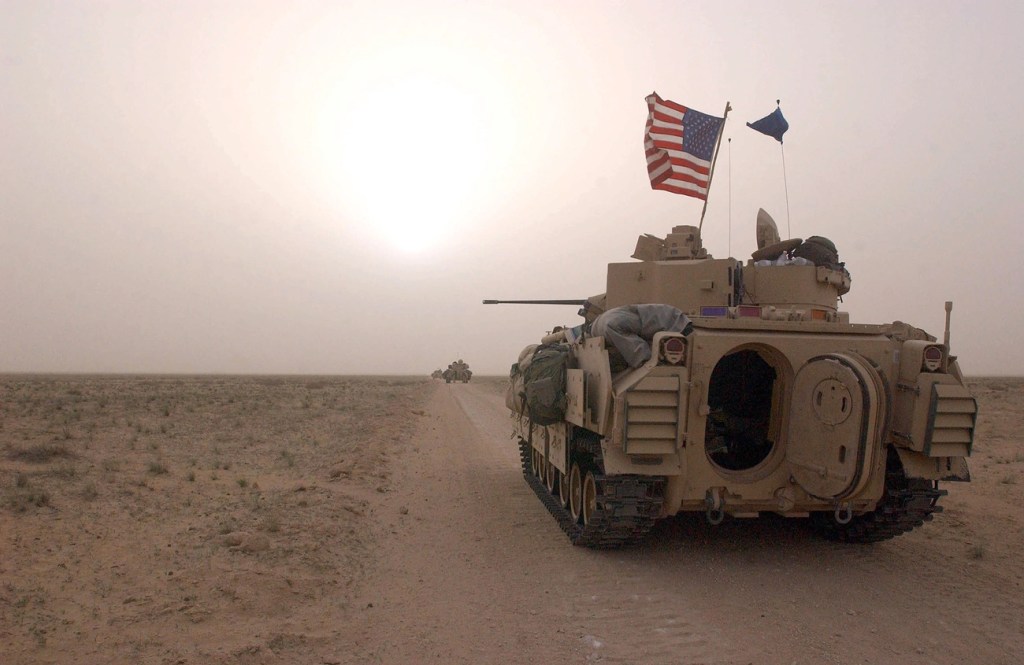
Image Source: Military Times
original analysis: Author predicted 2023-2025 escalations (Gaza trap, multi-front wars) – now reality with Lebanon, Syria, Houthis firing back, Russia/China arming proxies (Wikipedia, ISW reports). But Iran neutral: No nukes confirmed (IAEA), just a regime minding its mountains – why our fight?
Predictions warned us, yet DC elites ignored every red flag. The Gaza trap materialized exactly as forecast and dragged our Republic into a widening multi-front nightmare that serves foreign interests over Ethnic American security. Israel’s military operations killed more than 44,000 Palestinians and wounded 104,000 since October 7, 2023, according to Gaza’s Ministry of Health [3]. Nearly all Palestinians faced forcible displacement, many multiple times, with over 1.4 million forced to flee Rafah alone when Israeli forces attacked that May 2024 [3]. Israeli attacks destroyed or damaged 63 percent of Gaza’s buildings and rendered vast territories uninhabitable [3]. More than 87 percent of schools and all universities were destroyed or damaged, killing over 10,000 students and 441 educational staff [3]. Almost 84 percent of health facilities were destroyed or damaged [3].
This carnage sparked precisely the regional escalation that turned a localized conflict into the powder keg now threatening Ethnic American blood. Israel escalated airstrikes against Lebanon in September 2024, following attacks using booby-trapped pagers and walkie-talkies that killed at least 32 people and wounded more than 3,250 [3]. From October 7, 2023, to mid-November 2024, conflict-related deaths reached 3,445 with 14,600 wounded, most occurring after mid-September [3]. Since October 7, 2023, Hezbollah, Iran, the Houthis, and Palestinian armed groups launched 28,000 rockets, missiles, and drone attacks, mostly intercepted, killing at least 29 civilians as of mid-October [3].
Israel’s Gaza offensive pushed total Palestinian deaths past 65,000 by September 2025, when Israeli forces launched operations to take over Gaza City [8]. The expanded military campaign triggered famine conditions, with the Integrated Food Security Phase Classification confirming famine occurring and projecting spread to Deir al-Balah and Khan Younis governorates [8]. Less than 35 percent of the 2,000 metric tons of food supplies required daily to meet basic humanitarian needs entered the Gaza Strip since July 20, 2025, when regular food cargo uplifts resumed [8]. Violence intensified correspondingly, where 186 Palestinians and 16 Israelis died in conflict-related incidents through September 2025 [8].
Lebanon bore catastrophic destruction as Hezbollah, long considered the jewel in Iran’s proxy network crown, faced years of Israeli assault that diminished its capabilities [9]. The predominantly Shiite Islamist group lost its longtime leader, Hassan Nasrallah, during an Israeli airstrike [9]. Iraqi militias grouped under the Popular Mobilization Forces umbrella, technically part of the Iraqi armed forces but receiving aid and training from Iran’s Islamic Revolutionary Guard Corps, positioned themselves for potential confrontation [9]. The Houthis, who seized control of the capital Sanaa and large portions of northern Yemen during the 2014 civil war, launched drone and missile attacks against Israel and vessels [9].
Yet here’s the rub: Iran acts as a neutral sovereign minding its mountains and poses no direct threat to our shores. The International Atomic Energy Agency reported Iran maintains a stockpile of 440.9 kilograms of uranium enriched up to 60 percent purity [1]. IAEA director general Rafael Grossi warned this stockpile could allow Iran to build as many as 10 nuclear bombs should it decide to arm its program [1]. But Iran has not allowed the United Nations nuclear agency access to its nuclear facilities, bombed by Israel and the United States during the 12-day war in June 2025 [1]. The IAEA stressed it “cannot verify whether Iran has suspended all enrichment-related activities” or determine “the size of Iran’s uranium stockpile at the affected nuclear facilities” [1]. Iran insists its program remains peaceful, while the IAEA and Western nations claim Tehran had an organized nuclear weapons program up until 2003 [1].
Without confirmed weaponization, why bleed Irish-German-Italian Ethnic American stock for Persian sands? Russia and China recognized this vulnerability and moved quickly to arm Iran for the showdown that the DC elites engineered. Tehran finalized a major agreement with Russia valued at nearly $584 million in December 2025, focused on strengthening air defense capacities [10]. The deal has large quantities of portable air defense systems and thousands of associated missiles designed to counter aircraft, drones, and low-altitude threats [10]. Russia agreed to deliver 500 launcher units and 2,500 9M336 missiles of the 9K336 Verba shoulder-fired anti-aircraft system across three batches during 2027-2029 [10]. China entered negotiations for supplying advanced CM-302 supersonic anti-ship cruise missiles, the export version of the YJ-12 [10]. These systems travel at supersonic speeds and can hit targets up to 290 kilometers away, posing a threat to warships and shipping [10].
Detailed risks: A Hormuz blockade could spike gas to $10 per gallon (USA Today, The Hill) and plunge us into occupation hell like Iraq or Afghanistan (original info, Brookings). For the average American commuter driving 1,000 miles per month in a standard sedan, that would mean $200 extra out of pocket every single month just for getting to work and errands. Families with two vehicles may see their monthly fuel bill shoot up by $400, on top of all other inflation. (GasBuddy: Yearly Average Gas Prices to Fall Below $3 in 2026, 2026) No decapitation “win” awaits; chaos breeds insurgency, balkanization, and a new catalyst for global conflict.
Yet, patriots are not powerless on the brink of economic crisis. Take practical steps to prepare and resist. Support local energy initiatives by carpooling, forming community ride-shares, or switching to local fuel cooperatives if available. Organize bulk fuel purchases within your community to negotiate better prices. Actively participate in local town hall meetings or city councils to demand short-term assistance measures, such as temporary transit subsidies or lifting regulations on community food production. Build mutual aid networks for sharing transportation and supplies, so vulnerable families aren’t left alone to face price shocks. Finally, connect with other activists to coordinate pressure on lawmakers for energy policy improvements and robust relief for working Americans. Together, these actions help blunt the worst effects and keep America First communities resilient.
The economic devastation now unfolding confirms every anti-war warning. Oil prices rose sharply as disruptions to tanker traffic through the Strait of Hormuz raised uncertainty about global supply [6]. U.S. oil traded 8.40 percent higher at $72.63 per barrel, while international standard Brent was up 8.5 percent at $79.13 per barrel [6]. The strait at the southern end of the Persian Gulf handles 20 percent of the world’s oil supply [6]. Tanker traffic dropped sharply as satellite navigation systems faced disruption [2]. Iran threatened to “set fire” to ships passing through the channel [5]. QatarEnergy halted liquefied natural gas production after its facilities were attacked, removing one of the world’s top suppliers from the market [6]. Natural gas prices rose more than 40 percent [2].
The national average for a gallon of regular gasoline went up by more than 5 cents to $2.98, according to AAA [6]. Prices jumped 6 cents to $2.99 subsequently [2]. A sustained rise of $15 per barrel could add 0.5 percentage points to consumer prices [6]. Crude price increases are reflected in pump prices within 20 days, with a $ 10-per-barrel increase resulting in a roughly 25-cent-per-gallon increase [2]. Analysts warned that additional direct attacks on energy infrastructure could push oil prices past $80 per barrel, potentially to $90 and beyond [6].
Iran showed key Gulf energy infrastructure sits within its reach when it attacked the Ras Tanura refinery and forced the immediate shutdown of an Aramco facility that processes hundreds of thousands of crude barrels daily [11]. Iraq slashed oil production because storage capacities overflowed from logistics gridlock [11]. Brent crude futures rallied to reach $81.40 per barrel, surging roughly 12 percent since late February [11].
A US-Iran war combines advanced deterrence, entrenched proxy networks, and multipolar pushback, raising risks of regional escalation and global economic shock far beyond Iraq or Afghanistan [4]. Iran possesses a far more advanced defense network than pre-2003 Iraq, comprising one of the largest stockpiles of drones and ballistic missiles, plus cyber warfare tools [4]. Ground incursion means US forces face major logistical obstacles as tanks and convoys that rolled through Iraqi deserts become easy targets in Iran’s narrow mountain passes [4]. The terrain lends itself to guerrilla warfare, which Iran’s Islamic Revolutionary Guard Corps is equipped to conduct [4].
Unlike 2003 Iraq, where militias were divided, Iran serves as the epicenter of the Axis of Resistance [4]. Yemen’s Houthis and Iraq’s Kataib Hezbollah issued direct threats, warning that “total war” would result from attacks targeting Iran [4]. American bases faced attacks over 55 times since October 7, 2023 [4]. Should Washington intervene, Iran would benefit by activating the Axis of Resistance and by using military infrastructure, difficult terrain, and asymmetric tactics [4]. Russia strengthened ties with Iran, particularly in the military and energy sectors, and could open indirect fronts through cyberattacks on Western infrastructure, monetary disruptions, or activating proxies [4].
Iran’s cyber capabilities represent unprecedented threats. Against the Taliban, it was a non-starter, and Saddam lacked the foundation during the early internet days, but Iran built cyber warfare capacity since the STUXNET virus attack [12]. Regime change threatens the ruling class’s survival; gloves come off with cyber unleashed wholesale for the first time [12]. Expect everything from gas station outages to complete power failures to hospital ransomware attacks to corrupted Wall Street banking transactions [12].
Balkanization schemes promoted by neoconservative think tanks like the Foundation for Defense of Democracies overlook how schemes hatched by pro-Israel neoconservatives backfired and left chaos [13]. A destabilized Iran would unleash migration crises dwarfing the 2015 Syrian refugee wave and create fertile ground for terrorist groups like ISIS-Khorasan, which already conducted suicide bombings [13]. The United States reportedly entered talks with Iranian Kurdish militias on whether and when to attack Iran’s security forces [7]. The separatist Baluch militant group Jaish al-Adl joined forces with smaller Baluch groups to form “The Popular Resistance Front” [7]. Despite growing pressure, territorial fragmentation remains unlikely, as ethnic groups are increasingly integrated into the wider state, with Persian nationalism spanning divides [7]. More plausible scenarios involve insurgencies amid security vacuums, intensified cross-border tensions, and the prospect of civil conflict [7].
IV. Economic Ruin on Our Shores: Gas Spikes, Inflation, and the Dilution of Our Heritage
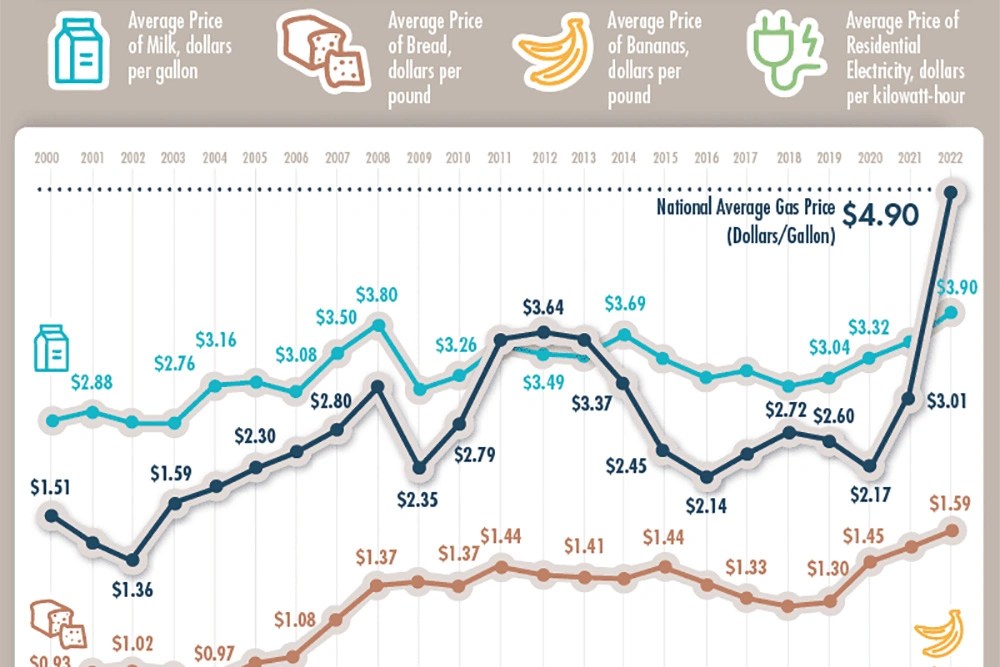
Image Source: Recoil Offgrid Magazine
home effects: War costs $1B/day (MSNBC), Venezuelan oil offset failing – we suffered Biden’s inflation, can’t absorb more! To put this in perspective, just one day of war spending could fund the entire annual budget of the Department of Veterans Affairs for over two weeks or cover a year’s worth of SNAP (food stamp) benefits for millions of struggling Americans. Every billion dollars burned on foreign conflict could instead strengthen the healthcare lifelines of those who served or put food on kitchen tables here at home. Refugees from widened conflict (strikes in the UAE, Bahrain, Cyprus – Al Jazeera, Reuters) damage our Ethnic American stock with a third-world influx.
War bleeds wallets before it bleeds bodies. Taxpayers pay an estimated $59.39 million per day for daily operations that move military forces into and across the region [14]. That same $59.39 million could instead cover daily Medicaid costs for more than 4 million Americans or SNAP (food stamp) benefits for more than 9.5 million Americans [14]. The U.S. spent roughly $779 million during the first 24 hours of Operation Epic Fury alone, according to estimates. The pre-strike military buildup cost an additional $630 million [15]. The Defense Department is working on emergency spending requests totaling $50 billion to replace munitions used and equipment lost so far, reportedly [16].
Americans feel the immediate story at the pump through gas prices. The average cost of a gallon jumped by 30 cents in less than a week due to strikes in Iran [17]. Gasoline prices soared to $3.20 per gallon on Wednesday, according to AAA data [18]. Gas prices rise by about 25 cents per gallon for every additional $10 per barrel of oil [19]. Goldman Sachs analysis warned that global oil prices would rise by $10 to $15 per barrel if the Strait of Hormuz were completely closed for one month. Live war risk premiums could reach $18 per barrel [3]. Inflation could rise to 2.7% by May from the December rate of 2.4%, Goldman Sachs estimated [8].
Fears of a regional conflagration that will send refugees flooding toward our shores sparked from Iran’s retaliatory strikes across the Gulf Arab states. Iran targeted United States assets in Bahrain, Kuwait, Qatar, and the United Arab Emirates, where airbases with U.S. assets are hosted [20]. At least one person died in Abu Dhabi after Iran launched missiles that were intercepted [20]. A fire broke out near a hotel on Dubai’s Palm Islands with huge plumes of smoke and multiple blasts [20]. Bahrain reported a missile attack targeted the headquarters of the U.S. Navy’s 5th Fleet in Manama [20]. Kuwait’s Ali al-Salem Air Base came under attack. A drone targeted Kuwait International Airport and left employees with minor injuries [20]. UK bases in Bahrain, Qatar, and Cyprus were also attacked [21].
The UN refugee agency warned that escalating conflict could intensify displacement and burden already overstretched humanitarian systems [9]. Many countries affected by violence already host millions of refugees. This makes them vulnerable to further instability [9]. The Syrian refugee crisis created one of the worst humanitarian catastrophes and forced more than 5.4 million Syrians out of the country [22]. More than 70 percent of Syrian refugees live in poverty with limited access to simple services [23]. The widened Middle East conflict threatens to weaken our Ethnic American stock with a third-world influx that dilutes the unbreakable bloodlines our forefathers forged.
Venezuelan oil agreements pledged to offset Iranian supply disruptions had failed. PDVSA emphasized recent agreements to supply crude to U.S. markets amid spiraling volatility [24]. But the Trump administration’s control over Venezuelan oil revenues deposited in U.S. Treasury accounts limits actual supply increases severely [24]. Venezuelan crude exports receded in February after the wind-down of shipments to China [24].
Blame the globalists for using war to blame their collapse. They censor speech, stall elections, and deport Muslims while ignoring real border invaders. For example, in March 2026, X suspended hundreds of anti-war accounts after users criticized the Iran strikes, citing “misinformation policies” as justification, but leaving pro-war voices untouched. Meanwhile, despite record apprehensions at the southern border in February 2026, the administration gave priority to detaining journalists and anti-war protesters over stopping illegal crossings, as documented in reports by the Texas Department of Public Safety.
To resist this wave of censorship, patriots should take concrete action. Organize and participate in alternative communication channels, such as encrypted messaging groups, independent forums, and newsletter networks outside mainstream platforms. Share vital information by building local anti-censorship alliances and training activists in digital security. Encourage the creation of print flyers and community bulletins that cannot be taken offline. Where censorship violations occur, work together to file legal claims using experienced First Amendment attorneys to push back against unfair bans or account removals. Finally, document every incident of censorship and escalate it via reliable watchdog sites and sympathetic media outlets to expose these actions to the public. Only by standing together and taking organized steps may we keep the anti-war voice alive.
Globalists engineered this crisis to distract from their economic collapse. Mortgage interest rates climbed to 6.13% on a 30-year fixed rate before ticking down slightly. This makes it more expensive for Americans to borrow money for homes [8]. The Strait of Hormuz also handles about one-third of the world’s fertilizer. Fertilizer prices, already at their highest levels in decades, are rising further [8]. Research confirms conflicts trigger inflation through both money creation that funds wars and supply-side disruptions [25]. Direct involvement in conflicts is associated with higher inflation rates on average, about 51 percent [25].
War serves as the perfect cover for censoring dissent and labeling liberty activists as “Iranian agents,” while real border invaders pour across our southern frontier unchecked. We, heirs to Irish-German-Italian resolve, refuse to absorb more economic devastation for globalist schemes that protect foreign interests over Ethnic American security.
V. Patriot Voices Ascend: X and Media Resonances of America First Dissent
sources: Tucker Carlson denounces strikes (Jerusalem Post); MTG blasts Trump betrayal (AFNewsAlerts); X patriots like @MattH_4America, @realveritas_85 cry “America First gone” – no war for Israel! Cite anti-war polls (59% oppose), Zeteo on Dems turning Israel-critical.
Trump’s base fractures over this globalist trap, with a firm split now undeniable. Patriot voices exploded in fury. Tucker Carlson told ABC News the Iran strikes were “absolutely disgusting and evil” and predicted they would “shuffle the deck in a serious way” for Trump’s political movement [10]. Former Rep. Marjorie Taylor Greene unleashed profanity-laced condemnation: “The Trump admin actually asked in a poll how many casualties voters were willing to accept in a war with Iran??? How about ZERO, you bunch of sick f—— liars. We voted for America First and ZERO wars” [10]. Greene hammered the betrayal: “Trump, Vance, basically the entire admin campaigned on it and promised to put America FIRST” [10]. The key shift: approval among self-identified MAGA voters dropped by 25 points after the strikes, denoting a historic break in support.
Polling confirms this local revolt. About 60 percent of Americans disapproved of the attacks, according to surveys by CNN, Reuters/Ipsos, and the Washington Post [26]. Only 27% approved, while 43% disapproved [27]. Trump got merely 55% Republican approval. This differs markedly from the 90%+ Republican support George W. Bush enjoyed for Iraq in March 2003 [28]. Other MAGA figures joined the chorus: podcaster Tim Pool blasted the betrayal, while influencers Keith and Kevin Hodge declared Trump “completely LIED to his voters” in the “biggest fall from grace” [10]. Rep. Thomas Massie announced plans with Rep. Ro Khanna to force a Congressional vote, stating, “This is not ‘America First’” [10].
Democratic voters changed dramatically on Israel. An overwhelming 71% of likely Democratic primary voters say the U.S. should restrict military aid to Israel until it stops attacking civilians, with only 20% supporting the Biden government’s posture [29]. Democrats show 56% believe Israel is committing genocide [30], while 83% support a permanent ceasefire [30].
Ethnic American unity: We, heirs to unbowed bloodlines, demand no forever wars – share fountains like American Conservative, VDARE, warning heritage dilution!
We stay united against this constitutional crime. We are heirs to Irish grit, German resolve, and Italian fire. Curt Mills, executive director of The American Conservative magazine, founded in opposition to the Iraq war, argues the Iran conflict could “shatter the president’s domestic coalition” [31]. The American Conservative warns there is “no legitimate cause for war” as “the Islamic Republic, though hostile, poses no threat to the U.S.” [1].
Fellow Ethnic American patriots, rise now! Take the most powerful action for peace: Call your representative today at 202-224-3121 and say, “I demand you vote to restore Congress’s sole war powers and stop unauthorized war with Iran. No further endless foreign entanglements—protect our Republic, our Constitution, and our communities.” Let them hear the America First voice directly from you. Our ancestors built this Republic for freedom, not foreign graves. Iran ain’t our fight!
But do not stop there. Organize and attend local rallies and peaceful demonstrations to make our opposition visible in the streets. Write op-eds, letters to the editor, or share your story in community newspapers to reach a wider audience. Join or volunteer for anti-war organizations in your area and support candidates who pledge to restore Congressional authority over war. Connect with your neighbors by hosting informational meetings or discussion groups in your neighborhood community center, church, or veterans’ hall. Use social media to amplify the America First anti-war message, and print flyers to distribute locally so no voice gets silenced. By adopting these actions together, we keep the movement alive and show that the call for peace cannot be ignored.
VI. The Road to Redemption: Demand Peace, Secure Our Heritage
Important to realize that Operation Epic Fury acts as the constitutional betrayal our Founders dreaded: Article I war powers trampled, $3.7 billion burned, gas prices spiking, all for a neutral Persian nation threatening neither our shores nor our people. By and large, as Americans from every background, joined by a love of liberty, the Constitution, and the Republic, we must reject foreign quagmires that risk our prosperity and freedom. While we honor the continuing sacrifices of Ethnic Americans, heirs to Irish-German-Italian resolve who built this Republic for freedom, the duty to defend self-government now calls on all patriots who value America’s founding principles, regardless of background. This is a cause for everyone who cherishes the right to decide our nation’s destiny without foreign entanglements or unauthorized wars that weaken our rights, prosperity, or security. Hence, call your Congressmen demanding War Powers Resolution passage, share this across X with #NoWarWithIran #AmericaFirst tagging @RonPaul @TuckerCarlson @RepThomasMassie, and support anti-war patriots at Antiwar.com because Iran ain’t our fight. Guard our blood, Constitution, and Republic!
FAQs
Q1. Does Congress have the constitutional authority to declare war? Yes, the Constitution grants Congress the sole power to declare war under Article I, Section 8, Clause 11. This means the legislative branch has exclusive authority to initiate hostilities, not the President acting unilaterally.
Q2. How does Iran’s military capability compare to that of the United States? Iran is at a significant disadvantage in terms of air defense compared to the U.S. and Israel. While Tehran has increased its stockpile of aerial missiles, drones, and ballistic weapons, it lacks the advanced military infrastructure and technology that American forces possess.
Q3. Did the United States support either side during the Iran-Iraq War? Yes, during the Iran-Iraq War in the 1980s, the United States provided aid to Iraq, along with the United Kingdom, the Soviet Union, France, and most Arab countries. This support helped create the military stalemate that eventually ended the conflict in 1988.
Q4. What impact does conflict in the Persian Gulf have on oil prices? Conflicts affecting the Strait of Hormuz significantly affect global oil prices, as approximately 20% of the world’s oil supply passes through this waterway. Disruptions might cause crude prices to spike $10-15 per barrel, translating to roughly 25 cents more per gallon at the pump.
Q5. What percentage of Americans support military action against Iran? Recent polling shows only about 27% of Americans approve of military strikes against Iran, while approximately 43% disapprove. This represents historically low support compared to previous military operations, with even Republican approval reaching only around 55%.
References
[1] – https://www.theamericanconservative.com/an-iran-war-puts-america-the-constitution-peace-and-the-facts-last/
[2] – https://triblive.com/news/world/oil-prices-surge-as-strait-of-hormuz-tanker-disruptions-rattle-global-supply/
[3] – https://finance.biggo.com/news/NZn7spwBvbjfYyetIXeF
[4] – https://www.orfonline.org/expert-speak/why-iran-may-prove-a-battlefield-for-the-us-unlike-iraq-or-afghanistan
[5] – https://uk.finance.yahoo.com/news/oil-prices-higher-closure-strait-of-hormuz-094030699.html
[6] – https://abcnews.com/Business/wireStory/oil-prices-surge-strait-hormuz-tanker-disruptions-rattle-130670290
[7] – https://nationalinterest.org/blog/middle-east-watch/why-iran-wont-balkanize
[8] – https://www.nbcnews.com/business/markets/iran-war-threaten-upend-trump-economic-gains-gas-groceries-rcna261599
[9] – https://www.aa.com.tr/en/europe/un-refugee-agency-warns-middle-east-escalation-could-worsen-displacement-crisis/3846681
[10] – https://abcnews.com/US/trumps-iran-decision-sparks-backlash-tucker-carlson-maga/story?id=130622270
[11] – https://www.heygotrade.com/en/news/oil-prices-skyrocket-as-hormuz-chokepoint-faces-blockade/
[12] – https://bradtaylorbooks.com/2019/06/27/war-with-iranthree-differences-and-one-similarity/
[13] – https://responsiblestatecraft.org/iran-war-2672502741/
[14] – https://www.nationalpriorities.org/analysis/2026/factsheet-how-much-war-iran-costing-taxpayers/
[15] – https://www.aljazeera.com/news/2026/3/3/how-much-could-the-iran-war-cost-the-us-heres-what-we-know
[16] – https://responsiblestatecraft.org/iran-war-costs/
[17] – https://www.facebook.com/ABC10tv/posts/the-average-cost-of-a-gallon-of-gas-has-jumped-30-cents-in-less-than-a-week-as-u/1443399314496916/
[18] – https://abcnews.com/Business/iran-war-impact-us-economy/story?id=130749101
[19] – https://foxbaltimore.com/news/nation-world/iran-strikes-rattle-energy-markets-bringing-higher-oil-prices-and-more-expensive-gas-strait-of-hormuz-middle-east-war-opec-crude-oil-natural-gas
[20] – https://www.aljazeera.com/news/2026/2/28/multiple-gulf-arab-states-that-host-us-assets-targeted-in-iran-retaliation
[21] – https://commonslibrary.parliament.uk/research-briefings/cbp-10521/
[22] – https://www.mercycorps.org/blog/facts-syria-crisis
[23] – https://www.unrefugees.org/news/syria-refugee-crisis-explained/
[24] – https://venezuelanalysis.com/news/venezuela-pdvsa-pledges-reliable-oil-supplies-to-us-amid-iran-war/
[25] – https://www.sciencedirect.com/science/article/abs/pii/S2110701724000581
[26] – https://www.nytimes.com/2026/03/04/us/iran-us-war-military-polls.html
[27] – https://www.theamericanconservative.com/on-the-iran-war-they-think-youre-stupid/
[28] – https://www.aljazeera.com/opinions/2026/3/4/the-iran-strikes-could-become-a-midterm-reckoning-for-trump-and-israel
[29] – https://zeteo.com/p/exclusive-dem-voters-overwhelming
[30] – https://zeteo.com/p/gaza-israel-genocide-poll-ceasefire-us-voters
[31] – https://www.nytimes.com/2026/03/05/opinion/iran-us-foreign-policy-curt-mills.html
[32] – (2023). U.S. Military Spending/Defense Budget | Historical Chart & Data. MacroTrends. https://www.macrotrends.net/global-metrics/countries/USA/us/military-spending-defense-budget
[33] – Kaloi, S. (February 27, 2026). MAGA Stalwarts MTG, Tucker Carlson, and More Decry Trump and Netanyahu’s Iran Attack: ‘Sick F–king Liars’. Yahoo News. https://www.yahoo.com/news/articles/maga-stalwarts-mtg-tucker-carlson-200729721.html
[24] – (2025). Iran Population (1950-2025). MacroTrends. https://www.macrotrends.net/global-metrics/countries/irn/iran/population
[35] – Northup, A. (March 4, 2026). Fetterman is the only Democrat to vote against reining in Trump’s war powers in Iran. Yahoo News. https://www.yahoo.com/news/articles/fetterman-only-democrat-vote-against-002924453.html
[36] – Jeffries, H. (February 27, 2026). LEADER JEFFRIES ON NPR: “THE WAR POWERS RESOLUTION WOULD REQUIRE IMMEDIATE TERMINATION OF ANY ADDITIONAL MILITARY ACTION”. NPR. https://jeffries.house.gov/2026/02/28/leader-jeffries-on-npr-the-war-powers-resolution-would-require-immediate-termination-of-any-additional-military-action/
[37] – (September 24, 2024). H.Amdt.1223 to H.R.3334 – 118th Congress (2023-2024). Congressional Record, Vol. 170, Issue 147, pp. H4176-4177. https://www.congress.gov/amendment/118th-congress/house-amendment/1223/text
[38] – (November 6, 1973). The War Powers Resolution. The Patriot Post. https://patriotpost.us/documents/256
[39] – (n.d.). War Powers Resolution: Expedited Procedures in the House and Senate. https://www.congress.gov/crs-product/R47603
[40] – (June 22, 2025). Leader Schumer Demands Immediate Classified Briefing From Trump Administration As Iran Begins Their Counterattacks Targeting American Troops. Senate Democratic Caucus. https://www.democrats.senate.gov/newsroom/press-releases/leader-schumer-demands-immediate-classified-briefing-from-trump-administration-as-iran-begins-their-counterattacks-targeting-american-troops
[41] – Garcia, J. (March 3, 2026). Mitch McConnell: Trump’s use of force in Iran is within his authority as president. Yahoo News. https://www.yahoo.com/news/articles/mitch-mcconnell-trumps-force-iran-184130772.html
[42] – (1796). George Washington’s Farewell Address. George Washington’s Mount Vernon. https://www.mountvernon.org/education/primary-source-collections/primary-source-collections/article/washingtons-farewell-address-1796
[43] – Sinnar, S. (2023). The Supreme Court & the Unaccountable Racialized Security State. Daedalus 152(1), pp. 1-15. https://doi.org/10.1162/daed_a_01956
[44] – (January 5, 2026). GasBuddy: Yearly Average Gas Prices to Fall Below $3 in 2026. GasBuddy. https://www.globenewswire.com/news-release/2026/01/06/3213735/0/en/GasBuddy-Yearly-Average-Gas-Prices-to-Fall-Below-3-in-2026-Lowest-Since-2020.html
[45] – https://www.infowars.com/posts/what-happens-next-in-iran-decapitation-quagmire-or-wwiii
[46] – https://alt-market.us/what-happens-next-in-iran-decapitation-quagmire-or-wwiii/
[47] – https://alt-market.us/iran-vs-israel-what-happens-next-now-that-shots-have-been-fired/
[48] – https://alt-market.us/world-war-iii-is-now-inevitable-heres-why-it-cant-be-avoided/
[49] – https://alt-market.us/its-a-trap-the-wave-of-repercussions-as-the-middle-east-fights-the-last-war/
[50] – https://x.com/DefiyantlyFree/status/1916901833609777243
[51] – https://x.com/SezSimon42/status/2027821176186106343
[52] – https://x.com/johnrossartist/status/1936904134440964396
[53] – https://x.com/TheThe1776/status/1937155730265796732
[54] – https://www.theoccidentalobserver.net/
[55] – https://www.amren.com/
[56] – https://vdare.com/
[58] – https://nationalinterest.org/blog/middle-east-watch/why-iran-wont-balkanize
[59] – https://www.cato.org/commentary/inspiring-legacy-anti-war-conservatism
 Critical Thinking Dispatch
Leave a comment