
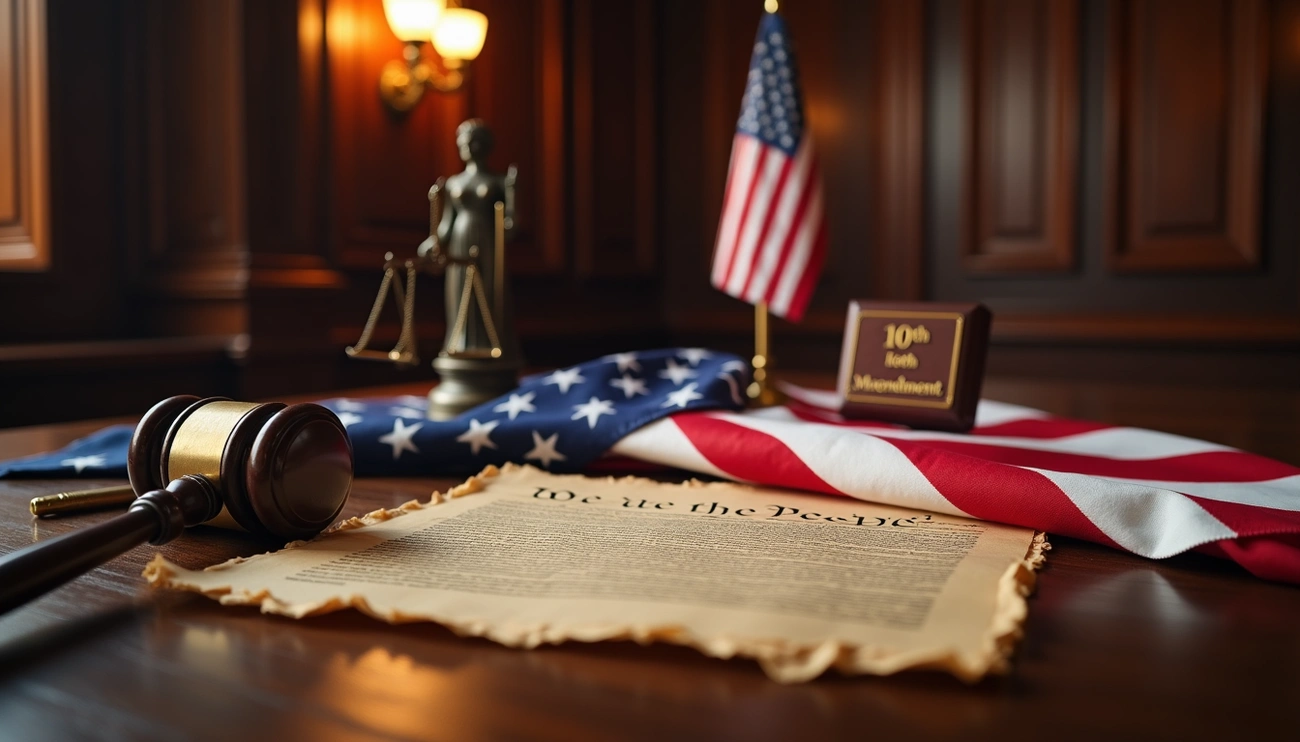
Key Takeaways
This article presents a constitutional perspective on government authority during health emergencies, emphasizing state sovereignty and citizen rights under the U.S. Constitution.
• The 10th Amendment reserves health and quarantine powers to states and the people, not federal or world entities like the WHO or UN agencies.
• State legislatures have successfully pushed back against executive overreach, with 12 states enacting laws to limit gubernatorial emergency powers after COVID-19.
• Citizens can effectively influence policy by contacting governors and state representatives to demand constitutional compliance and rejection of international health mandates.
• Past emergency responses included costly field hospitals that remained largely unused, demonstrating the importance of proportional responses to actual threats.
• Constitutional protections remain in effect during emergencies, as affirmed by Supreme Court rulings that rejected unlimited government authority during health crises.
Alex Jones just issued the full RED ALERT live:
The article stresses that defending constitutional principles requires active citizen engagement through legislative contact, public participation, and support for state-level protections of health freedom and sovereignty. Hantavirus Lockdowns 2.0 are unfolding right now. We refuse to surrender our Republic again (States, 2022). Three passengers from the MV Hondius have died from the Andes strain, while 94 people of 19 nationalities were evacuated. (Chrisafis & Agencies, 2026) The globalist playbook is back: quarantine camps, 42-day isolations, and fear theater designed to crush sovereignty. We the People reject (Ginsburg & Versteeg, 2021)WHO treaties, foreign mandates, and any assault on our Constitutional Republic. The 10th Amendment reserves health powers to the States and the (State Police Power and Tenth Amendment Jurisprudence, n.d)People, not unelected bureaucrats. This is our red line. America First Sovereignty cannot be compromised. The (42 U.S. Code § 247d – Public health emergencies, n.d.)The Nebraska Quarantine Unit will not become another tool for global control.
Alex Jones just dropped the warning heard around the Republic:
President Trump is already pushing back hard:
Even the U.S. Department of Health & Human Services confirms it:
The Globalist Playbook Exposed – Same Script, New Virus

- Image Source: Human Rights Watch
We’ve seen this script before. Videos appeared across the United Kingdom during the spring of 2020 showing empty hospital corridors. People filmed these clips while walking through quiet hallways. The footage spread through Facebook groups and Twitter feeds, garnering hundreds of thousands of views. NHS England chief executive Sir Simon Stevens responded bluntly: “When people say that, that is a lie” [1]. Hospital trusts insisted their services remained “very busy” and explained that reorganization to separate COVID patients from others, combined with canceled non-urgent care, left certain corridors looking empty [1]. The footage showed waiting rooms and hallways, not clinical areas where actual patient care occurred.
Parallels to 2020: empty hospitals, PCR amplification, moved death counts, fear theater
The field hospital debacle was just as revealing. The Army Corps of Engineers mobilized across the United States and hired private contractors to build emergency facilities. This is a big deal, as it means the cost exceeded $660 million [1]. Most of these facilities hadn’t treated a single patient nearly four months into the pandemic (Rose, 2020). Contractors built two field hospitals at SUNY Stony Brook and SUNY Old Westbury on Long Island alone for more than $270 million [1]. Officials completed the Stony Brook contract award in “little more than three days” to support the “unusual and compelling nature of the immediacy” [1]. Both facilities finished construction in late April, never opened to the public, and didn’t treat any patients [1].
Florida Governor Ron DeSantis noted that “all those field hospitals and available beds sit empty today” [1]. Michigan Governor Gretchen Whitmer stated, “These 1,000-bed alternate care sites are not necessary; they’re not filled. Thank God” [1]. The Javits Center field hospital did treat COVID-19 patients even in New York City, but it never reached full capacity [1]. Javits treated about 1,100 patients during its three weeks of operation, while it was designed to handle far more [1]. Hospitals complained that the intake process was too complicated and sent few patients, even as they resorted to treating people in hallways [1].
We the People watched non-COVID hospital admissions drop by almost half by mid-April 2020 [1]. Patients stayed away from hospitals out of fear. A study by Sound Physicians, which represents almost 4,000 doctors specializing in hospital medicine, compared admissions data from more than 200 hospitals across 36 states [1]. The mantra became “don’t come to the hospital, don’t go to the doctor, stay home till your lips turn blue” [1]. Public health experts later called this “a crazy set of advice” [1].
The pattern repeats itself now with Hantavirus Lockdowns 2.0. Moon suits, hazmat theater, and the same fear-driven messaging resurface. PCR cycle threshold concerns that plagued COVID testing stay unaddressed in public discourse. We recognize the playbook because we lived through it.
WHO/Tedros/UN pushing pandemic treaty and “international coordination.”
WHO’s 194 Member States decided to draft and negotiate an agreement to address pandemic prevention, preparedness, and response in light of COVID-19’s effect [2]. The World Health Assembly launched this process through a special session in December 2021, during the pandemic itself [2]. The World Health Assembly adopted the WHO Pandemic Agreement on May 20, 2025, with 124 Member States voting in favor, 11 abstaining, and none opposing [3]. The United States was in the process of withdrawing from the WHA and declined to participate in the vote [3].
WHO Director-General Tedros Adhanom Ghebreyesus proclaimed the agreement “a victory for public health, science, and multilateral action” [4]. He stated it would “ensure we, collectively, can better protect the world from future pandemic threats” [4]. The 30-page treaty lays out a framework to prevent pandemics and respond more effectively [5]. Countries must still ratify the agreement internally before it enters into force, and this requires 60 countries to complete this process [5].
The treaty text itself contains specific sovereignty protections despite these lofty declarations. Article 22, paragraph 2, states this: “Nothing in the WHO Pandemic Agreement shall be interpreted as providing the Secretariat of the World Health Organization, including the Director-General of the World Health Organization, any authority to direct, order, alter or otherwise prescribe the national and/or domestic law, as appropriate, or policies of any Party, or to mandate or otherwise impose any requirements that Parties take specific actions, such as ban or accept travelers, impose vaccination mandates or therapeutic or diagnostic measures or implement lockdowns” [2].
Opponents of our position often point to these sovereignty clauses as proof that the treaty is harmless or cannot override state or national rights. As (Asiedu, 2024), patriots, here are proven counterpoints and questions you can use in conversation:
– If the treaty has no real enforcement power, why build such a detailed framework and international bureaucracy around it? What is the purpose of creating global health authorities if they are truly powerless?
– Could future amendments or political pressure, once the system is established, gradually erode these sovereignty protections? Are we establishing an example of foreign involvement in our health policy?
– Why does the treaty specify what the WHO “cannot” do, if there was never any intention for overreach in the first place? What is really being planned behind the legal language?
– In practice, how much influence did the WHO exert during COVID-19 through recommendations, political pressure, and media amplification—despite an absence of formal enforcement? Could “recommendations” under the treaty become de facto mandates through backdoor channels, funding pressure, or regulatory threats?
– Can we sincerely trust unelected global health officials to respect American sovereignty, when our own national agencies have exceeded their statutory powers in previous emergencies?
Keep these talking points and questions close at hand. Use them when others raise sovereignty arguments to challenge our defense of the 10th Amendment and the Constitution.
The agreement “reaffirms the principle of sovereignty of States Parties in dealing with public health matters” [2]. Article 3 states the agreement shall be guided by the sovereign right of states to “legislate and to implement legislation, within their jurisdiction” [6]. WHO itself confirmed there is “no enforcement mechanism that the WHO or any other body can invoke against a sovereign government if it does not follow a future WHO recommendation” [6].
“They promised Trump a new outbreak — here it is.”
President Trump called Hantavirus “hype” and noted it’s “not easily transferable.” His common-sense realism stands in sharp contrast to the worldwide coordination machinery now activating. We the People never consented to surrender our health policy decisions to international bureaucrats. The 10th Amendment reserves these powers to the States and the People, not to Tedros or any UN-affiliated body.
The WHO Pandemic Agreement took three years to negotiate and began in late 2021, as the Omicron variant swept the world [4]. The timing brought out the gulf in vaccine availability between wealthy and developing nations [4]. Countries are still negotiating the details of how a nation shares pathogen samples and sequences found within its borders, with manufacturers expected to donate or sell at low prices 20% of what they produce [4].
WHO assessed and verified around 500 health threats and worked with countries to respond to 450 of those events [7]. The organization defines itself as the “preeminent forum for developing a common understanding of vital worldwide cooperation” [7]. Tensions appeared regarding countries’ withdrawal from the WHO during the WHO’s Executive Board meeting, with concern expressed about “the public health ramifications of an à la carte approach to multilateralism” [7].
Global health authorities are hungry for power over sovereign nations.
The circulation of misinformation about the pandemic treaty has been substantial [8]. Claims spread on YouTube and X that the treaty threatens national sovereignty, that the WHO would deploy troops to enforce it, and that national armed forces would implement it under UN orders [8]. These claims are false and have been debunked by independent fact checkers [8]. The bureau text has provisions defending national sovereignty that were emphasized during Intergovernmental Negotiating Body negotiations [8].
When responding to accusations of spreading misinformation, patriots must stay alert, concentrate on facts, and cite historical examples in which formal accounts later shifted or proved incomplete. Remind others that insisting on honesty and asking hard questions are American traditions. Remain calm, cite reliable sources, and promote free discourse rather than censorship. Past events have shown that what was labeled “misinformation” can sometimes turn out to be legitimate concerns. Use this awareness to strengthen the importance of continual oversight and citizen engagement.
Yet the push for “international coordination” continues unabated. The Global Health Emergency Corps launched in 2023 and integrated with the International Health Regulations and the WHO’s Health Emergency Prevention, Preparedness, Response, and Resilience framework [9]. Exercise Polaris, held in April 2025, brought together 15 participating countries to control a pandemic caused by a fictional orthopox virus [9]. The framework stresses sovereignty, equity, and solidarity as guiding principles [9].
Protesters stood outside the United Nations headquarters in Geneva, calling the pandemic treaty a handover of power to “globalist elites” [10]. Organizations like CitizenGo reject efforts to “centralize global authority” in future pandemics and view the treaty as an affront to civil liberties and national sovereignty [10]. Sebastian Lukomski stated: “We want our governments, whom we elected, to call the shots in a time of crisis” [10]. He added that pandemic responses should be adapted to country contexts and noted “an outbreak of a disease in China is not the same as an outbreak of a disease in Italy” [10].
The WHO CA+ was drafted by countries through the INB’s processes and gains international legal effect only after an undetermined number of countries ratify it [8]. The right of a sovereign state to ratify or not ratify remains part of each nation’s autonomy [8]. WHO’s powers are described in a binding international constitution that confines its authority to undertaking international health work, not jurisdiction over national health work [8]. The WHO Director-General and staff cannot enforce decisions such as imposing lockdowns, mandating vaccination, or dictating border policies [8].
Lawrence Gostin, Georgetown University law professor and director of the university’s WHO Collaborating Center on National and Global Health Law, stated this: “These claims are utterly false. The United States retains sovereignty to set its own domestic public health policies. WHO does not gain any power to override domestic policy decisions” [11]. The U.S. Department of Health and Human Services confirmed: “It is false to claim that the World Health Organization has now, or will have by virtue of these activities, any authority to direct U.S. health policy or national health emergency response actions” [11].
Most provisions are framed as things signatories “should” do rather than “must” do, as in the actual treaty language [11]. There are no compliance mechanisms written into the draft, and provisions address international obligations, not domestic policy [11]. Experts note there are no judicial penalties for signatories who fail to adhere to or violate terms, other than actions akin to an international “slap on the wrist” [11].
We the People recognize the difference between what the treaty text says and what the global health apparatus seeks to accomplish. The WHO Pandemic Agreement describes a detailed framework with a Global Supply Chain and Logistics Network coordinated by WHO to ensure pandemic-related health products are distributed rapidly and equitably [12]. A Coordinating Financial Mechanism will support strengthening pandemic prevention, preparedness, and response capacities in countries [12]. A Conference of the Parties will serve as the main governing body and meet regularly to examine progress and make decisions [12].
The treaty represents a global commitment by WHO member states to work together as an “international community of sovereign nations” [2]. WHO’s constitution itself refers to the organization as the “directing and co-ordinating authority” in the event of a pandemic [3]. This language raises fundamental questions about who directs and coordinates American health policy during emergencies: elected officials accountable to We the People, or international bureaucrats in Geneva.
Sovereignty First. Constitution First. America First. We reject the premise that global health coordination requires ceding decision-making authority to unelected international bodies. The pattern from 2020 repeats itself with Hantavirus Lockdowns 2.0: fear theater, quarantine camps, and international coordination mechanisms activating. Australia sends passengers to the reactivated Bullsbrook facility. Nebraska Medicine operates its biocontainment unit. WHO member states position themselves as the coordinating authority.
The Constitution grants no such power to foreign entities. Article I, Section 8, enumerates federal powers and provides no blank check to international health bureaucrats. The 10th Amendment reserves all powers not delegated to the United States to the States respectively, or to the People. Health and quarantine powers rest with state governments and with We the People, who never ratified any Constitution surrendering our sovereignty to Tedros or the UN.
Constitutional Red Line – The Republic Will Not Yield
constitutionalist:
American constitutional law establishes an ironclad framework: state governments, not the federal government, hold the main authority over public health and quarantine measures. The Centers for Disease Control and Prevention acknowledges that states have the primary power to place people in isolation or quarantine under specific circumstances [13]. This allocation of authority flows from the 10th Amendment.
The 10th Amendment reserves health and quarantine powers to the States and the People
The text stands unambiguous: “The powers not delegated to the United States by the Constitution, nor prohibited by it to the States, are reserved to the States respectively, or to the people” [14]. States have shouldered responsibility for public health since 1791. That’s when the 10th Amendment granted them any powers not assigned to the federal government [15]. The Congressional Research Service determined that the power to quarantine is reserved to the states under this amendment [13].
Marshall’s reasoning in Gibbons v. Ogden set the precedent almost 200 years ago. It established that police powers remain reserved to states for activities within their borders, with limited exceptions [13][16]. The Supreme Court ruled in 1824 that states possess the power to provide for their citizens’ health [16]. Those police powers include knowing how to impose isolation and quarantine conditions [13]. More than a century ago, the Court decided the seminal case of Jacobson v. Commonwealth of Massachusetts. This affirmed the constitutionality of state statutes authorizing local health boards to require vaccination or payment of fines [16].
The federal government does maintain important but circumscribed quarantine powers. Under Section 361 of the Public Health Service Act, the U.S. Secretary of Health and Human Services has the authority to take measures to prevent communicable diseases from entering the United States from foreign countries and from spreading between states [13]. Federal public health statutes give the government authority to isolate and quarantine individuals with certain diseases, as authorized by an executive order issued by President George W. Bush in 2003 [13]. These federal powers exist, but they remain constrained by constitutional limitations and state primacy.
The federal government possesses only the powers enumerated by the Constitution. State governments wield police power to establish public health and safety laws as long as those laws don’t violate the Constitution [17]. Since the nation’s founding, the responsibility for controlling the transmission of infectious diseases has rested with states under their respective police powers [17]. Policymakers and courts have recognized the states’ leading role in limiting the spread of disease. The federal government provides support [17].
Under the 5th and 14th Amendments’ rights of Due Process and Equal Protection, public health regulations imposing quarantine conditions cannot be arbitrary, oppressive, and unreasonable [13]. Precedents exist in which courts ruled that states or local governments failed to meet their burden of proof to justify a quarantine [13]. Those quarantined possess the right to medical review and to ask a federal court to review federal quarantine orders, including habeas review rights [13].
Article I, Section 8 limits federal power — no blank voucher for foreign bureaucrats
Article I, Section 8 specifies Congress’s powers in great detail [18]. These powers are limited to those listed and those needed to carry them out. All other lawmaking powers remain with the states [18]. The First Congress was concerned that the limited nature of the federal government wasn’t clear enough in the first Constitution. They adopted Amendment X, which reserves to the states or to the people all powers not granted to the federal government [18].
Commerce clause powers, while broad, are not unlimited [18]. The Supreme Court has expressed greater concern for states’ rights over the last several years. It issued rulings that limit Congress’s power to enact legislation under the Commerce Clause or other Article I, Section 8 powers [18]. Rulings have found unconstitutional federal laws aimed at protecting battered women or protecting schools from gun violence. These policy matters are managed by states [18].
The beauty of American federalism is that states can take different approaches to complex policy matters. This reflects their different economic, political, and social priorities [17]. The federal government imposing on-the-fly rules and regulations creates confusion, costly litigation, and longer-term problems [17]. The Supreme Court may have stopped specific CDC overreach, but many members of Congress, administrations, and sitting Supreme Court justices see few limits to agency authority during pandemics [17].
“We the People never ratified any Constitution that surrenders our sovereignty to Tedros or the UN.”
The president cannot force someone to take a vaccine or force a state to stop fluoridating the water supply, according to Lawrence Gostin, a public health law expert at Georgetown University [15]. Nor can the president deny a state the right to require vaccinations or fluoridation [15]. HHS could cut funds to state public health departments and constrain the scope and vibrancy of their programs [15]. States can counterpunch against federal requirements with lawsuits [15].
We the People never consented to have our health policy decisions made by international bureaucrats. The Constitution grants no authority to the WHO, Tedros, or UN-affiliated bodies to direct American public health actions. State and local governments are responsible for defending public health and managing the spread of disease within their borders [19]. The federal CDC monitors and responds to communicable disease spread across national and state borders, but this interstate coordination function is different from domestic health policy control [19].
Governors and state legislatures must assert their authority.
State codes allow governors to declare states of emergency in response to disease epidemics and dangers to public health [20]. Executive powers remain in effect until the emergency ends. This includes authority reserved for legislatures [21]. Governors cannot promulgate emergency rules granting themselves authority beyond statutory limits, even if they otherwise have the power to alter statutes [21]. Legislatures retain the authority to impose firm limits on emergency executive power [21].
Public officials, voters, and stakeholders raised questions throughout 2020 and into 2021 about emergency powers used to respond to the pandemic. This led to conflict between governors and legislatures [20]. Officials introduced bills that would allow legislators to terminate emergency declarations and orders, or restrict a governor’s authority to regulate city- and county-level public health decisions [20].
Between March 2020 and December 2023, 12 bills aimed at increasing legislative oversight of gubernatorial emergency power were enacted in 9 states: Arkansas, Colorado, Indiana, Kansas, Kentucky, New York, Ohio, Pennsylvania, and Utah [20]. Arkansas limited disaster emergencies to 60 days unless extended by the governor and authorized the Legislative Council to vote to block disaster emergency extensions beyond 60 days [20]. Kansas allowed anyone burdened by an executive order, school board policy, or county health directive to file a civil action in court [20]. Kentucky limited the governor’s emergency orders to 30 days unless extended by the legislature [20]. Ohio granted the legislature authority to cancel health orders lasting more than 30 days [20].
Several states impose specific limits on the exercise of emergency powers [21]. Common restrictions include prohibiting governors from limiting freedom of the press or confiscating citizens’ firearms [21]. Constitutional limits on state authority and guaranteed rights remain in full effect during emergencies [21]. Legislatures may retain power to nullify emergency proclamations by resolution, which requires a simple majority vote of both chambers [21].
“This is not public health. This is power — and we reject it.”
The equilibrium between individual liberty and public health powers struck after September 11, 2001, proved neither appropriate for a prolonged global pandemic nor acceptable to a substantial segment of the American public [22]. Nearly 200 laws have been adopted in states curtailing health officials’ powers during or outside emergencies [22]. Montana no longer allows its governor to renew an emergency declaration; only the legislature may do so [22]. Florida limits local health orders to seven days and requires local officials to show that a narrower policy would not be enough [22].
These post-COVID reforms acknowledge that emergency powers cannot remain unchecked. States maintain the obligation and legal authority to sustain public health and safety [23]. But a state cannot make a law that violates or supersedes the United States Constitution [23]. The Supreme Court noted in Roman Catholic Diocese of Brooklyn v. Cuomo that even during a pandemic, the Constitution cannot be put away and forgotten [16]. Justice Gorsuch distinguished Jacobson as a modest decision and stated it supports cutting the Constitution loose during a pandemic [16].
We the People recognize the difference between legitimate public health measures and power grabs disguised as health policy. Hantavirus Lockdowns 2.0 represents the latter. Reactivated COVID camps in Australia, 42-day quarantines, Nebraska biocontainment units activated for limited human-to-human transmission virus, moon-suit theater
Lessons from COVID – We Were Right Then, We’re Right Now

- Image Source: LA Times
Past excess and how patriots stopped it
Our warnings proved accurate. The darkest days of 2020 and 2021 brought forth voices across America questioning emergency powers that exceeded constitutional limits. Those voices faced ridicule, censorship, and condemnation from mainstream outlets. Yet we stood firm, and the victories came in time.
Twelve states enacted legislation reining in unchecked executive authority. Arkansas, Colorado, Indiana, Kansas, Kentucky, New York, Ohio, Pennsylvania, and Utah passed bills increasing legislative oversight of gubernatorial emergency powers. These weren’t abstract policy modifications. They represented direct responses to overreach observed directly by citizens who refused to accept emergency rule without end.
Kansas authorized anyone burdened by executive orders to file a civil action in court. Kentucky limited gubernatorial emergency orders to 30 days without legislative extension. Ohio granted the legislature the authority to cancel health orders that exceed 30 days. Montana stripped its governor of the power to renew emergency declarations and reserved that authority solely to the legislature. Florida imposed a 7-day limit on local health orders and required officials to demonstrate that narrower policies would suffice.
Those legislative victories didn’t materialize from thin air. Patriots attended town halls, flooded representatives’ phone lines, organized recall efforts, and demanded accountability. We the People forced elected officials to remember who holds ultimate authority in this Republic. State sovereignty reasserted itself because Americans refused to surrender.
The courts delivered victories as well. The Supreme Court distinguished legitimate public health measures from unconstitutional overreach in Roman Catholic Diocese of Brooklyn v. Cuomo and noted that even during pandemics, the Constitution cannot be put away and forgotten. Justice Gorsuch rejected expansive interpretations of precedent and affirmed that emergency conditions do not grant unlimited power to restrict fundamental liberties.
Nearly 200 laws were adopted in states curtailing health officials’ powers during and outside emergencies. Each law represents a battle won by citizens who recognized the difference between defending public health and consolidating government control. We identified the playbook in 2020: fear theater, empty field hospitals costing hundreds of millions, contradictory guidance keeping Americans away from medical care, and emergency powers extended without accountability.
“The same voices warning us in 2020 are warning us again.”
We recognize Hantavirus Lockdowns 2.0 employing similar tactics. The pattern repeats with precise accuracy: reactivated COVID camps, 42-day quarantine periods, hazmat theater, and international coordination mechanisms are activating. Australia sends passengers to Bullsbrook. Nebraska Medicine operates biocontainment units. WHO member states position themselves as coordinating authorities.
We called out empty hospitals in 2020. Field hospitals across America sat vacant after $660 million in construction costs. Both major facilities on Long Island never treated a single patient despite urgent procurement processes. (Staff, 2020) Governors admitted these thousand-bed alternate care sites remained empty. We documented the contradiction between apocalyptic warnings and clinical reality.
In fact, the same pattern emerges now. President Trump labels Hantavirus “hype” and notes limited human-to-human transmission. Common-sense realism confronts worldwide coordination machinery. Three deaths from the Andes strain trigger moon-suit imagery and mass quarantine protocols designed for highly contagious pathogens. (Management of contacts of Andes virus (ANDV) cases from the MV Hondius cruise ship, 2026) The response scale bears no relationship to the actual threat profile.
Patriots who warned about PCR cycle thresholds, moved death counts, and coordinated fear campaigns in 2020 issue similar warnings today. We the People came to recognize the signs: outsized response to limited threats, international bodies demanding coordination authority, media amplification of worst scenarios, and constitutional objections dismissed as dangerous misinformation.
Our performance speaks louder than their credibility. We predicted emergency powers would not surrender on their own. Legislatures had to force the issue. We predicted that courts would eventually check executive overreach. The Supreme Court delivered. We predicted Americans would reject restrictions without end. States passed nearly 200 limiting laws.
Sovereignty First. Constitution First. America First. We reject WHO coordination. We reject reactivated camps. We reject any framework subordinating American health policy to international bureaucrats. The same voices warning patriots in 2020 warn us again: defend the Republic now, or lose it forever.
Call to Duty – What Every Patriot Must Do Today
Contact governors and state reps — just need 10th Amendment defense.
Act now. Contact your legislators right away and ask them to publicly affirm their constitutional authority. You can find your representatives in minutes through state legislature systems like Texas’s “Who Represents Me?” tool. It provides information about current districts and members by street address, ZIP code, or county [24]. Phone numbers, room numbers, district office addresses, and email forms are available [24].
If you are not sure what to say, here is a sample message you can use when you call or write to your legislators:
Subject: Defend State Sovereignty and the Constitution
Dear [Representative/Senator Name],
As your constituent, I am asking you to publicly affirm your devotion to the 10th Amendment and defend our state’s constitutional authority over public health decisions. I urge you to oppose any federal or international mandates, including those from the WHO or the UN, that undermine state sovereignty and the rights of the people. Please stand with us to keep America’s health policy decisions in the hands of duly elected state officials—not unelected international bureaucrats.
Thank you for protecting our liberties and our Constitution.
Sincerely,
[Your Name]
[Your Address/City (optional)]
[Your Contact Information (optional)]
Identify yourself as a voting constituent in the first paragraph when you write to legislators [1]. Provide facts that support your position. Personalize how federal or international mandates will negatively affect you or those you represent [1]. Limit correspondence to one page for maximum effect [1]. The biggest switchboard at the U.S. Capitol reaches all Senate and House offices at (202) 224-3121 [1].
Reject federal/international mandates in your state.
Just need your state to reject any WHO coordination, federal camp mandates, or international treaty obligations that violate the 10th Amendment. One of the best ways to influence policy and promote the future we deserve is by contacting legislators [25].
Get directly involved by supporting active campaigns happening right now in states across the nation. For example, Texas is currently debating House Bill 4812, which would prohibit state agencies from enforcing any WHO or UN pandemic mandates. In Florida, grassroots groups are backing SB 1930 to reinforce state sovereignty over quarantine procedures and limit the governor’s emergency authority. Ohio patriots are rallying behind a new Health Freedom Act, which is gathering signatures to qualify for the 2026 ballot.
You can join community advocacy groups pushing these bills, volunteer to help collect petition signatures, attend committee hearings, and boost the message on social media. Search for “No WHO Power Over Texas,” “Florida Health Liberty Coalition,” or “Ohio Patriots for Sovereignty” to connect with citizen-led efforts in your state. Each opinion and action can make a difference—help turn grassroots energy into permanent protection for our constitutional rights.
Repost, tag representatives, attend town halls.
“Flood the zone. Make your voice heard. The Republic belongs to US — not them.”
AMERICANS, THE TIME FOR SILENCE IS OVER.
Hantavirus Lockdowns 2.0 have begun. Global bureaucrats are testing whether We the People will once again surrender our God-given liberties to their fear theater and power grabs. The real-world risks of our response are clear: if states blindly comply with international mandates, we could see unnecessary lockdowns, forced quarantines, and restrictions that interrupt daily life, local businesses, and vital services, even when the actual threat is limited. On the other hand, if states stand firm in defense of constitutional authority, there may be political or funding pressures from international organizations, but communities can retain control over how to respond, adapt measures to local realities, and prevent one-size-fits-all solutions from being imposed. The choice is between unquestioned compliance that may hurt communities or active resistance that supports both liberty and practical public health protection.
We will not.
The Constitution is not a suggestion. The 10th Amendment reserves to the States and the People the powers of health, quarantine, and police. Not to the WHO, the UN, Tedros, or any foreign “global health authority.”
Stand up and act today:
- Contact your Governor and State Legislators right away. Just need to publicly affirm their 10th Amendment authority and refuse any federal or international lockdown, forced testing, or camp mandates on sovereign American soil.
- Tag your Senators and Representatives on X and Facebook. Tell them: “No more unconstitutional overreach. America First means sovereignty first.”
- Repost this piece far and wide. Share it with your family, church, veterans group, and local patriots. Flood the zone before they memory-hole it.
- Show up at town halls and public meetings. Make your voice heard in person.
- Support and push state legislation that protects health freedom and rejects WHO/UN treaties.
This fight is about whether America stays a sovereign Constitutional Republic or becomes a subordinate province of globalist control.
We beat them once by refusing to comply. We will beat them again.
The Republic belongs to US, not them. Defend it now with fortitude, conviction, and firm fidelity to the Constitution.
SOVEREIGNTY FIRST. CONSTITUTION FIRST. AMERICA FIRST.
Share. Act. Stand firm.
#HantavirusLockdowns2.0 #NoNewLockdowns #RejectWHO #10thAmendment #WeThePeople #AmericaFirst #ConstitutionalRepublic
Powerful Conclusion – Defend the Republic
We the People face a sharp choice: surrender our Republic to globalist health theater or defend the Constitution that secures our God-given liberties. The 10th Amendment acts as our protection against WHO mandates, reactivated camps, and foreign control. Patriots stopped the overreach once through legislative action and court victories with strong devotion. We beat them once by refusing to comply. We will beat them again. The Republic belongs to US, not them. Defend it now with bravery and fidelity to the Constitution. SOVEREIGNTY FIRST. CONSTITUTION FIRST. AMERICA FIRST. Share. Act. Stand firm. Future generations are watching us.
#HantavirusLockdowns2.0 #NoNewLockdowns #RejectWHO #10thAmendment #WeThePeople #AmericaFirst #ConstitutionalRepublic
References
[1] – https://aahd.us/public-policy/contacting-congress/
[2] – https://www.who.int/news-room/questions-and-answers/item/pandemic-prevention–preparedness-and-response-accord
[3] – https://en.wikipedia.org/wiki/WHO_Pandemic_Agreement
[4] – https://www.statnews.com/2025/05/20/who-pandemic-treaty-tedros-us-covid/
[5] – https://www.npr.org/sections/goats-and-soda/2025/05/20/g-s1-67867/pandemic-treaty-covid-world-health-organization
[6] – https://www.reuters.com/fact-check/nothing-draft-who-pandemic-pact-overrides-national-sovereignty-2025-06-30/
[7] – https://unfoundation.org/blog/post/health-sovereignty-and-reform-at-whos-158th-executive-board/
[8] – https://www.thelancet.com/journals/lancet/article/PIIS0140-6736(23)02018-4/fulltext
[9] – https://pmc.ncbi.nlm.nih.gov/articles/PMC12374631/
[10] – https://www.devex.com/news/is-the-pandemic-treaty-a-un-power-grab-110100
[11] – https://apnews.com/article/fact-check-world-health-organization-pandemic-treaty-212446302001
[12] – https://www.who.int/health-topics/who-pandemic-agreement
[13] – https://constitutioncenter.org/blog/constitutional-powers-and-issues-during-a-quarantine-situation
[14] – https://constitution.congress.gov/constitution/amendment-10/
[15] – https://globalhealthnow.org/2024-12/who-controls-us-public-health-feds-or-states
[16] – https://www.wilaw.com/health-care-law-advisor-alert-did-the-united-states-supreme-court-just-suggest-a-change-to-the-established-public-health-constitutional-framework/
[17] – https://www.mercatus.org/research/policy-briefs/congress-and-cdc-overreach
[18] – https://www.annenbergclassroom.org/article-i-section-8/
[19] – https://www.ncsl.org/health/state-quarantine-and-isolation-statutes
[20] – https://ballotpedia.org/Changes_to_state_emergency_power_laws_in_response_to_the_coronavirus_(COVID-19)_pandemic,_2020-2023
[21] – https://www.ncsl.org/about-state-legislatures/legislative-oversight-of-emergency-executive-powers
[22] – https://www.commonwealthfund.org/blog/2023/modernizing-public-health-emergency-powers-laws-again
[23] – https://pmc.ncbi.nlm.nih.gov/articles/PMC8178057/
[24] – https://lrl.texas.gov/genInfo/contactleg.cfm
[25] – https://www.sierraclub.org/texas/contact-texas-legislators
[26] – States, S. C. (January 12, 2022). NATIONAL FEDERATION OF INDEPENDENT BUSINESS v. OSHA. Legal Information Institute. https://www.law.cornell.edu/supremecourt/text/21A244
[27] – Chrisafis, A. & Agencies. (May 10, 2026). Passengers evacuated from the US- and French-flagged MV Hondius test positive for hantavirus. The Guardian. https://www.theguardian.com/world/2026/may/11/evacuated-us-and-french-mv-hondius-cruise-ship-passengers-test-positive-for-hantavirus
[28] – Ginsburg, T. & Versteeg, M. (2021). The Bound Executive: Emergency Powers During the Pandemic. International Journal of Constitutional Law 19(5). https://doi.org/10.1093/icon/moab059
[29] – (n.d.). State Police Power and Tenth Amendment Jurisprudence. Legal Information Institute. https://www.law.cornell.edu/constitution-conan/amendment-10/state-police-power-and-tenth-amendment-jurisprudence
[30] – (n.d.). 42 U.S. Code § 247d – Public health emergencies. U.S. Code. https://www.law.cornell.edu/uscode/text/42/247d
[31] – Rose, J. (May 6, 2020). U.S. Field Hospitals Stand Down, Most Without Treating Any COVID-19 Patients. NPR & Houston Public Media. https://www.houstonpublicmedia.org/npr/2020/05/07/851712311/u-s-field-hospitals-stand-down-most-without-treating-any-covid-19-patients/
[32] – Asiedu, K. G. (April 9, 2024). False claim resurfaces about the WHO pandemic treaty and US sovereignty. PolitiFact. https://www.politifact.com/factchecks/2024/apr/10/facebook-posts/false-claim-resurfaces-about-who-pandemic-treaty-a/
[33] – Staff, W. (May 9, 2020). Most field hospitals in the $660 million project treated ZERO coronavirus patients. WorldNetDaily. https://www.wnd.com/2020/05/field-hospitals-660-million-project-treated-zero-coronavirus-patients/
[34] – (May 9, 2026). Management of contacts of Andes virus (ANDV) cases from the MV Hondius cruise ship. World Health Organization. https://www.who.int/publications/m/item/management-of-contacts-of-andes-virus-%28andv%29-cases-from-the-mv-hondius-cruise-ship
[36] – https://x.com/RealAlexJones/status/2053882237544722904?s=20
[37] – https://x.com/RealAlexJones/status/2053892704510373923?s=20
[38] – https://x.com/RealAlexJones/status/2053885347021344774?s=20
[39] – https://rumble.com/v79l078-alex-jones-live.html
[43] – https://www.foxnews.com/media/doctor-warns-terrifying-cruise-virus-mistaken-flu-turning-deadly
[44] – https://www.foxnews.com/health/hantavirus-us-rare-sometimes-deadly-disease-found
[47] – https://www.foxnews.com/category/travel/general/cruises
[49] – https://www.cdc.gov/hantavirus/about/andesvirus.html
[52] – https://www.foxnews.com/live-news/hantavirus-outbreak-cruise-ship-05-11-26
[53] – https://www.foxnews.com/category/us/us-regions/midwest/nebraska
[54] – https://www.foxnews.com/category/health/infectious-disease
[56] – https://www.thegatewaypundit.com/2026/05/breaking-one-u-s-cruise-passenger-returning-america/
[57] – https://x.com/HHSGov/status/2053656580118216985?s=20
[58] – https://www.thegatewaypundit.com/2026/05/four-states-now-monitoring-potential-hantavirus-cases/
[59] – https://www.breitbart.com/news/us-citizen-from-hantavirus-ship-tests-positive/
[…] arrest of Cortes-Cartagena and thousands of criminal aliens stopped at the southern border under constitutional enforcement. Children sleep more safely in their beds when the federal government obeys Article IV, Section 4. […]
[…] boy who a school official says was used as ‘bait’, 2026) sympathy and obscure the constitutional issues at stake. The jury saw through this manipulation and acquitted Hendrix on the child-related count. […]